



Where Is Obesity Prevention on the Map? Distribution and Predictors of Local Health Department Prevention Activities in Relation to County-Level Obesity Prevalence in the US
Supporting Files

-
2012 ; Sep-Oct 2012
-
Available in CDC Stacks on September 01, 2013, 12:00 AM
File Language:
English
Details
-
Alternative Title:J Public Health Manag Pract
-
Personal Author:
-
Description:Context
The system of local health departments (LHD) in the US has potential to advance a locally-oriented public health response in obesity control and reduce geographic disparities. However, the extent to which obesity prevention programs correspond to local obesity levels is unknown.
Objective
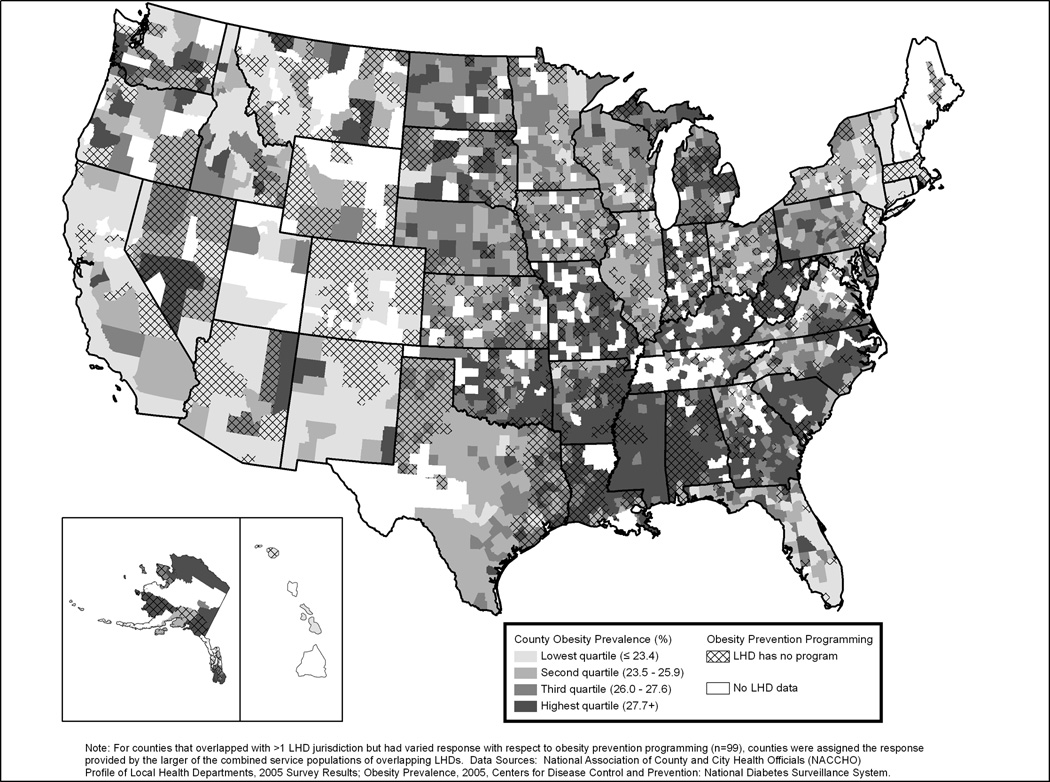
This study examines the extent to which LHDs across the US have responded to local levels of obesity by examining the association between jurisdiction level obesity prevalence and the existence of obesity prevention programs.
Design
Data on LHD organizational characteristics from the Profile Study of Local Health Departments and county-level estimates of obesity from the Behavioral Risk Factor Surveillance System were analyzed (n=2,300). Since local public health systems are nested within state infrastructure, multilevel models were used to examine the relationship between county-level obesity prevalence and LHD obesity prevention programming and to assess the impact of state-level clustering.
Setting
2,300 local health department jurisdictions defined with respect to county boundaries
Participants
Practitioners in local health departments who responded to the 2005 Profile Study of Local Health Departments.
Main Outcome Measures
Likelihood of having obesity prevention activities and association with area-level obesity prevalence
Results
The existence of obesity prevention activities was not associated with prevalence of obesity in the jurisdiction. A substantial portion of the variance in LHD activities was explained by state-level clustering.
Conclusions
This paper identified a gap in the local public health response to the obesity epidemic and underscores the importance of multilevel modeling in examining predictors of LHD performance. -
Subjects:
- Catchment Area, Health
- Community Networks
- Evidence-Based Practice
- Health Care Surveys
- Health Plan Implementation
- Health Planning Guidelines
- Health Promotion
- Health Status Disparities
- Humans
- Interinstitutional Relations
- Local Government
- Obesity
- Prevalence
- Program Evaluation
- Public Health Administration
- Residence Characteristics
- United States
-
Keywords:
-
Source:J Public Health Manag Pract. 18(5):402-411
-
Pubmed ID:22836530
-
Pubmed Central ID:PMC3711616
-
Document Type:
-
Funding:U48 DP000060-04/DP/NCCDPHP CDC HHSUnited States/ ; P30 DK092950/DK/NIDDK NIH HHSUnited States/ ; DP000060-04/DP/NCCDPHP CDC HHSUnited States/ ; UL1 TR000448/TR/NCATS NIH HHSUnited States/ ; U48/DP000060/DP/NCCDPHP CDC HHSUnited States/ ; KL2 RR024994/RR/NCRR NIH HHSUnited States/ ; U48 DP000060/DP/NCCDPHP CDC HHSUnited States/ ; KL2 TR000450/TR/NCATS NIH HHSUnited States/ ; UL1RR024992/RR/NCRR NIH HHSUnited States/ ; UL1 RR024992/RR/NCRR NIH HHSUnited States/
-
Volume:18
-
Issue:5
-
Download URL:
-
File Type:
 [PDF - 1.84 MB]
 -
Collection(s):
-
Main Document Checksum:urn:sha256:0bf16ad646dfb3bb3e78115b1e92dbcf7e5f74f844cc2af2f44579fe7e09116a
Supporting Files


File Language:
English
 Was this page helpful?
 Found an issue?

CDC STACKS serves as an archival repository of CDC-published products including
scientific findings, journal articles, guidelines, recommendations, or other public health information authored or
co-authored by CDC or funded partners.
As a repository, CDC STACKS retains documents in their original published format to ensure public access to scientific information.
As a repository, CDC STACKS retains documents in their original published format to ensure public access to scientific information.
You May Also Like
COLLECTION
CDC Public Access