


A Natural Vanishing Act: The Enzyme-Catalyzed Degradation of Carbon Nanomaterials
Supporting Files

-
Jul 23 2012
-
File Language:
English
Details
-
Alternative Title:Acc Chem Res
-
Personal Author:
-
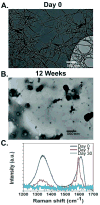
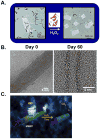
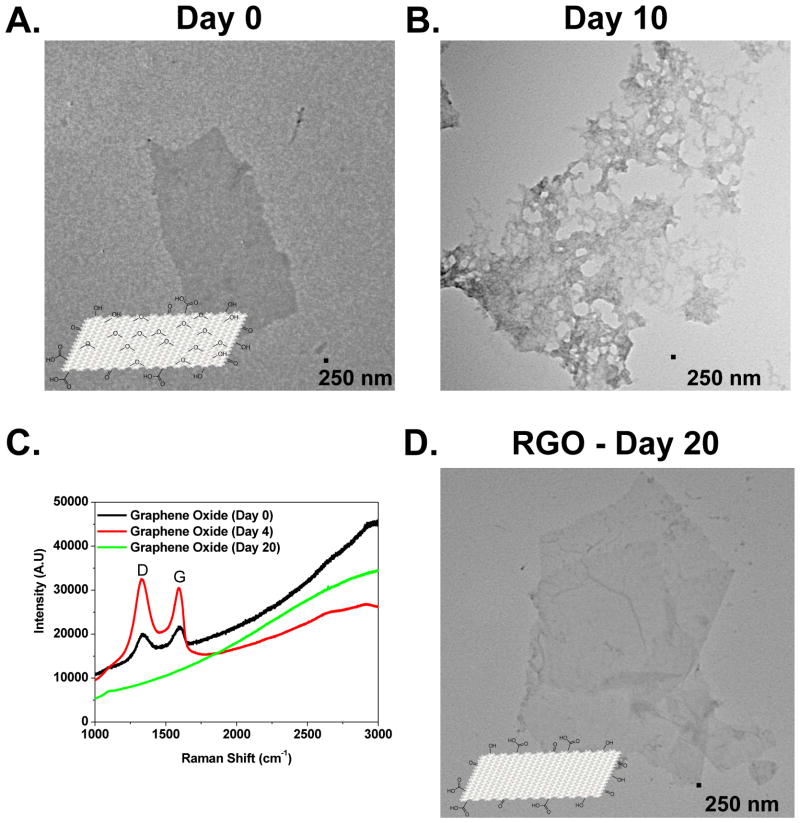
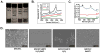
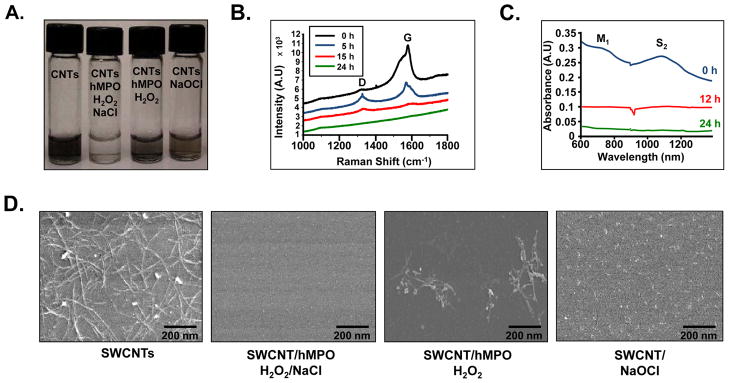
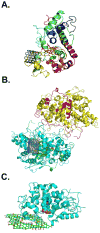
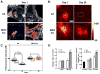
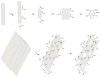
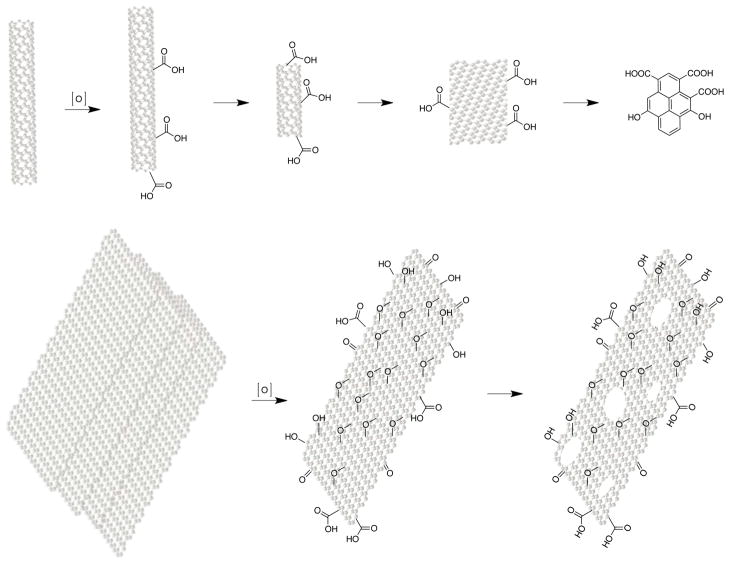
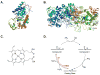
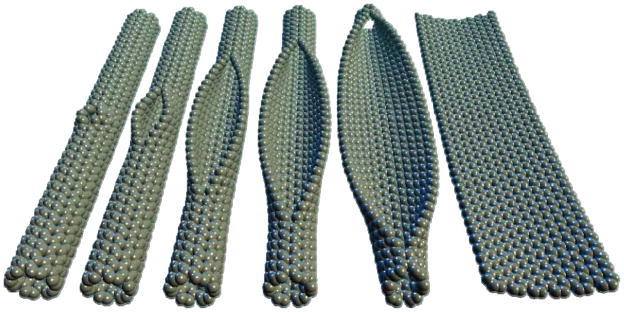
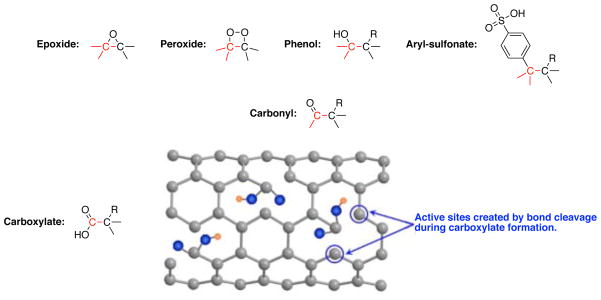
Description:Over the past three decades, revolutionary research in nanotechnology by the scientific, medical, and engineering communities has yielded a treasure trove of discoveries with diverse applications that promise to benefit humanity. With their unique electronic and mechanical properties, carbon nanomaterials (CNMs) represent a prime example of the promise of nanotechnology with applications in areas that include electronics, fuel cells, composites, and nanomedicine. Because of toxicological issues associated with CNMs, however, their full commercial potential may not be achieved. The ex vitro, in vitro, and in vivo data presented in this Account provide fundamental insights into the biopersistence of CNMs, such as carbon nanotubes and graphene, and their oxidation/biodegradation processes as catalyzed by peroxidase enzymes. We also communicate our current understanding of the mechanism for the enzymatic oxidation and biodegradation. Finally, we outline potential future directions that could enhance our mechanistic understanding of the CNM oxidation and biodegradation and could yield benefits in terms of human health and environmental safety. The conclusions presented in this Account may catalyze a rational rethinking of CNM incorporation in diverse applications. For example, armed with an understanding of how and why CNMs undergo enzyme-catalyzed oxidation and biodegradation, researchers can tailor the structure of CNMs to either promote or inhibit these processes. In nanomedical applications such as drug delivery, the incorporation of carboxylate functional groups could facilitate biodegradation of the nanomaterial after delivery of the cargo. On the other hand, in the construction of aircraft, a CNM composite should be stable to oxidizing conditions in the environment. Therefore, pristine, inert CNMs would be ideal for this application. Finally, the incorporation of CNMs with defect sites in consumer goods could provide a facile mechanism that promotes the degradation of these materials once these products reach landfills.
-
Subjects:
-
Source:Acc Chem Res. 45(10):1770-1781.
-
Pubmed ID:22824066
-
Pubmed Central ID:PMC3473158
-
Document Type:
-
Funding:1927ZHF/PHS HHS/United States ; HL094488/HL/NHLBI NIH HHS/United States ; HL70755/HL/NHLBI NIH HHS/United States ; OH008282/OH/NIOSH CDC HHS/United States ; R01 ES019304/ES/NIEHS NIH HHS/United States ; R01 HL070755/HL/NHLBI NIH HHS/United States ; R01 HL094488/HL/NHLBI NIH HHS/United States ; R01ES019304/ES/NIEHS NIH HHS/United States ; U19 AI068021/AI/NIAID NIH HHS/United States ; U19AI068021/AI/NIAID NIH HHS/United States
-
Volume:45
-
Issue:10
-
Collection(s):
-
Main Document Checksum:urn:sha256:bd1ba672fd8c3cdca7dc4c2555b519e5fb3abb927ca63b25f8f46494a0eaceff
-
Download URL:
-
File Type:
 [PDF
- 5.74 MB
]
[PDF
- 5.74 MB
]
Supporting Files


File Language:
English
ON THIS PAGE









CDC STACKS serves as an archival repository of CDC-published products including
scientific findings,
journal articles, guidelines, recommendations, or other public health information authored or
co-authored by CDC or funded partners.
As a repository, CDC STACKS retains documents in their original published format to ensure public access to scientific information.
As a repository, CDC STACKS retains documents in their original published format to ensure public access to scientific information.
You May Also Like
COLLECTION
CDC Public Access