



“Good Enough Solutions” and the Genetics of Complex Diseases
Supporting Files

-
8 3 2012 ; 8-3-
-
Available in CDC Stacks on 2013-08-03T00:00:00Z
File Language:
English
Details
-
Alternative Title:Circ Res
-
Personal Author:Weiss, James N. ; Karma, Alain ; MacLellan, W. Robb ; Deng, Mario ; Rau, Christoph ; Rees, Colin M. ; Wang, Jessica ; Wisniewski, Nicholas ; Eskin, Eleazar ; Horvath, Steve ; Qu, Zhilin ; Wang, Yibin ; Lusis, Aldons J.
-
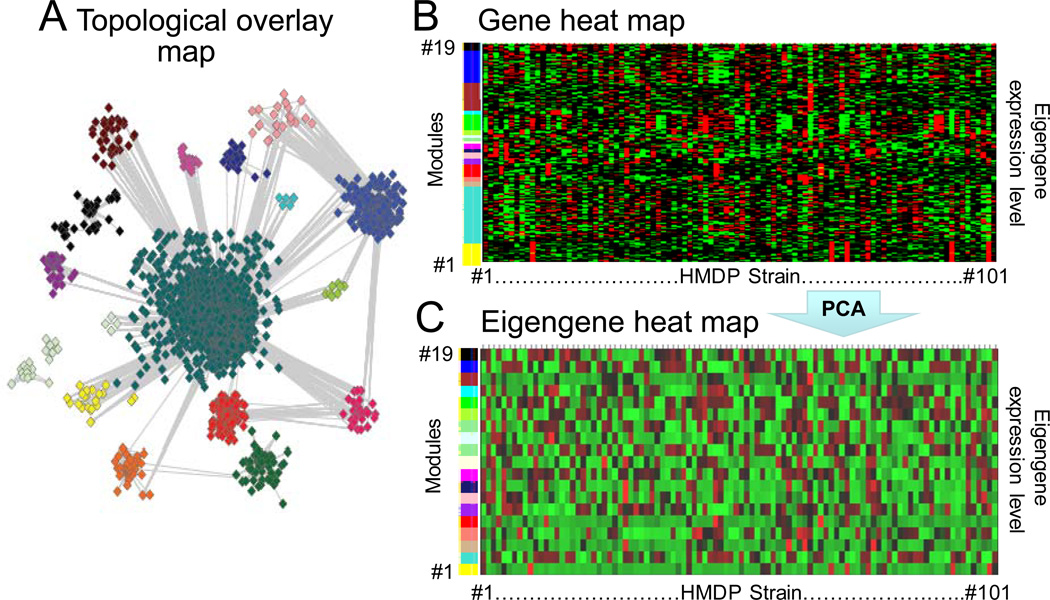
Description:Rationale and Objective ; In this Emerging Science Review, we discuss a systems genetics strategy, which we call Gene Module Association Study (GMAS), as a novel approach complementing Genome Wide Association Studies (GWAS), to understand complex diseases by focusing on how genes work together in groups rather than singly. ; Methods ; The first step is to characterize phenotypic differences among a genetically diverse population. The second step is to use gene expression microarray (or other high throughput) data from the population to construct gene co-expression networks. Co-expression analysis typically groups 20,000 genes into 20–30 modules containing 10’s to 100’s of genes, whose aggregate behavior can be represented by the module’s “eigengene.” The third step is to correlate expression patterns with phenotype, as in GWAS, only applied to eigengenes instead of SNPs. ; Results and Conclusions ; The goal of the GMAS approach is to identify groups of co-regulated genes that explain complex traits from a systems perspective. From an evolutionary standpoint, we hypothesize that variability in eigengene patterns reflects the “good enough solution” concept, that biological systems are sufficiently complex so that many possible combinations of the same elements (in this case eigengenes) can produce an equivalent output, i.e. a “good enough solution” to accomplish normal biological functions. However, when faced with environmental stresses, some “good enough solutions” adapt better than others, explaining individual variability to disease and drug susceptibility. If validated, GMAS may imply that common polygenic diseases are related as much to group interactions between normal genes, as to multiple gene mutations.
-
Subjects:
- Article
- systems genetics
- genetics of complex diseases
- scale-free networks
- hybrid mouse diversity panel
- computational biology
- Animals
- Databases, Genetic
- Evolution, Molecular
- Gene Expression Profiling
- Gene Expression Regulation
- Gene Regulatory Networks
- Genetic Predisposition to Disease
- Genetic Variation
- Genome-Wide Association Study
- Genomics
- Humans
- Inheritance Patterns
- Oligonucleotide Array Sequence Analysis
- Phenotype
- Reproducibility of Results
- Systems Biology
-
Source:Circ Res. 111(4):493-504
-
Pubmed ID:22859671
-
Pubmed Central ID:PMC3428228
-
Document Type:
-
Funding:R01 HL094322/HL/NHLBI NIH HHSUnited States/ ; P01 HL080111/HL/NHLBI NIH HHSUnited States/ ; HHSN268201000035C/HL/NHLBI NIH HHSUnited States/ ; 1DP3 D094311/DP/NCCDPHP CDC HHSUnited States/ ; R01 HL101228/HL/NHLBI NIH HHSUnited States/ ; P01 HL30568/HL/NHLBI NIH HHSUnited States/ ; R21 HL110667-01/HL/NHLBI NIH HHSUnited States/ ; P01 HL030568/HL/NHLBI NIH HHSUnited States/ ; T32 HL069766/HL/NHLBI NIH HHSUnited States/ ; R01 GM095656/GM/NIGMS NIH HHSUnited States/ ; R21 HL110667/HL/NHLBI NIH HHSUnited States/ ; P01 HL28481/HL/NHLBI NIH HHSUnited States/ ; K25 HL080079/HL/NHLBI NIH HHSUnited States/ ; P01 HL078931/HL/NHLBI NIH HHSUnited States/ ; P01 HL028481/HL/NHLBI NIH HHSUnited States/ ; UL1 TR000124/TR/NCATS NIH HHSUnited States/ ; T32HL69766/HL/NHLBI NIH HHSUnited States/ ; R01 HL070748/HL/NHLBI NIH HHSUnited States/
-
Volume:111
-
Issue:4
-
Download URL:
-
File Type:
 [PDF - 3.38 MB]
 -
Collection(s):
-
Main Document Checksum:urn:sha256:f3da1e1d0afc0a27570fda8a135d3dc44ea3658d256f82e5f38d6dee7d218ec6
Supporting Files


File Language:
English
 Was this page helpful?
 Found an issue?




CDC STACKS serves as an archival repository of CDC-published products including
scientific findings, journal articles, guidelines, recommendations, or other public health information authored or
co-authored by CDC or funded partners.
As a repository, CDC STACKS retains documents in their original published format to ensure public access to scientific information.
As a repository, CDC STACKS retains documents in their original published format to ensure public access to scientific information.
You May Also Like
COLLECTION
CDC Public Access