



Contributions of social factors to disparities in prostate cancer risk profiles among Black men and Non-Hispanic White men with prostate cancer in California
Supporting Files

-
2 01 2022 ; 2-2022
-
Available in CDC Stacks on 2022-02-09T00:00:00Z
File Language:
English
Details
-
Alternative Title:Cancer Epidemiol Biomarkers Prev
-
Personal Author:Press, David J. ; Shariff-Marco, Salma ; Lichtensztajn, Daphne Y. ; Lauderdale, Diane ; Murphy, Adam B. ; Inamdar, Pushkar P. ; DeRouen, Mindy C. ; Hamilton, Ann S. ; Yang, Juan ; Lin, Katherine ; Hedeker, Donald ; Haiman, Christopher A. ; Cheng, Iona ; Gomez, Scarlett Lin
-
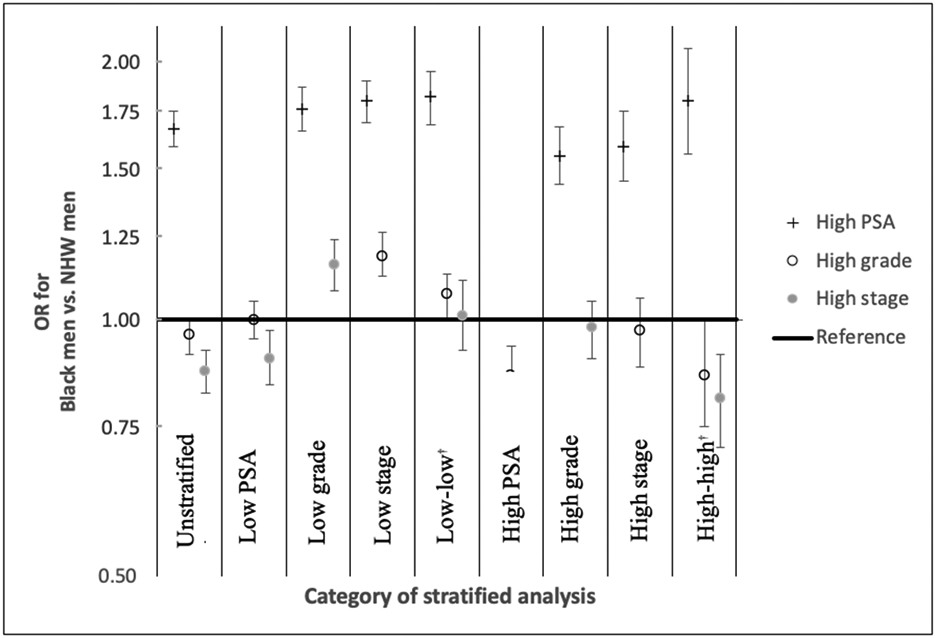
Description:Background: ; Black men are more likely than Non-Hispanic White (NHW) men to be diagnosed with high-risk prostate cancer (PCa). We examined the extent to which social factors were associated with differences in PCa risk profiles between Black men and NHW men (using a modification to the original D’Amico risk groups based on prostate specific antigen (PSA), Gleason score (GS), and TNM stage (stage)), based on individual and combined clinicopathologic characteristics. ; Methods: ; We conducted a cross-sectional population-based study of 23,555 Black men and 146,889 NHW men diagnosed with PCa in the California Cancer Registry from 2004 to 2017. We conducted multivariable logistic regression to examine the association of year of diagnosis, block group-level neighborhood socioeconomic status (nSES), marital status, and insurance type on differences in PCa risk profiles between Black and NHW men. ; Results: ; High PSA (>20 ng/mL), GS, stage, individually and combined PCa risk profiles were more common among Black men versus NHW men. In fully-adjusted models, relative to NHW men, we observed a persistent 67% increased odds of high PSA among Black men. NSES was the factor most strongly associated with racial disparity in high PSA, accounting for 25% of the difference. Marital status was the factor that was second most associated with a racial disparity. ; Conclusions: ; NSES was the factor most strongly associated with racial disparities in high PSA PCa. ; Impact: ; The influence of nSES on racial disparities in PSA, GS, stage, and PCa risk profiles warrants further consideration.
-
Keywords:
-
Source:Cancer Epidemiol Biomarkers Prev. 31(2):404-412
-
Pubmed ID:34853020
-
Pubmed Central ID:PMC8825684
-
Document Type:
-
Funding:HHSN261201800032C/CA/NCI NIH HHSUnited States/ ; HHSN261201800009C/CA/NCI NIH HHSUnited States/ ; NU58DP006344/DP/NCCDPHP CDC HHSUnited States/ ; U19 CA214253/CA/NCI NIH HHSUnited States/ ; HHSN261201800015I/CA/NCI NIH HHSUnited States/ ; T32 CA193193/CA/NCI NIH HHSUnited States/ ; HHSN261201800032I/CA/NCI NIH HHSUnited States/ ; HHSN261201800015C/CA/NCI NIH HHSUnited States/ ; HHSN261201800009I/CA/NCI NIH HHSUnited States/ ; T32 AG000243/AG/NIA NIH HHSUnited States/
-
Volume:31
-
Issue:2
-
Download URL:
-
File Type:
 [PDF - 492.41 KB]
 -
Collection(s):
-
Main Document Checksum:urn:sha256:114707d042ac866a7454000e27a2f1750e1cd9dbb9f1dc8df312525b13dc1345
Supporting Files


File Language:
English
 Was this page helpful?
 Found an issue?



CDC STACKS serves as an archival repository of CDC-published products including
scientific findings, journal articles, guidelines, recommendations, or other public health information authored or
co-authored by CDC or funded partners.
As a repository, CDC STACKS retains documents in their original published format to ensure public access to scientific information.
As a repository, CDC STACKS retains documents in their original published format to ensure public access to scientific information.
You May Also Like
COLLECTION
CDC Public Access