


PRE-EXISTING ALBUMINURIA PREDICTS AIDS AND NON-AIDS MORTALITY IN WOMEN INITIATING ANTIRETROVIRAL THERAPY
Supporting Files

-
2011
-
File Language:
English
Details
-
Alternative Title:Antivir Ther
-
Personal Author:
-
Description:Background
We previously reported an increased risk of all-cause and AIDS mortality among HIV-infected women with albuminuria (proteinuria or microalbuminuria) enrolled in the Women’s Interagency HIV Study (WIHS) prior to the introduction of highly active antiretroviral therapy (HAART).
Methods
The current analysis includes 1,073 WIHS participants who subsequently initiated HAART. Urinalysis for proteinuria and semi-quantitative testing for microalbuminuria from two consecutive study visits prior to HAART initiation were categorized as follows: confirmed proteinuria (both specimens positive for protein), confirmed microalbuminuria (both specimens positive with at least one microalbuminuria), unconfirmed albuminuria (one specimen positive for proteinuria or microalbuminuria), or negative (both specimens negative). Time from HAART initiation to death was modeled using proportional hazards analysis.
Results
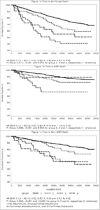
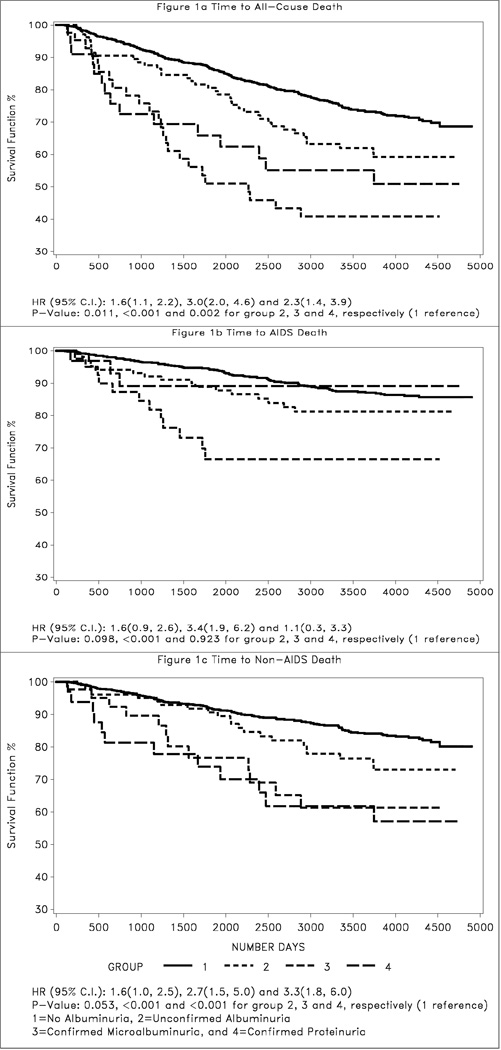
Compared to the reference group of women with two negative specimens, the hazard ratio (HR) for all-cause mortality was significantly elevated for women with confirmed microalbuminuria (HR 1.9; 95% CI 1.2–2.9). Confirmed microalbuminuria was also independently associated with AIDS death (HR 2.3; 95% CI 1.3–4.3), while women with confirmed proteinuria were at increased risk for non-AIDS death (HR 2.4; 95% CI 1.2–4.6).
Conclusions
In women initiating HAART, pre-existing microalbuminuria independently predicted increased AIDS mortality, while pre-existing proteinuria predicted increased risk of non-AIDS death. Urine testing may identify HIV-infected individuals at increased risk for mortality even after the initiation of HAART. Future studies should consider whether these widely available tests can identify individuals who would benefit from more aggressive management of HIV infection and comorbid conditions associated with mortality in this population.
-
Subjects:
-
Source:Antivir Ther. 16(4):591-596.
-
Pubmed ID:21685547
-
Pubmed Central ID:PMC3119869
-
Document Type:
-
Funding:K23 DK077568/DK/NIDDK NIH HHS/United States ; K23 DK077568-05/DK/NIDDK NIH HHS/United States ; K23-AI-66943/AI/NIAID NIH HHS/United States ; K23-DK-077568/DK/NIDDK NIH HHS/United States ; UL1 RR024131/RR/NCRR NIH HHS/United States ; UO1-AI-31834/AI/NIAID NIH HHS/United States ; UO1-AI-34989/AI/NIAID NIH HHS/United States ; UO1-AI-34993/AI/NIAID NIH HHS/United States ; UO1-AI-34994/AI/NIAID NIH HHS/United States ; UO1-AI-35004/AI/NIAID NIH HHS/United States ; UO1-AI-42590/AI/NIAID NIH HHS/United States ; UO1-HK-32632/HK/PHITPO CDC HHS/United States
-
Volume:16
-
Issue:4
-
Collection(s):
-
Main Document Checksum:urn:sha256:8c9a644813d4139eec400efd3a8c1b4ff85984c3ba7852de07702c4fb2838e29
-
Download URL:
-
File Type:
 [PDF
- 307.52 KB
]
[PDF
- 307.52 KB
]
Supporting Files


File Language:
English
ON THIS PAGE

CDC STACKS serves as an archival repository of CDC-published products including
scientific findings,
journal articles, guidelines, recommendations, or other public health information authored or
co-authored by CDC or funded partners.
As a repository, CDC STACKS retains documents in their original published format to ensure public access to scientific information.
As a repository, CDC STACKS retains documents in their original published format to ensure public access to scientific information.
You May Also Like
COLLECTION
CDC Public Access