



Quantifying Cardiometabolic Risk Using Modifiable Non–Self-Reported Risk Factors
Supporting Files

-
8 2014 ; 8-2014
-
Available in CDC Stacks on August 01, 2015, 12:00 AM
File Language:
English
Details
-
Alternative Title:Am J Prev Med
-
Personal Author:
-
Description:Background
Sensitive general cardiometabolic risk assessment tools of modifiable risk factors would be helpful and practical in a range of primary prevention interventions or for preventive health maintenance.
Purpose
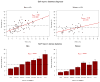
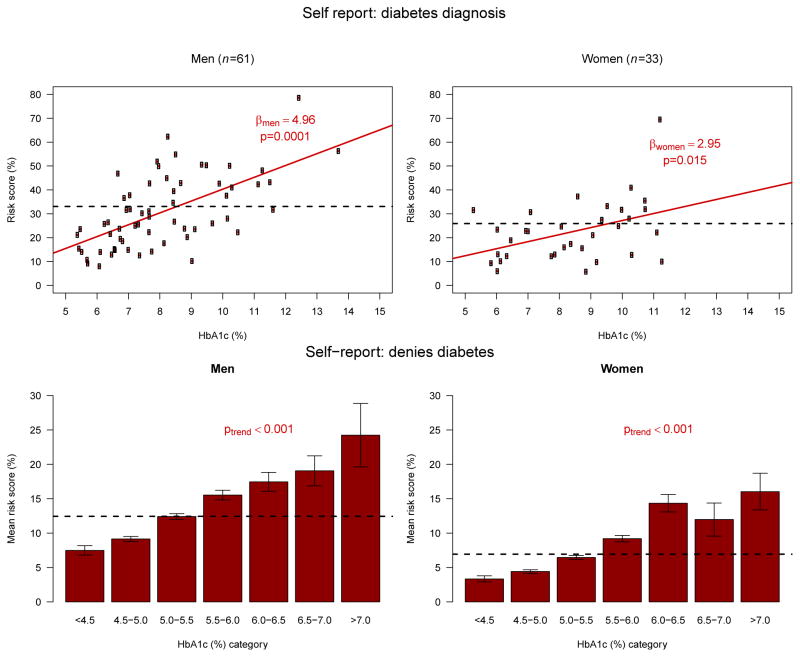
To develop and validate a cumulative general cardiometabolic risk score that focuses on non–self-reported modifiable risk factors such as glycosylated hemoglobin (HbA1c) and BMI so as to be sensitive to small changes across a span of major modifiable risk factors, which may not individually cross clinical cut off points for risk categories.
Methods
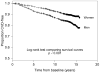
We prospectively followed 2,359 cardiovascular disease (CVD)-free subjects from the Framingham offspring cohort over a 14–year follow-up. Baseline (fifth offspring examination cycle) included HbA1c and cholesterol measurements. Gender–specific Cox proportional hazards models were considered to evaluate the effects of non–self-reported modifiable risk factors (blood pressure, total cholesterol, high–density lipoprotein cholesterol, smoking, BMI, and HbA1c) on general CVD risk. We constructed 10–year general cardiometabolic risk score functions and evaluated its predictive performance in 2012–2013.
Results
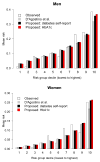
HbA1c was significantly related to general CVD risk. The proposed cardiometabolic general CVD risk model showed good predictive performance as determined by cross-validated discrimination (male C-index=0.703, 95% CI=0.668, 0.734; female C-index=0.762, 95% CI=0.726, 0.801) and calibration (lack-of-fit χ2=9.05 p=0.338 and 12.54 p=0.128 for men and women, respectively).
Conclusions
This study presents a risk factor algorithm that provides a convenient and informative way to quantify cardiometabolic risk based on modifiable risk factors that can motivate an individual’s commitment to prevention and intervention. -
Keywords:
- Adult
- Algorithms
- Cardiovascular Diseases
- Cohort Studies
- Female
- Follow-Up Studies
- Glycated Hemoglobin
- Humans
- Male
- Metabolic Diseases
- Middle Aged
- Predictive Value of Tests
- Primary Prevention
- Proportional Hazards Models
- Prospective Studies
- Risk Assessment
- Risk Factors
- Sensitivity and Specificity
- Sex Factors
-
Source:Am J Prev Med. 2014; 47(2):131-140
-
Pubmed ID:24951039
-
Pubmed Central ID:PMC4107093
-
Document Type:
-
Funding:N01-HC-25195/HC/NHLBI NIH HHSUnited States/ ; U01OH008788/OH/NIOSH CDC HHSUnited States/ ; R01HL107240/HL/NHLBI NIH HHSUnited States/ ; N01 HC025195/HC/NHLBI NIH HHSUnited States/ ; U01 HD051217/HD/NICHD NIH HHSUnited States/ ; U01 HD051256/HD/NICHD NIH HHSUnited States/ ; U01HD059773/HD/NICHD NIH HHSUnited States/ ; U01HD051276/HD/NICHD NIH HHSUnited States/ ; U01 OH008788/OH/NIOSH CDC HHSUnited States/ ; U01HD051256/HD/NICHD NIH HHSUnited States/ ; U01HD051218/HD/NICHD NIH HHSUnited States/ ; U01AG027669/AG/NIA NIH HHSUnited States/ ; N01HC25195/HL/NHLBI NIH HHSUnited States/ ; R01 AG040248/AG/NIA NIH HHSUnited States/ ; U01HD051217/HD/NICHD NIH HHSUnited States/ ; U01 AG027669/AG/NIA NIH HHSUnited States/ ; R01 HL107240/HL/NHLBI NIH HHSUnited States/ ; U01 HD059773/HD/NICHD NIH HHSUnited States/ ; U01 HD051276/HD/NICHD NIH HHSUnited States/ ; U01 HD051218/HD/NICHD NIH HHSUnited States/
-
Volume:47
-
Issue:2
-
Download URL:
-
File Type:
 [PDF - 562.73 KB]
 -
Collection(s):
-
Main Document Checksum:urn:sha256:949736bf9c47ff1ca6dcef1d11dbc100aadd3192bc76ccc16b53da893b9b6bfc
Supporting Files


File Language:
English
 Was this page helpful?
 Found an issue?



CDC STACKS serves as an archival repository of CDC-published products including
scientific findings, journal articles, guidelines, recommendations, or other public health information authored or
co-authored by CDC or funded partners.
As a repository, CDC STACKS retains documents in their original published format to ensure public access to scientific information.
As a repository, CDC STACKS retains documents in their original published format to ensure public access to scientific information.
You May Also Like
COLLECTION
CDC Public Access