



The Newborn Screening Quality Assurance Program at the Centers for Disease Control and Prevention: Thirty-five Year Experience Assuring Newborn Screening Laboratory Quality
Supporting Files

-
2015 ; 2015
-
Available in CDC Stacks on January 01, 2016, 12:00 AM
File Language:
English
Details
-
Alternative Title:Int J Neonatal Screen
-
Personal Author:
-
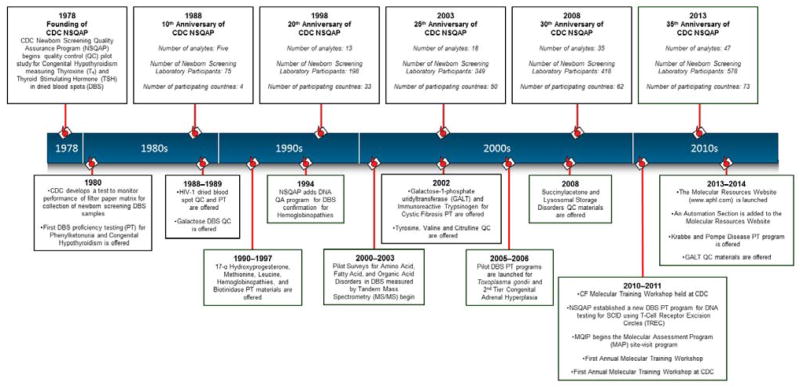
Description:Newborn screening is the largest genetic testing effort in the United States and is considered one of the ten great public health achievements during the first 10 years of the 21| century. For over 35 years, the Newborn Screening Quality Assurance Program (NSQAP) at the US Centers for Disease Control and Prevention has helped NBS laboratories ensure that their testing does not delay diagnosis, minimizes false-positive reports, and sustains high-quality testing performance. It is a multi-component program that provides comprehensive quality assurance services for dried blood spot testing. The NSQAP, the Biochemical Mass Spectrometry Laboratory (BMSL), the Molecular Quality Improvement Program (MQIP) and the Newborn Screening Translation Research Initiative (NSTRI), aid screening laboratories achieve technical proficiency and maintain confidence in their performance while processing large volumes of specimens daily. The accuracy of screening tests could be the difference between life and death for many babies; in other instances, identifying newborns with a disorder means that they can be treated and thus avoid life-long disability or severe cognitive impairment. Thousands of newborns and their families have benefited from reliable and accurate testing that has been accomplished by a network of screening laboratories and the NSQAP, BMSL, MQIP and NSTRI.
-
Keywords:
-
Source:Int J Neonatal Screen. 1(1):13-26
-
Pubmed ID:26309908
-
Pubmed Central ID:PMC4545740
-
Document Type:
-
Funding:
-
Volume:1
-
Issue:1
-
Download URL:
-
File Type:
 [PDF - 477.58 KB]
 -
Collection(s):
-
Main Document Checksum:urn:sha256:dc4ed28a582bab98f5cbb225a8e43710eb1e2e9d872600aae58ce5fffc7372a3
Supporting Files


File Language:
English
 Was this page helpful?
 Found an issue?

CDC STACKS serves as an archival repository of CDC-published products including
scientific findings, journal articles, guidelines, recommendations, or other public health information authored or
co-authored by CDC or funded partners.
As a repository, CDC STACKS retains documents in their original published format to ensure public access to scientific information.
As a repository, CDC STACKS retains documents in their original published format to ensure public access to scientific information.
You May Also Like
COLLECTION
CDC Public Access