



Clinical and Demographic Factors Associated With Receipt of Non Guideline-concordant Initial Therapy for Nonmetastatic Prostate Cancer
Supporting Files

-
2 2016 ; 2-2016
-
Available in CDC Stacks on 2017-02-01T00:00:00Z
File Language:
English
Details
-
Alternative Title:Am J Clin Oncol
-
Personal Author:
-
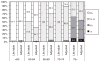
Description:Objectives ; To determine the extent to which initial therapy for nonmetastatic prostate cancer was concordant with nationally recognized guidelines using supplemented cancer registry data and what factors were associated with receipt of nonguideline-concordant care. ; Methods ; Initial therapy for 8229 nonmetastatic prostate cancer cases diagnosed in 2004 from cancer registries in 7 states was abstracted as part of the Centers for Disease Control’s Patterns of Care Breast and Prostate Cancer study conducted during 2007 to 2009. The National Comprehensive Cancer Network clinical practice guidelines version 1.2002 was used as the standard of care based on recurrence risk group and life expectancy (LE). A multivariable model was used to determine risk factors associated with receipt of nonguideline-concordant care. ; Results ; Nearly 80% with nonmetastatic prostate cancer received guideline-concordant care for initial therapy. Receipt of nonguideline-concordant care (including receiving either less aggressive therapy or more aggressive therapy than indicated) was related to older age, African American race/ethnicity, being unmarried, rural residence, and especially to being in the high recurrence risk group where receiving less aggressive therapy than indicated occurred more often than receiving more aggressive therapy (adjusted OR = 4.2; 95% CL, 3.5–5.2 vs. low-risk group). Compared with life table estimates adjusted for comorbidity, physicians tended to underestimate LE. ; Conclusions ; Receipt of less aggressive therapy than indicated among high-risk group men with >5-year LE based on life table estimates adjusted for comorbidity was a concern. Physicians may tend to underestimate 5-year survival among this group and should be alerted to the importance of recommending aggressive therapy when warranted. However, based on more recent guidelines, among those with low-risk disease, the proportion considered to be receiving less aggressive therapy than indicated may now be lower because active surveillance is now considered appropriate.
-
Subjects:
- Black or African American
- Age Factors
- Aged
- Androgen Antagonists
- Brachytherapy
- Guideline Adherence
- Humans
- Insurance, Health
- Male
- Marital Status
- Middle Aged
- Multivariate Analysis
- Practice Guidelines as Topic
- Prostatectomy
- Prostatic Neoplasms
- Radiotherapy
- Registries
- Risk Factors
- Rural Population
- Urban Population
- Watchful Waiting
- White People
-
Keywords:
-
Source:Am J Clin Oncol. 39(1):55-63
-
Pubmed ID:24390274
-
Pubmed Central ID:PMC4514560
-
Document Type:
-
Funding:U01 DP000261/DP/NCCDPHP CDC HHSUnited States/ ; U01 DP000258/DP/NCCDPHP CDC HHSUnited States/ ; U01 DP000251/DP/NCCDPHP CDC HHSUnited States/ ; U01 DP000259/DP/NCCDPHP CDC HHSUnited States/ ; U01 DP000260/DP/NCCDPHP CDC HHSUnited States/ ; 1-U01-DP000259/DP/NCCDPHP CDC HHSUnited States/ ; 1-U01-DP000258/DP/NCCDPHP CDC HHSUnited States/ ; CC999999/Intramural CDC HHSUnited States/ ; 1-U01-DP000253/DP/NCCDPHP CDC HHSUnited States/ ; 1-U01-DP000251/DP/NCCDPHP CDC HHSUnited States/ ; 1-U01-DP000260/DP/NCCDPHP CDC HHSUnited States/ ; 1-U01-DP000264/DP/NCCDPHP CDC HHSUnited States/ ; U01 DP000264/DP/NCCDPHP CDC HHSUnited States/ ; 1-U01-DP000261/DP/NCCDPHP CDC HHSUnited States/ ; U01 DP000253/DP/NCCDPHP CDC HHSUnited States/
-
Volume:39
-
Issue:1
-
Download URL:
-
File Type:
 [PDF - 617.08 KB]
 -
Collection(s):
-
Main Document Checksum:urn:sha256:2e4ec40aad2f8c3e5d4c20375f82281313e433a73494f62bd2863a5055f7b92e
Supporting Files


File Language:
English
 Was this page helpful?
 Found an issue?


CDC STACKS serves as an archival repository of CDC-published products including
scientific findings, journal articles, guidelines, recommendations, or other public health information authored or
co-authored by CDC or funded partners.
As a repository, CDC STACKS retains documents in their original published format to ensure public access to scientific information.
As a repository, CDC STACKS retains documents in their original published format to ensure public access to scientific information.
You May Also Like
COLLECTION
CDC Public Access