


Females with FVIII and FIX deficiency have reduced joint range of motion
Supporting Files

-
May 21 2014
-
Details
-
Alternative Title:Am J Hematol
-
Personal Author:
-
Corporate Authors:
-
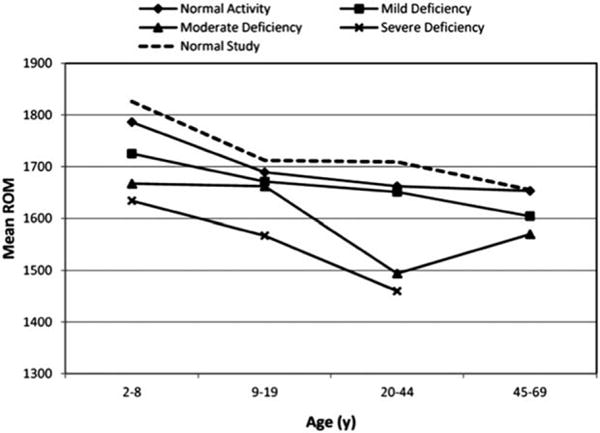
Description:Little is known about rates of joint bleeding among females with FVIII/FIX deficiency or hemophilia carriers. In a cross-sectional study, we tested the hypothesis that females with FVIII or FIX deficiency enrolled in the Universal Data Collection (UDC) project had a reduced mean overall joint range of motion (ROM) compared with historic controls from the Normal Joint Study. Demographics, clinical characteristics, and joint ROM measurements on 303 females without a bleeding disorder and 148 females with FVIII and FIX deficiency, respectively, between the ages of 2-69 years and a body mass index (BMI) ≤ 35 were compared. Multivariate linear regression was performed with the overall joint ROM (sum of the right and left ROM measurements of five joints) as the dependent variable and FVIII or FIX activity as the independent variable adjusting for age, race, BMI, and number of joint bleeds reported over the last 6 months. As FVIII and FIX activity decreased, the mean overall joint ROM became reduced and in most cases was significantly lower than that of the controls regardless of age and clinical hemophilia severity. Further investigation of reduced joint ROM as evidence of subclinical joint bleeding in females with FVIII and FIX deficiency is warranted.
-
Subjects:
-
Source:Am J Hematol. 2014; 89(8):831-836.
-
Pubmed ID:24838518
-
Pubmed Central ID:PMC4477796
-
Document Type:
-
Funding:
-
Volume:89
-
Issue:8
-
Collection(s):
-
Main Document Checksum:urn:sha256:db405c7369f8ea4dd3b396e49a647473414ce5610c2c106a2553420660ec35a9
-
Download URL:
-
File Type:
 [PDF
- 247.48 KB
]
[PDF
- 247.48 KB
]
Supporting Files


ON THIS PAGE

CDC STACKS serves as an archival repository of CDC-published products including
scientific findings,
journal articles, guidelines, recommendations, or other public health information authored or
co-authored by CDC or funded partners.
As a repository, CDC STACKS retains documents in their original published format to ensure public access to scientific information.
As a repository, CDC STACKS retains documents in their original published format to ensure public access to scientific information.
You May Also Like
COLLECTION
CDC Public Access