



Risk Factors for Nipah Virus Encephalitis in Bangladesh1
Supporting Files
Public Domain

-
Oct 2008
File Language:
English
Details
-
Alternative Title:Emerg Infect Dis
-
Personal Author:Montgomery, Joel M. ; Hossain, Mohamed J. ; Gurley, E. ; Carroll, D.S. ; Croisier, A. ; Bertherat, E. ; Asgari, N. ; Formenty, P. ; Keeler, N. ; Comer, J. ; Bell, M.R. ; Akram, K. ; Molla, A.R. ; Zaman, K. ; Islam, Mohamed R. ; Wagoner, K. ; Mills, J.N. ; Rollin, P.E. ; Ksiazek, T.G. ; Breiman, R.F.
-
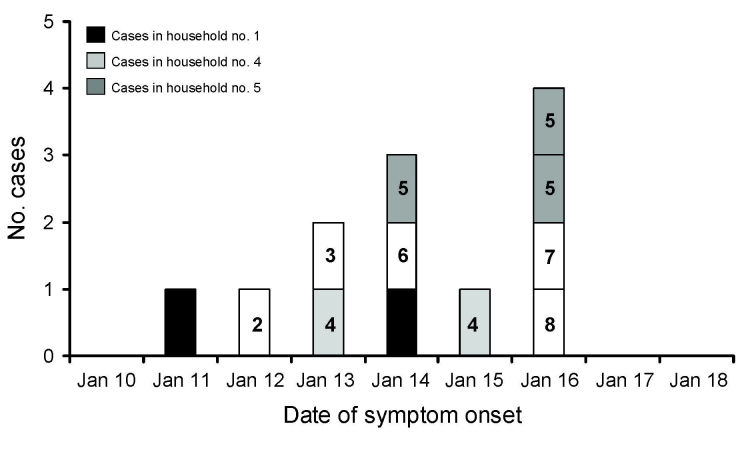
Description:Nipah virus (NiV) is a paramyxovirus that causes severe encephalitis in humans. During January 2004, twelve patients with NiV encephalitis (NiVE) were identified in west-central Bangladesh. A case-control study was conducted to identify factors associated with NiV infection. NiVE patients from the outbreak were enrolled in a matched case-control study. Exact odds ratios (ORs) and 95% confidence intervals (CIs) were calculated by using a matched analysis. Climbing trees (83% of cases vs. 51% of controls, OR 8.2, 95% CI 1.25-infinity) and contact with another NiVE patient (67% of cases vs. 9% of controls, OR 21.4, 95% CI 2.78-966.1) were associated with infection. We did not identify an increased risk for NiV infection among persons who had contact with a potential intermediate host. Although we cannot rule out person-to-person transmission, case-patients were likely infected from contact with fruit bats or their secretions.
-
Subjects:
-
Source:Emerg Infect Dis. 14(10):1526-1532
-
Pubmed ID:18826814
-
Pubmed Central ID:PMC2609878
-
Document Type:
-
Place as Subject:
-
Location:
-
Volume:14
-
Issue:10
-
Download URL:
-
File Type:
 [PDF - 172.63 KB]
 -
Collection(s):
-
Main Document Checksum:urn:sha-512:7a2e2b1f34ab4f979cc366d7d309141260b55cafce8bedfda6e699dee8dcb11991c9ee40e25ceae530e6ce77d491d2a1ab551cc5f5234a406697d38b1f2ab51a
Supporting Files


File Language:
English
 Was this page helpful?
 Found an issue?



CDC STACKS serves as an archival repository of CDC-published products including
scientific findings, journal articles, guidelines, recommendations, or other public health information authored or
co-authored by CDC or funded partners.
As a repository, CDC STACKS retains documents in their original published format to ensure public access to scientific information.
As a repository, CDC STACKS retains documents in their original published format to ensure public access to scientific information.
You May Also Like
COLLECTION
Emerging Infectious Diseases