



Delayed-Onset Hemolytic Anemia in Patients with Travel-Associated Severe Malaria Treated with Artesunate, France, 2011–2013
Supporting Files
Public Domain

-
May 2015
File Language:
English
Details
-
Alternative Title:Emerg Infect Dis
-
Personal Author:Jauréguiberry, Stéphane ; Thellier, Marc ; Ndour, Papa Alioune ; Ader, Flavie ; Roussel, Camille ; Sonneville, Romain ; Mayaux, Julien ; Matheron, Sophie ; Angoulvant, Adela ; Wyplosz, Benjamin ; Rapp, Christophe ; Pistone, Thierry ; Lebrun-Vignes, Bénédicte ; Kendjo, Eric ; Danis, Martin ; Houzé, Sandrine ; Bricaire, François ; Mazier, Dominique ; Buffet, Pierre ; Caumes, Eric
-
Corporate Authors:
-
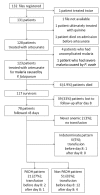
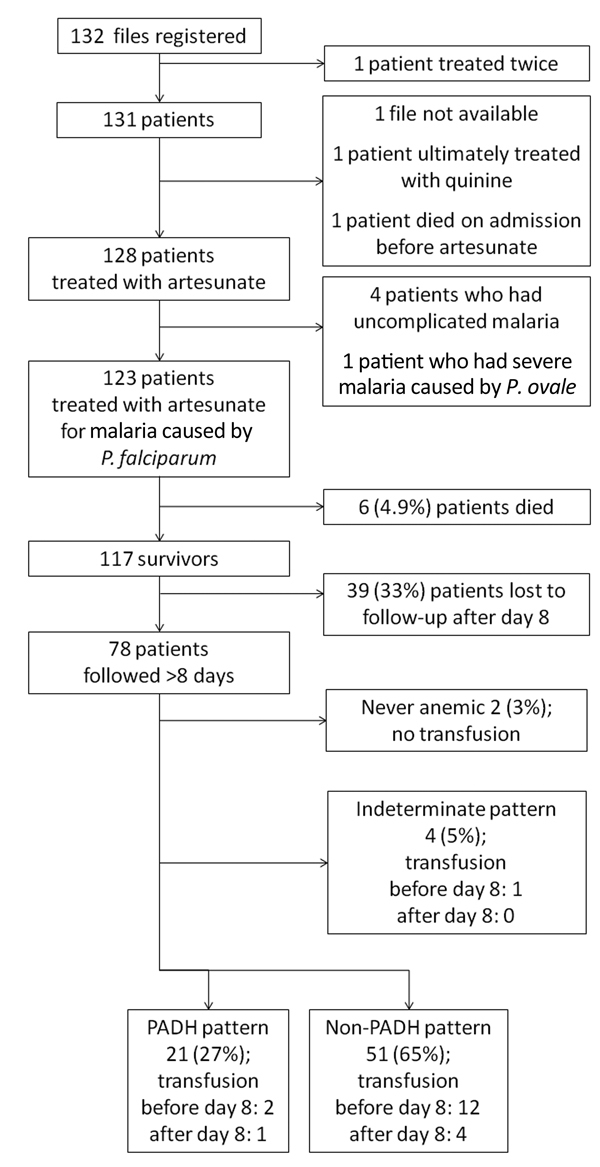
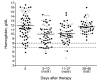
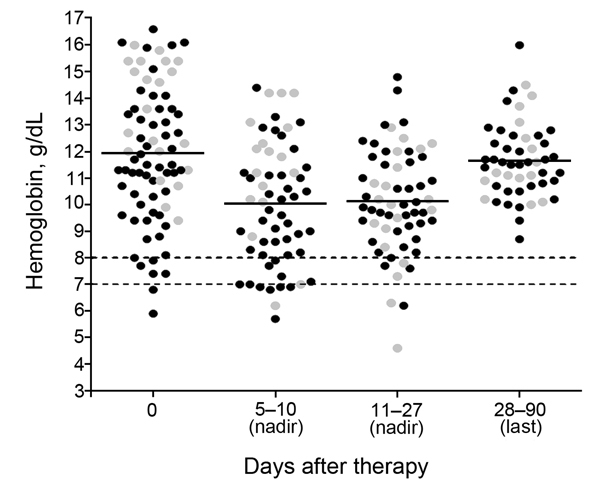
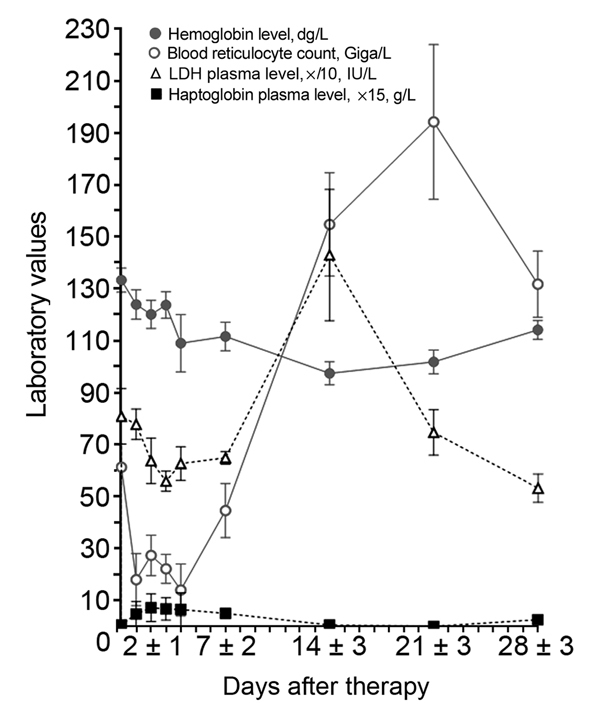
Description:Artesunate is the most effective treatment for severe malaria. However, delayed-onset hemolytic anemia has been observed in ≈20% of travelers who receive artesunate, ≈60% of whom require transfusion. This finding could discourage physicians from using artesunate. We prospectively evaluated a cohort of 123 patients in France who had severe imported malaria that was treated with artesunate; our evaluation focused on outcome, adverse events, and postartesunate delayed-onset hemolysis (PADH). Of the 123 patients, 6 (5%) died. Overall, 97 adverse events occurred. Among the 78 patients who received follow-up for >8 days after treatment initiation, 76 (97%) had anemia, and 21 (27%) of the 78 cases were recorded as PADH. The median drop in hemoglobin levels was 1.3 g/dL; 15% of patients with PADH had hemoglobin levels of <7 g/dL, and 1 required transfusion. Despite the high incidence of PADH, the resulting anemia remained mild in 85% of cases. This reassuring result confirms the safety and therapeutic benefit of artesunate.
-
Subjects:
- Research
- Delayed-Onset Hemolytic Anemia In Patients With Travel-Associated Severe Malaria Treated With Artesunate, France, 2011–2013
- Hemolysis
- Hemolytic Anemia
- Malaria
- Artesunate
- Delayed-Onset
- Safety
- Therapeutic Benefit
- Incidence
- Outcome
- Travelers
- Imported
- Travel-Associated
- Vector-Borne Infections
- Parasites
- Plasmodium Falciparum
- France
-
Source:Emerg Infect Dis. 21(5):804-812.
-
Document Type:
-
Volume:21
-
Issue:5
-
Download URL:
-
File Type:
 [PDF - 1.26 MB]
 -
Collection(s):
-
Main Document Checksum:urn:sha256:4a9d5c8c9c5f87df87ffdafe8d1d0d66c4ab199e7a641771de6541927fd1b12b
Supporting Files


File Language:
English
 Was this page helpful?
 Found an issue?

CDC STACKS serves as an archival repository of CDC-published products including
scientific findings, journal articles, guidelines, recommendations, or other public health information authored or
co-authored by CDC or funded partners.
As a repository, CDC STACKS retains documents in their original published format to ensure public access to scientific information.
As a repository, CDC STACKS retains documents in their original published format to ensure public access to scientific information.
You May Also Like
COLLECTION
Emerging Infectious Diseases