



Adherence to extended postpartum antiretrovirals is associated with decreased breastmilk HIV-1 transmission: Results of the BAN study
Supporting Files

-
11 28 2014 ; 11-28-
-
Available in CDC Stacks on November 28, 2015, 12:00 AM
File Language:
English
Details
-
Alternative Title:AIDS
-
Personal Author:
-
Corporate Authors:
-
Description:Objective
Estimate association between postpartum antiretroviral adherence and breastmilk HIV-1 transmission
Design
Prospective cohort study
Methods
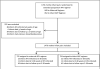
Mother-infant pairs were randomized after delivery to immediately begin receiving 28 weeks of either triple maternal antiretrovirals (zidovudine, lamivudine, and either nevirapine, nelfinavir, or lopinavir-ritonavir) or daily infant nevirapine as part of the Breastfeeding, Antiretrovirals, and Nutrition study. Associations between postpartum antiretroviral adherence and rate of breastmilk HIV-1 transmission were estimated using Cox models. We measured adherence over four postpartum time intervals using pill count, suspension bottle weight, and maternal self-report. Adherence was categorized and lagged by one interval. Missing adherence measures were multiply imputed. Infant HIV-1 infection was determined by DNA PCR every 2-6 weeks. The primary endpoint was infant HIV-1 infection by 38 weeks of age among infants alive and uninfected at 5 weeks.
Results
Analyses included 1479 mother-infant pairs and 45 transmission events. Using pill count and bottle weight information, 22-40% of mother-infant pairs at any given interval were <90% adherent. Having ≥90% adherence was associated with a 52% (95% CI 3-76%) relative reduction in the rate of breastmilk HIV-1 transmission, compared with having <90% adherence when controlling for study arm, breastfeeding status, and maternal characteristics. Complete case analysis rendered similar results (n=501; relative reduction 59%, 95% CI 6-82%).
Conclusion
Non-adherence to extended postpartum ART regimens in ‘real world’ settings is likely to be higher than that seen in BAN. Identifying mothers with difficulty adhering to antiretrovirals, and developing effective adherence interventions, will help maximize benefits of ARV provision throughout breastfeeding. -
Keywords:
- adherence
- antiretroviral
- breastfeeding
- HIV transmission
- PMTCT
- Adolescent
- Adult
- Anti-Retroviral Agents
- Breast Feeding
- Cohort Studies
- Disease Transmission, Infectious
- Female
- HIV Infections
- Humans
- Infant
- Infant, Newborn
- Male
- Medication Adherence
- Middle Aged
- Milk, Human
- Postpartum Period
- Pregnancy
- Prospective Studies
- Young Adult
-
Source:AIDS. 28(18):2739-2749
-
Pubmed ID:25493600
-
Pubmed Central ID:PMC4397579
-
Document Type:
-
Funding:D43 TW001039/TW/FIC NIH HHSUnited States/ ; U48-CCU409660-09/PHS HHSUnited States/ ; U48DP001944/ACL HHSUnited States/ ; U48-DP000059-01/DP/NCCDPHP CDC HHSUnited States/ ; R24 TW007988/TW/FIC NIH HHSUnited States/ ; P30-AI50410/AI/NIAID NIH HHSUnited States/ ; 5T32AI070114/AI/NIAID NIH HHSUnited States/ ; U48-DP001944-01/DP/NCCDPHP CDC HHSUnited States/ ; T32 AI070114/AI/NIAID NIH HHSUnited States/ ; U48 DP000059/DP/NCCDPHP CDC HHSUnited States/ ; 2-D43 TW01039-06/TW/FIC NIH HHSUnited States/ ; P30 AI050410/AI/NIAID NIH HHSUnited States/
-
Volume:28
-
Issue:18
-
Download URL:
-
File Type:
 [PDF - 809.84 KB]
 -
Collection(s):
-
Main Document Checksum:urn:sha256:f38505ce877767d6115de5d7c730f869d4392255c6e4efa2c009eff7d0afa57c
Supporting Files


File Language:
English
 Was this page helpful?
 Found an issue?


CDC STACKS serves as an archival repository of CDC-published products including
scientific findings, journal articles, guidelines, recommendations, or other public health information authored or
co-authored by CDC or funded partners.
As a repository, CDC STACKS retains documents in their original published format to ensure public access to scientific information.
As a repository, CDC STACKS retains documents in their original published format to ensure public access to scientific information.
You May Also Like
COLLECTION
CDC Public Access