


Human Papillomavirus Genotype Prevalence in Invasive Vaginal Cancer from a Registry-Based Population
Supporting Files

-
Apr 2014
-
Details
-
Alternative Title:Obstet Gynecol
-
Personal Author:Sinno, Abdulrahman K. ; Saraiya, Mona ; Thompson, Trevor D ; Hernandez, Brenda Y. ; Goodman, Marc T. ; Steinau, Martin ; Lynch, Charles F. ; Cozen, Wendy ; Saber, Maria Sibug ; Peters, Edward S. ; Wilkinson, Edward J. ; Copeland, Glenn ; Hopenhayn, Claudia ; Watson, Meg ; Lyu, Christopher ; Unger, Elizabeth R.
-
Description:Objective
To describe the human papillomavirus (HPV) genotype distribution in invasive vaginal cancers diagnosed prior to the introduction of the HPV vaccine, and evaluate if survival differed by HPV status.
Methods
Four population-based registries and three residual tissue repositories provided formalin-fixed, paraffin-embedded tissue from microscopically confirmed primary vaginal cancer cases diagnosed between 1994 and 2005 that were tested by L1 consensus polymerase chain reaction with type-specific hybridization in a central laboratory. Clinical, demographic, and all-cause survival data were assessed by HPV status.
Results
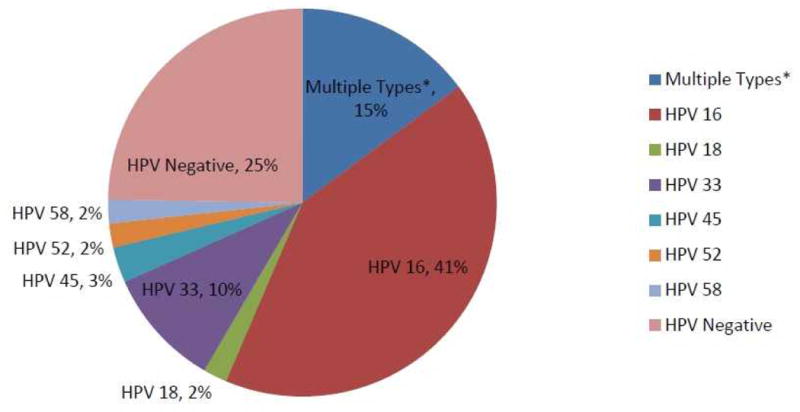
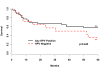
Sixty cases of invasive vaginal cancer were included. HPV was detected in 75% (45) and 25% (15) were HPV negative. HPV 16 was most frequently detected (55%, 33/60) followed by HPV 33 (18.3%, 11/60). Only one case was positive for HPV 18 (1.7%) Multiple types were detected in 15% of the cases. Vaginal cancers in women < 60 were more likely to be HPV 16 or HPV 18 positive (HPV 16/18) than older women; 77.3% vs. 44.7% (P = .038). The median age at diagnosis was younger in the HPV16/18 (59 years) group vs. other HPV positive (68 years) and no HPV (77 years) (P =.003). The HPV distribution did not significantly vary by race or ethnicity or place of residence. The 5-year unadjusted all-cause survival was 57.4% for women with HPV-positive vaginal cancers vs. 35.7% among those with HPV-negative tumors (p=0.243).
Conclusion
Three quarters of all vaginal cancers in the United States had HPV detected, much higher than previously found , and 57% could be prevented by current HPV vaccines, .
-
Subjects:
-
Source:Obstet Gynecol. 123(4):817-821.
-
Pubmed ID:24785610
-
Pubmed Central ID:PMC4009490
-
Document Type:
-
Funding:1U58DP000807-03/DP/NCCDPHP CDC HHS/United States ; 5U58DP000810-5/DP/NCCDPHP CDC HHS/United States ; 5U58DP000812-5/DP/NCCDPHP CDC HHS/United States ; 5U58DP000844-5/DP/NCCDPHP CDC HHS/United States ; N01 PC035139/PC/NCI NIH HHS/United States ; N01-PC-2010-00035/PC/NCI NIH HHS/United States ; N01-PC-35137/PC/NCI NIH HHS/United States ; N01-PC-35139/PC/NCI NIH HHS/United States ; N01-PC-35143/PC/NCI NIH HHS/United States ; N01PC35137/CA/NCI NIH HHS/United States ; N01PC35143/CA/NCI NIH HHS/United States ; P30 CA071789/CA/NCI NIH HHS/United States ; P30 CA086862/CA/NCI NIH HHS/United States ; P30 CA177558/CA/NCI NIH HHS/United States
-
Volume:123
-
Issue:4
-
Collection(s):
-
Main Document Checksum:urn:sha256:24093d6c146ccb7f788c393630e9c0819d509d872880809b5783331b0d72e076
-
Download URL:
-
File Type:
 [PDF
- 305.90 KB
]
[PDF
- 305.90 KB
]
Supporting Files


ON THIS PAGE



CDC STACKS serves as an archival repository of CDC-published products including
scientific findings,
journal articles, guidelines, recommendations, or other public health information authored or
co-authored by CDC or funded partners.
As a repository, CDC STACKS retains documents in their original published format to ensure public access to scientific information.
As a repository, CDC STACKS retains documents in their original published format to ensure public access to scientific information.
You May Also Like
COLLECTION
CDC Public Access