


A Microfluidic Paper-Based Analytical Device for Rapid Quantification of Particulate Chromium
Supporting Files

-
10 24 2013
-
File Language:
English
Details
-
Alternative Title:Anal Chim Acta
-
Personal Author:
-
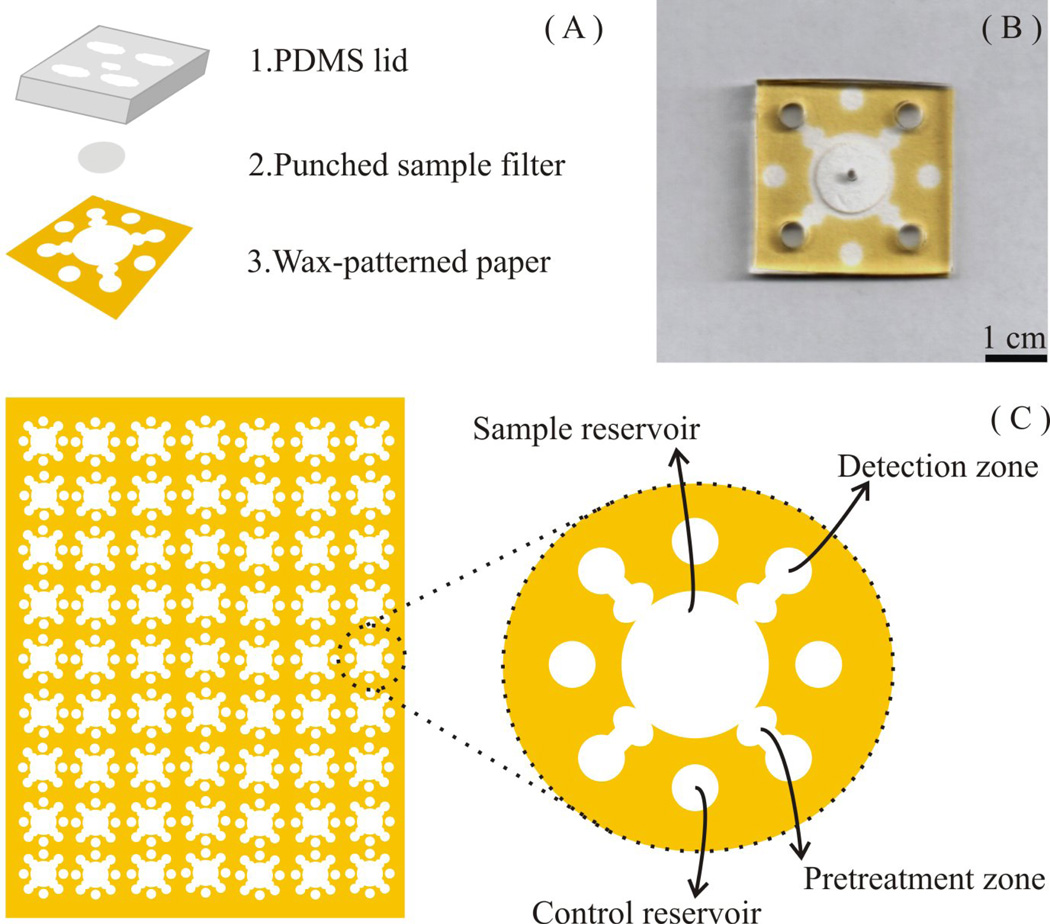
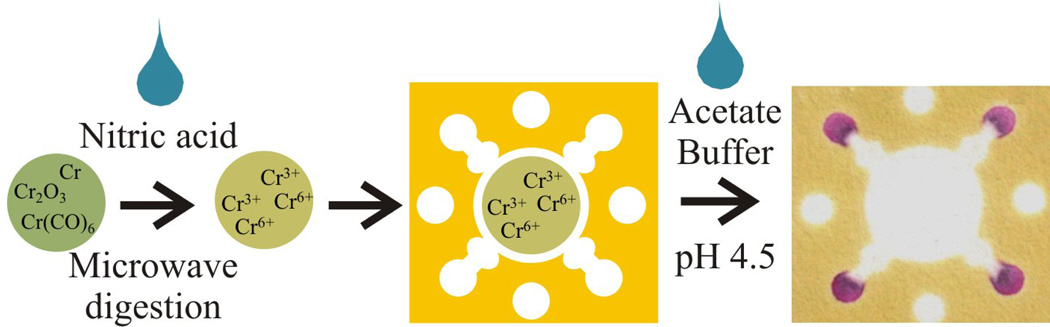
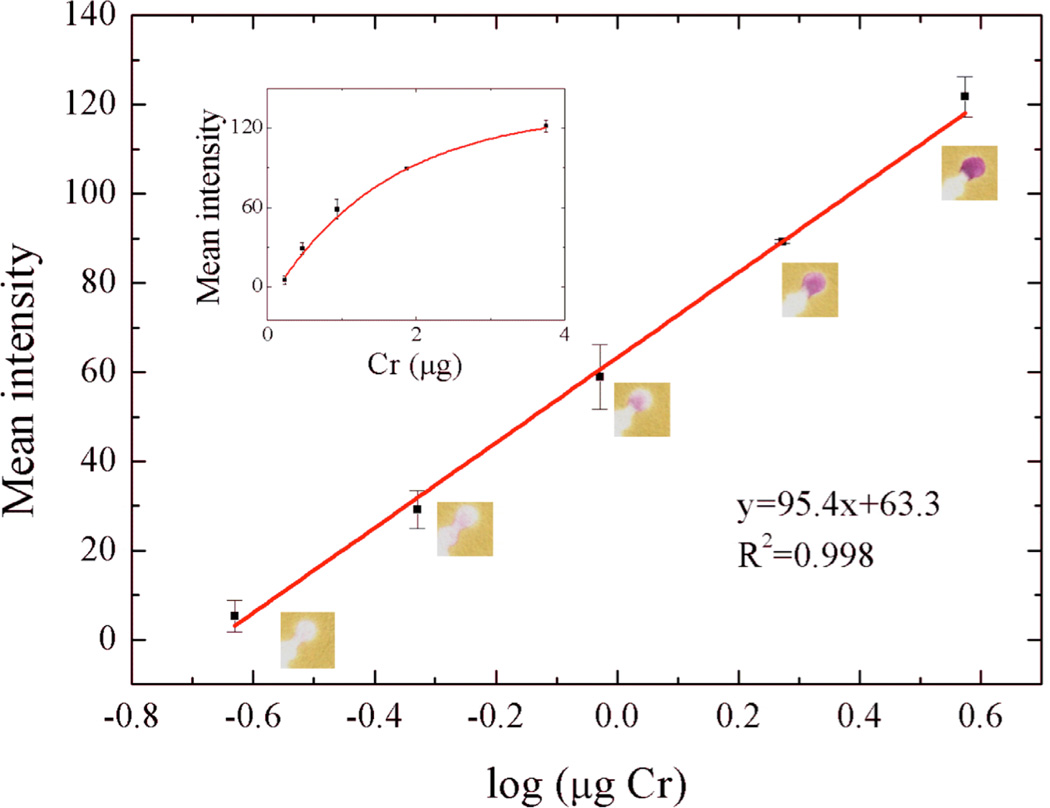
Description:Occupational exposure to Cr is concerning because of its myriad of health effects. Assessing chromium exposure is also cost and resource intensive because the analysis typically uses sophisticated instrumental techniques like inductively coupled plasma-mass spectrometry (ICP-MS). Here, we report a novel, simple, inexpensive microfluidic paper-based analytical device (μPAD) for measuring total Cr in airborne particulate matter. In the μPAD, tetravalent cerium (Ce(IV)) was used in a pretreatment zone to oxidize all soluble Cr to Cr(VI). After elution to the detection zone, Cr(VI) reacts with 1,5-diphenylcarbazide (1,5-DPC) forming 1,5-diphenylcarbazone (DPCO) and Cr(III). The resulting Cr(III) forms a distinct purple colored complex with the DPCO. As proof-of-principle, particulate matter (PM) collected on a sample filter was analyzed with the μPAD to quantify the mass of total Cr. A log-linear working range (0.23-3.75 μg; r(2)=0.998) between Cr and color intensity was obtained with a detection limit of 0.12 μg. For validation, a certified reference containing multiple competing metals was analyzed. Quantitative agreement was obtained between known Cr levels in the sample and the Cr measured using the μPAD.
-
Subjects:
-
Source:Anal Chim Acta. 2013; 800:50-55
-
Pubmed ID:24120167
-
Pubmed Central ID:PMC3842604
-
Document Type:
-
Funding:
-
Volume:800
-
Collection(s):
-
Main Document Checksum:urn:sha-512:5622067e542d4af7715af83f4b5ce07bbf70b9657a1dd56a2c83c1af725def7e09a11049ac904e550896300ecf7f367cda890865b9b3c9c5179126169bd7949f
-
Download URL:
-
File Type:
 [PDF
- 1.70 MB
]
[PDF
- 1.70 MB
]
Supporting Files


File Language:
English
ON THIS PAGE






CDC STACKS serves as an archival repository of CDC-published products including
scientific findings,
journal articles, guidelines, recommendations, or other public health information authored or
co-authored by CDC or funded partners.
As a repository, CDC STACKS retains documents in their original published format to ensure public access to scientific information.
As a repository, CDC STACKS retains documents in their original published format to ensure public access to scientific information.
You May Also Like
COLLECTION
CDC Public Access