


Burden of Human Metapneumovirus Infection in Young Children
Supporting Files

-
Feb 14 2013
-
File Language:
English
Details
-
Alternative Title:N Engl J Med
-
Personal Author:
-
Description:BACKGROUND
The inpatient and outpatient burden of human metapneumovirus (HMPV) infection among young children has not been well established.
METHODS
We conducted prospective, population-based surveillance for acute respiratory illness or fever among inpatient and outpatient children less than 5 years of age in three U.S. counties from 2003 through 2009. Clinical and demographic data were obtained from parents and medical records, HMPV was detected by means of a reverse-transcriptase polymerase-chain-reaction assay, and population-based rates of hospitalization and estimated rates of outpatient visits associated with HMPV infection were determined.
RESULTS
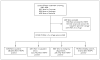
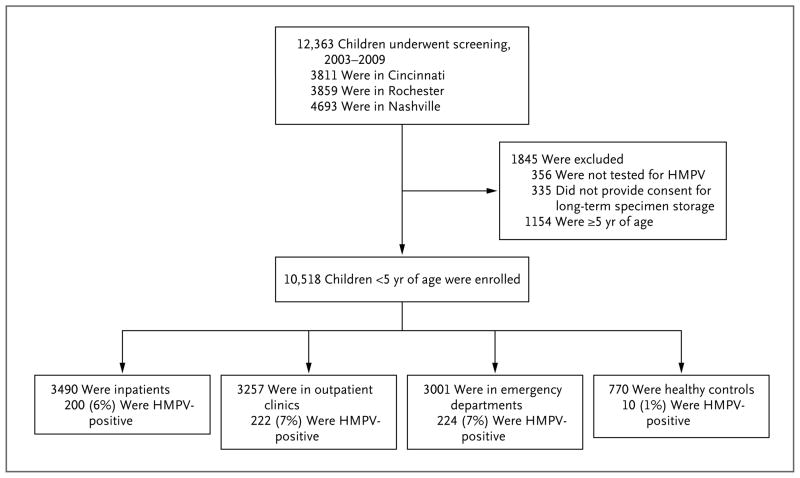
HMPV was detected in 200 of 3490 hospitalized children (6%), 222 of 3257 children in outpatient clinics (7%), 224 of 3001 children in the emergency department (7%), and 10 of 770 asymptomatic controls (1%). Overall annual rates of hospitalization associated with HMPV infection were 1 per 1000 children less than 5 years of age, 3 per 1000 infants less than 6 months of age, and 2 per 1000 children 6 to 11 months of age. Children hospitalized with HMPV infection, as compared with those hospitalized without HMPV infection, were older and more likely to receive a diagnosis of pneumonia or asthma, to require supplemental oxygen, and to have a longer stay in the intensive care unit. The estimated annual burden of outpatient visits associated with HMPV infection was 55 clinic visits and 13 emergency department visits per 1000 children. The majority of HMPV-positive inpatient and outpatient children had no underlying medical conditions, although premature birth and asthma were more frequent among hospitalized children with HMPV infection than among those without HMPV infection.
CONCLUSIONS
HMPV infection is associated with a substantial burden of hospitalizations and outpatient visits among children throughout the first 5 years of life, especially during the first year. Most children with HMPV infection were previously healthy. (Funded by the Centers for Disease Control and Prevention and the National Institutes of Health.)
-
Subjects:
-
Source:N Engl J Med. 2013; 368(7):633-643
-
Pubmed ID:23406028
-
Pubmed Central ID:PMC3662802
-
Document Type:
-
Funding:U01 IP000147/IP/NCIRD CDC HHS/United States ; U38/CCU417958/PHS HHS/United States ; U01/IP000147/IP/NCIRD CDC HHS/United States ; R01 AI085062/AI/NIAID NIH HHS/United States ; U38/CCU217969/PHS HHS/United States ; U01/IP000022/IP/NCIRD CDC HHS/United States ; R21 AI082417/AI/NIAID NIH HHS/United States ; U01 IP000022/IP/NCIRD CDC HHS/United States ; U01/IP000017/IP/NCIRD CDC HHS/United States ; U38/CCU522352/PHS HHS/United States ; AI-085062/AI/NIAID NIH HHS/United States ; AI-82417/AI/NIAID NIH HHS/United States ; U01 IP000017/IP/NCIRD CDC HHS/United States
-
Place as Subject:
-
Volume:368
-
Issue:7
-
Collection(s):
-
Main Document Checksum:urn:sha256:84d664caf0f1d46be492574e4ef9e0d51afb481dac56d6673438c11ca06db0f5
-
Download URL:
-
File Type:
 [PDF
- 634.58 KB
]
[PDF
- 634.58 KB
]
Supporting Files


File Language:
English
ON THIS PAGE

CDC STACKS serves as an archival repository of CDC-published products including
scientific findings,
journal articles, guidelines, recommendations, or other public health information authored or
co-authored by CDC or funded partners.
As a repository, CDC STACKS retains documents in their original published format to ensure public access to scientific information.
As a repository, CDC STACKS retains documents in their original published format to ensure public access to scientific information.
You May Also Like
COLLECTION
CDC Public Access