


Patient-, health worker-, and health facility-level determinants of correct malaria case management at publicly funded health facilities in Malawi: results from a nationally representative health facility survey
Supporting Files
Public Domain

-
Feb 20 2014
-
File Language:
English
Details
-
Alternative Title:Malar J
-
Personal Author:
-
Description:Background
Prompt and effective case management is needed to reduce malaria morbidity and mortality. However, malaria diagnosis and treatment is a multistep process that remains problematic in many settings, resulting in missed opportunities for effective treatment as well as overtreatment of patients without malaria.
Methods
Prior to the widespread roll-out of malaria rapid diagnostic tests (RDTs) in late 2011, a national, cross-sectional, complex-sample, health facility survey was conducted in Malawi to assess patient-, health worker-, and health facility-level factors associated with malaria case management quality using multivariate Poisson regression models.
Results
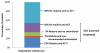
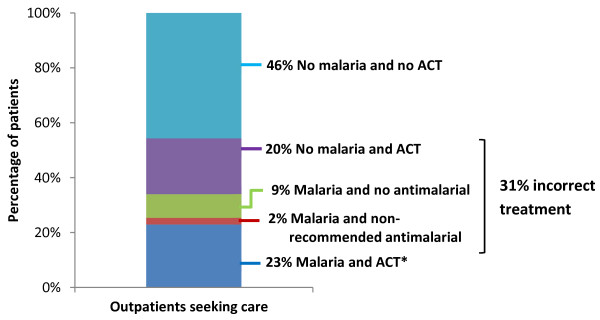
Among the 2,019 patients surveyed, 34% had confirmed malaria defined as presence of fever and parasitaemia on a reference blood smear. Sixty-seven per cent of patients with confirmed malaria were correctly prescribed the first-line anti-malarial, with most cases of incorrect treatment due to missed diagnosis; 31% of patients without confirmed malaria were overtreated with an anti-malarial. More than one-quarter of patients were not assessed for fever or history of fever by health workers. The most important determinants of correct malaria case management were patient-level clinical symptoms, such as spontaneous complaint of fever to health workers, which increased both correct treatment and overtreatment by 72 and 210%, respectively (p < 0.0001). Complaint of cough was associated with a 27% decreased likelihood of correct malaria treatment (p = 0.001). Lower-level cadres of health workers were more likely to prescribe anti-malarials for patients, increasing the likelihood of both correct treatment and overtreatment, but no other health worker or health facility-level factors were significantly associated with case management quality.
Conclusions
Introduction of RDTs holds potential to improve malaria case management in Malawi, but health workers must systematically assess all patients for fever, and then test and treat accordingly, otherwise, malaria control programmes might miss an opportunity to dramatically improve malaria case management, despite better diagnostic tools.
-
Subjects:
-
Source:Malar J. 2014; 13:64.
-
Document Type:
-
Place as Subject:
-
Volume:13
-
Collection(s):
-
Main Document Checksum:urn:sha256:4539f903e6641f6813dc7bf3932e8caf9fb3d968fe24853f501c5180511dd3a6
-
Download URL:
-
File Type:
 [PDF
- 620.83 KB
]
[PDF
- 620.83 KB
]
Supporting Files


File Language:
English
ON THIS PAGE


CDC STACKS serves as an archival repository of CDC-published products including
scientific findings,
journal articles, guidelines, recommendations, or other public health information authored or
co-authored by CDC or funded partners.
As a repository, CDC STACKS retains documents in their original published format to ensure public access to scientific information.
As a repository, CDC STACKS retains documents in their original published format to ensure public access to scientific information.
You May Also Like
COLLECTION
CDC Public Access