


Effects of Mefloquine Use on Plasmodium vivax Multidrug Resistance
Supporting Files
Public Domain

-
Oct 2014
-
File Language:
English
Details
-
Alternative Title:Emerg Infect Dis
-
Personal Author:Khim, Nimol ; Andrianaranjaka, Voahangy ; Popovici, Jean ; Kim, Saorin ; Ratsimbasoa, Arsene ; Benedet, Christophe ; Barnadas, Celine ; Durand, Remy ; Thellier, Marc ; Legrand, Eric ; Musset, Lise ; Menegon, Michela ; Severini, Carlo ; Nour, Bakri Y.M. ; Tichit, Magali ; Bouchier, Christiane ; Mercereau-Puijalon, Odile ; Ménard, Didier
-
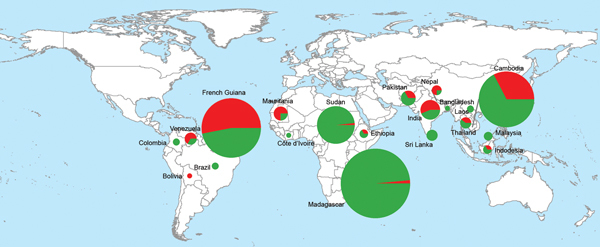
Description:Numerous studies have indicated a strong association between amplification of the multidrug resistance-1 gene and in vivo and in vitro mefloquine resistance of Plasmodium falciparum. Although falciparum infection usually is not treated with mefloquine, incorrect diagnosis, high frequency of undetected mixed infections, or relapses of P. vivax infection triggered by P. falciparum infections expose non-P. falciparum parasites to mefloquine. To assess the consequences of such unintentional treatments on P. vivax, we studied variations in number of Pvmdr-1 (PlasmoDB accession no. PVX_080100, NCBI reference sequence NC_009915.1) copies worldwide in 607 samples collected in areas with different histories of mefloquine use from residents and from travelers returning to France. Number of Pvmdr-1 copies correlated with drug use history. Treatment against P. falciparum exerts substantial collateral pressure against sympatric P. vivax, jeopardizing future use of mefloquine against P. vivax. A drug policy is needed that takes into consideration all co-endemic species of malaria parasites.
-
Subjects:
-
Source:Emerg Infect Dis. 20(10):1637-1644.
-
Document Type:
-
Place as Subject:
-
Volume:20
-
Issue:10
-
Collection(s):
-
Main Document Checksum:urn:sha256:7c2b6e62109064781644db4a9eafe155fce7c7979fef7fa4cd92d6d7c6a10c87
-
Download URL:
-
File Type:
 [PDF
- 546.21 KB
]
[PDF
- 546.21 KB
]
Supporting Files


File Language:
English
ON THIS PAGE




CDC STACKS serves as an archival repository of CDC-published products including
scientific findings,
journal articles, guidelines, recommendations, or other public health information authored or
co-authored by CDC or funded partners.
As a repository, CDC STACKS retains documents in their original published format to ensure public access to scientific information.
As a repository, CDC STACKS retains documents in their original published format to ensure public access to scientific information.
You May Also Like
COLLECTION
Emerging Infectious Diseases