


Pneumocystis jirovecii Pneumonia in Patients with or without AIDS, France
Supporting Files
Public Domain

-
Sep 2014
-
File Language:
English
Details
-
Alternative Title:Emerg Infect Dis
-
Personal Author:Roux, Antoine ; Canet, Emmanuel ; Valade, Sandrine ; Gangneux-Robert, Florence ; Hamane, Samia ; Lafabrie, Ariane ; Maubon, Daniéle ; Debourgogne, Anne ; Le Gal, Soléne ; Dalle, Fréderic ; Leterrier, Marion ; Toubas, Dominique ; Pomares, Christelle ; Bellanger, Anne Pauline ; Bonhomme, Julie ; Berry, Antoine ; Durand-Joly, Isabelle ; Magne, Denis ; Pons, Denis ; Hennequin, Christophe ; Maury, Eric ; Roux, Patricia ; Azoulay, Élie
-
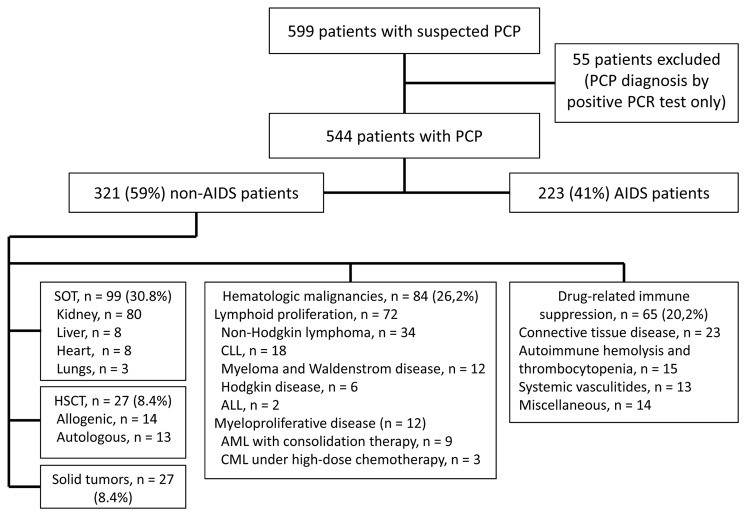
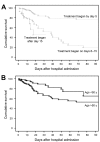
Description:Pneumocystis jirovecii pneumonia (PCP) in patients without AIDS is increasingly common. We conducted a prospective cohort study of consecutive patients with proven PCP; of 544 patients, 223 (41%) had AIDS (AIDS patients) and 321 (59%) had other immunosuppressive disorders (non-AIDS patients). Fewer AIDS than non-AIDS patients required intensive care or ventilation, and the rate of hospital deaths--17.4% overall--was significantly lower for AIDS versus non-AIDS patients (4% vs. 27%; p<0.0001). Multivariable analysis showed the odds of hospital death increased with older age, receipt of allogeneic bone marrow transplant, immediate use of oxygen, need for mechanical ventilation, and longer time to treatment; HIV-positive status or receipt of a solid organ transplant decreased odds for death. PCP is more often fatal in non-AIDS patients, but time to diagnosis affects survival and is longer for non-AIDS patients. Clinicians must maintain a high index of suspicion for PCP in immunocompromised patients who do not have AIDS.
-
Subjects:
-
Source:Emerg Infect Dis. 20(9):1490-1497.
-
Document Type:
-
Volume:20
-
Issue:9
-
Collection(s):
-
Main Document Checksum:urn:sha256:39231d7cbe5267fb2669c25518754e9b5962b87cf76c495a5f9dd5d8fd73f6b0
-
Download URL:
-
File Type:
 [PDF
- 516.87 KB
]
[PDF
- 516.87 KB
]
Supporting Files


File Language:
English
ON THIS PAGE


CDC STACKS serves as an archival repository of CDC-published products including
scientific findings,
journal articles, guidelines, recommendations, or other public health information authored or
co-authored by CDC or funded partners.
As a repository, CDC STACKS retains documents in their original published format to ensure public access to scientific information.
As a repository, CDC STACKS retains documents in their original published format to ensure public access to scientific information.
You May Also Like
COLLECTION
Emerging Infectious Diseases