


Rio Mamore Virus and Hantavirus Pulmonary Syndrome, Brazil
Supporting Files
Public Domain

-
2014/09/01
-
Series: Emerging Infectious Diseases
File Language:
English
Details
-
Journal Article:Emerging Infectious Diseases
-
Personal Author:Carvalho de Oliveira, Renata ; Cordeiro-Santos, Marcelo ; Guterres, Alexandro ; Fernandes, Jorlan ; de Melo, Alexsandro X. ; João, Guilherme A.P. ; Novais, Maria A.M. ; Travassos da Rosa, Elizabeth Salbé ; Vasconcelos, Pedro Fernando da Costa ; Vilges de Oliveira, Stefan ; Cláudio de Albuquerque, Bernardino ; Sampaio de Lemos, Elba Regina
-
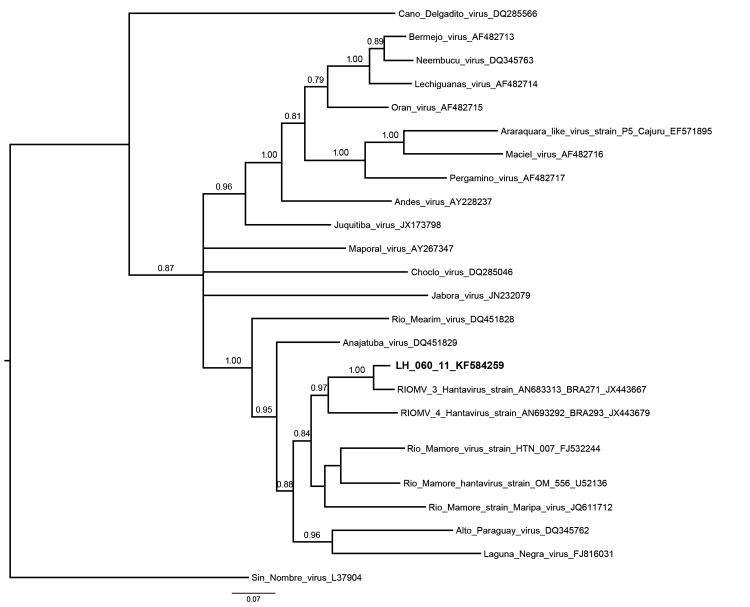
Description:Hantavirus pulmonary syndrome (HPS) is an acute, severe, frequently fatal disease associated with cardiopulmonary failure; it is caused by hantaviruses naturally hosted by wild rodents. Rio Mamore virus (RIOMV) was first described in 1996 in Bolivia; it was associated with the small-eared pygmy rice rat, Oligoryzomys microtis (1). Subsequently, 1 strain of RIOMV was isolated from O. microtis rats in Peru, designated HTN-007 (2); and 2 strains were recovered in the Brazilian Amazon from O. microtis rats (RIOMV-3) and uncharacterized species of rodents of the genus Oligoryzomys (RIOMV-4) (3). Recently, HPS cases associated with RIOMV have been reported: 2 cases in Peru (4) and 1 case in French Guiana (caused by a variant named Maripa virus) (5). We report isolation of a strain of RIOMV from a patient with fatal HPS in Brazil.
-
Subjects:
-
Series:
-
DOI:
-
ISSN:1080-6059 (digital) ; 1080-6040 (print)
-
Publisher:
-
Pubmed ID:25152089
-
Pubmed Central ID:PMC4178416
-
Document Type:
-
Genre:
-
Place as Subject:
-
Rights:Public Domain
-
Topic:
-
Location:
-
Volume:20
-
Issue:9
-
Citation:Emerg Infect Dis. 20(9):1568-1570.
-
Collection(s):
-
Main Document Checksum:urn:sha-512:623169ae3b93f01281d97b0c2ed1c110f922c472ede14269b170365cf1bebf2101efb8f0a1e5a8be98effe21b874d0390463d8f29cbfd2297a7e5b896b2166c3
-
Download URL:
-
File Type:
 [PDF
- 294.61 KB
]
[PDF
- 294.61 KB
]
Supporting Files


File Language:
English
ON THIS PAGE

CDC STACKS serves as an archival repository of CDC-published products including
scientific findings,
journal articles, guidelines, recommendations, or other public health information authored or
co-authored by CDC or funded partners.
As a repository, CDC STACKS retains documents in their original published format to ensure public access to scientific information.
As a repository, CDC STACKS retains documents in their original published format to ensure public access to scientific information.
You May Also Like
COLLECTION
Emerging Infectious Diseases