



Plasmodium knowlesi Malaria in Children
Supporting Files
Public Domain

-
May 2011
Details
-
Alternative Title:Emerg Infect Dis
-
Personal Author:
-
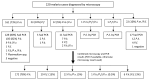
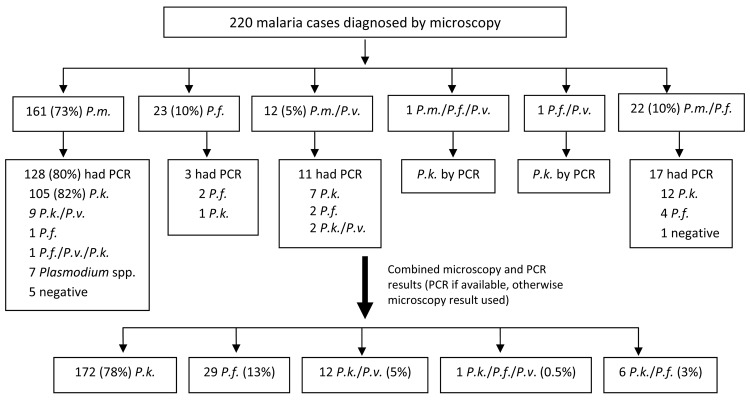
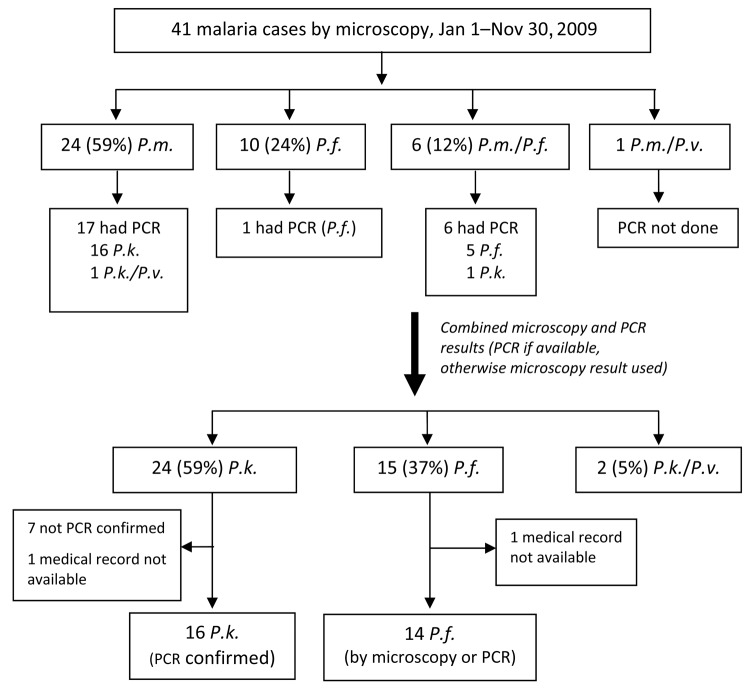
Description:Plasmodium knowlesi can cause severe malaria in adults; however, descriptions of clinical disease in children are lacking. We reviewed case records of children (age <15 years) with a malaria diagnosis at Kudat District Hospital, serving a largely deforested area of Sabah, Malaysia, during January-November 2009. Sixteen children with PCR-confirmed P. knowlesi monoinfection were compared with 14 children with P. falciparum monoinfection diagnosed by microscopy or PCR. Four children with knowlesi malaria had a hemoglobin level at admission of <10.0 g/dL (minimum lowest level 6.4 g/dL). Minimum level platelet counts were lower in knowlesi than in falciparum malaria (median 76,500/μL vs. 156,000/mL; p = 0.01). Most (81%) children with P. knowlesi malaria received chloroquine and primaquine; median parasite clearance time was 2 days (range 1-5 days). P. knowlesi is the most common cause of childhood malaria in Kudat. Although infection is generally uncomplicated, anemia is common and thrombocytopenia universal. Transmission dynamics in this region require additional investigation.
-
Subjects:
- Research
- malaria
- Plasmodium knowlesi
- children
- Plasmodium falciparum
- parasites
- Malaysia
- research
- Adolescent
- Age Factors
- Anemia
- Antimalarials
- Child
- Child, Preschool
- Chloroquine
- Female
- Humans
- Malaria
- Malaria, Falciparum
- Male
- Primaquine
- Retrospective Studies
- Sex Factors
- Thrombocytopenia
- Treatment Outcome
-
Source:Emerg Infect Dis. 17(5):814-820.
-
Document Type:
-
Volume:17
-
Issue:5
-
Download URL:
-
File Type:
 [PDF - 232.96 KB]
 -
Collection(s):
-
Main Document Checksum:urn:sha256:f4e62bf859594f83be92a3058608b4442a7289cbccbc546efef5efbb456f8a35
Supporting Files


 Was this page helpful?
 Found an issue?


CDC STACKS serves as an archival repository of CDC-published products including
scientific findings, journal articles, guidelines, recommendations, or other public health information authored or
co-authored by CDC or funded partners.
As a repository, CDC STACKS retains documents in their original published format to ensure public access to scientific information.
As a repository, CDC STACKS retains documents in their original published format to ensure public access to scientific information.
You May Also Like
COLLECTION
Emerging Infectious Diseases