



Seroprevalence of Trichodysplasia Spinulosa–associated Polyomavirus
Supporting Files
Public Domain

-
Aug 2011
Details
-
Alternative Title:Emerg Infect Dis
-
Personal Author:
-
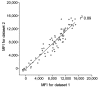
Description:We identified a new polyomavirus in skin lesions from a patient with trichodysplasia spinulosa (TS). Apart from TS being an extremely rare disease, little is known of its epidemiology. On the basis of knowledge regarding other polyomaviruses, we anticipated that infections with trichodysplasia spinulosa-associated polyomavirus (TSV) occur frequently and become symptomatic only in immunocompromised patients. To investigate this hypothesis, we developed and used a Luminex-based TSV viral protein 1 immunoassay, excluded cross-reactivity with phylogenetically related Merkel cell polyomavirus, and measured TSV seroreactivity. Highest reactivity was found in a TS patient. In 528 healthy persons in the Netherlands, a wide range of seroreactivities was measured and resulted in an overall TSV seroprevalence of 70% (range 10% in small children to 80% in adults). In 80 renal transplant patients, seroprevalence was 89%. Infection with the new TSV polyomavirus is common and occurs primarily at a young age.
-
Subjects:
- Research
- trichodysplasia spinulosa
- trichodysplasia spinulosa–associated virus
- viruses
- polyomavirus
- immunoassay
- seroprevalence
- epidemiology
- immunocompromised host
- the Netherlands
- research
- Adolescent
- Adult
- Aged
- Antibodies, Viral
- Capsid Proteins
- Child
- Child, Preschool
- Humans
- Immunoassay
- Immunocompromised Host
- Infant
- Kidney Transplantation
- Middle Aged
- Netherlands
- Polyomavirus
- Polyomavirus Infections
- Seroepidemiologic Studies
- Skin Diseases
- Tumor Virus Infections
- Young Adult
-
Source:Emerg Infect Dis. 17(8):1355-1363.
-
Document Type:
-
Volume:17
-
Issue:8
-
Download URL:
-
File Type:
 [PDF - 787.87 KB]
 -
Collection(s):
-
Main Document Checksum:urn:sha256:24d4c0535815c6eb9a4c4eaf843599be1b05933fbe4b00a1b594e8bfc101f438
Supporting Files


 Was this page helpful?
 Found an issue?














CDC STACKS serves as an archival repository of CDC-published products including
scientific findings, journal articles, guidelines, recommendations, or other public health information authored or
co-authored by CDC or funded partners.
As a repository, CDC STACKS retains documents in their original published format to ensure public access to scientific information.
As a repository, CDC STACKS retains documents in their original published format to ensure public access to scientific information.
You May Also Like
COLLECTION
Emerging Infectious Diseases