



Asymptomatic Primary Merkel Cell Polyomavirus Infection among Adults
Supporting Files

-
Aug 2011
File Language:
English
Details
-
Alternative Title:Emerg Infect Dis
-
Personal Author:
-
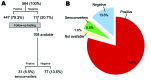
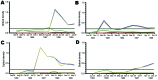
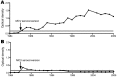
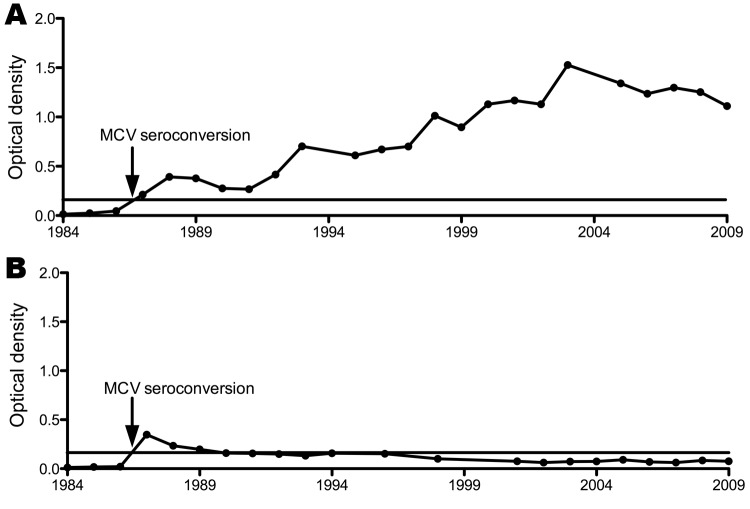
Description:Merkel cell polyomavirus (MCV) is a recently discovered virus that causes 80% of Merkel cell carcinomas. We examined data for 564 gay/bisexual male participants >18 years of age in the Multicenter AIDS Cohort Study in Pittsburgh, Pennsylvania, USA, and found that 447 (79.3%) were MCV-antibody positive at initial enrollment. Of the 117 MCV-seronegative men, 31 subsequently seroconverted over a 4-year follow-up period, corresponding to a 6.6% annual conversion rate. MCV immunoglobulin G levels remained detectable up to 25 years after exposure. No signs, symptoms, or routine diagnostic test results were associated with MCV infection, and no correlation between HIV infection or AIDS progression and MCV infection was noted. An initial correlation between chronic hepatitis B virus infection and MCV prevalence could not be confirmed among MCV seroconverters or in studies of a second hepatitis B virus-hyperendemic cohort from Qidong, China. In adults, MCV is typically an asymptomatic, common, and commensal viral infection that initiates rare cancers after virus (rather than host cell) mutations.
-
Subjects:
-
Source:Emerg Infect Dis. 17(8):1371-1380.
-
Document Type:
-
Funding:
-
Place as Subject:
-
Location:
-
Volume:17
-
Issue:8
-
Download URL:
-
File Type:
 [PDF - 535.19 KB]
 -
Collection(s):
-
Main Document Checksum:urn:sha256:529998b072cb41dcf74af92c5af46be407936f4c2d3686cb71c7a96a16202c26
Supporting Files


File Language:
English
 Was this page helpful?
 Found an issue?




CDC STACKS serves as an archival repository of CDC-published products including
scientific findings, journal articles, guidelines, recommendations, or other public health information authored or
co-authored by CDC or funded partners.
As a repository, CDC STACKS retains documents in their original published format to ensure public access to scientific information.
As a repository, CDC STACKS retains documents in their original published format to ensure public access to scientific information.
You May Also Like
COLLECTION
Emerging Infectious Diseases