



Parent-Of-Origin Effects in Autism Identified through Genome-Wide Linkage Analysis of 16,000 SNPs
Supporting Files

-
Sep 02 2010
File Language:
English
Details
-
Alternative Title:PLoS One
-
Personal Author:
-
Description:Background
Autism is a common heritable neurodevelopmental disorder with complex etiology. Several genome-wide linkage and association scans have been carried out to identify regions harboring genes related to autism or autism spectrum disorders, with mixed results. Given the overlap in autism features with genetic abnormalities known to be associated with imprinting, one possible reason for lack of consistency would be the influence of parent-of-origin effects that may mask the ability to detect linkage and association.
Methods and Findings
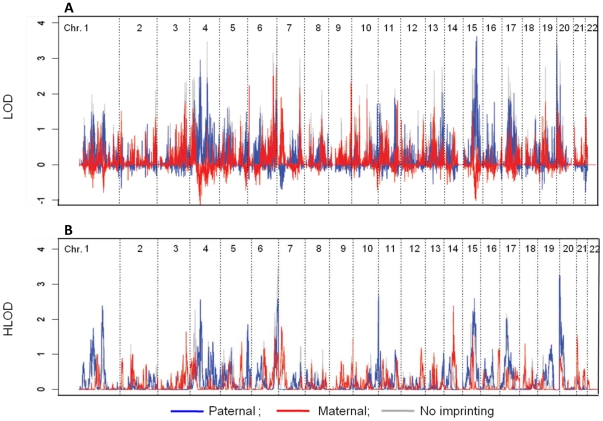
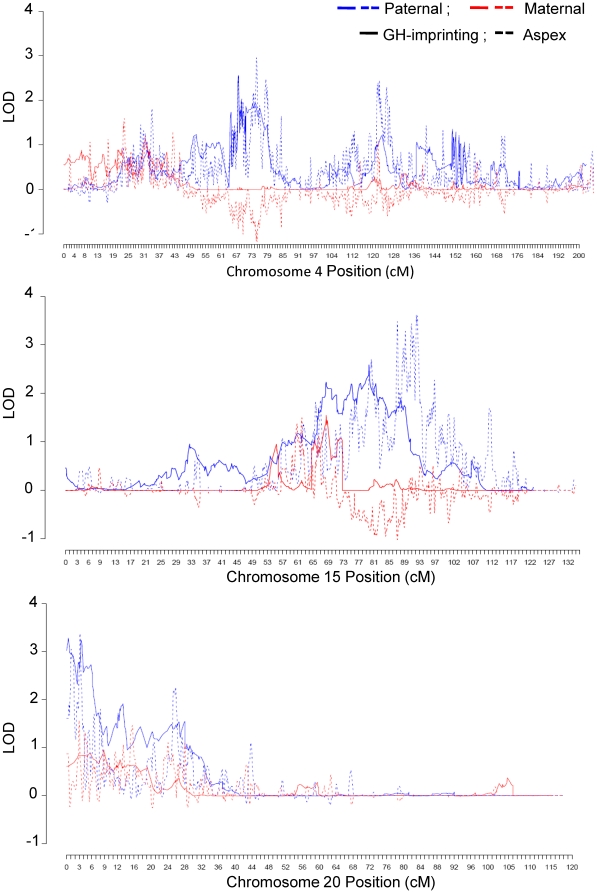
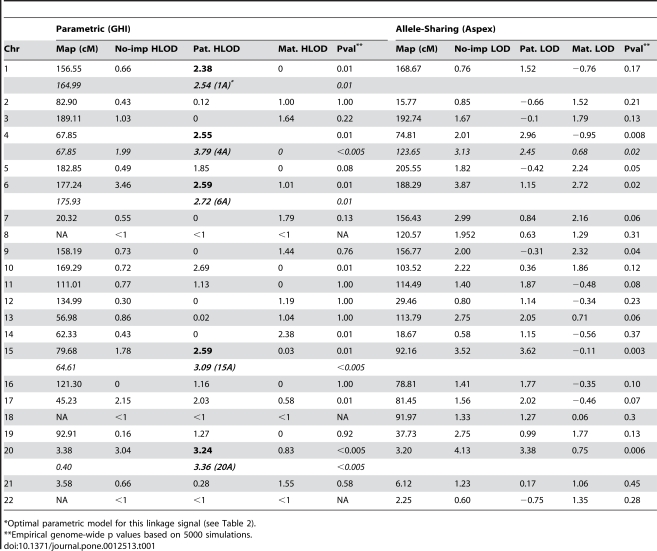
We have performed a genome-wide linkage scan that accounts for potential parent-of-origin effects using 16,311 SNPs among families from the Autism Genetic Resource Exchange (AGRE) and the National Institute of Mental Health (NIMH) autism repository. We report parametric (GH, Genehunter) and allele-sharing linkage (Aspex) results using a broad spectrum disorder case definition. Paternal-origin genome-wide statistically significant linkage was observed on chromosomes 4 (LODGH = 3.79, empirical p<0.005 and LODAspex = 2.96, p = 0.008), 15 (LODGH = 3.09, empirical p<0.005 and LODAspex = 3.62, empirical p = 0.003) and 20 (LODGH = 3.36, empirical p<0.005 and LODAspex = 3.38, empirical p = 0.006).
Conclusions
These regions may harbor imprinted sites associated with the development of autism and offer fruitful domains for molecular investigation into the role of epigenetic mechanisms in autism. -
Subjects:
-
Source:PLoS One. 5(9).
-
Pubmed ID:20824079
-
Pubmed Central ID:PMC2932694
-
Document Type:
-
Funding:
-
Volume:5
-
Issue:9
-
Download URL:
-
File Type:
 [PDF - 404.12 KB]
 -
Collection(s):
-
Main Document Checksum:urn:sha256:7096e49cd16fdebf35c1b578d83b6234fb527e10e04e4f7cb97b6daf507e1d06
Supporting Files


File Language:
English
 Was this page helpful?
 Found an issue?


CDC STACKS serves as an archival repository of CDC-published products including
scientific findings, journal articles, guidelines, recommendations, or other public health information authored or
co-authored by CDC or funded partners.
As a repository, CDC STACKS retains documents in their original published format to ensure public access to scientific information.
As a repository, CDC STACKS retains documents in their original published format to ensure public access to scientific information.
You May Also Like