



Breath Formate Is a Marker of Airway S-Nitrosothiol Depletion in Severe Asthma
Supporting Files

-
Jul 30 2010
File Language:
English
Details
-
Alternative Title:PLoS One
-
Personal Author:
-
Description:Background
Children with severe asthma have poor symptom control and elevated markers of airway oxidative and nitrosative stress. Paradoxically, they have decreased airway levels of S-nitrosothiols (SNOs), a class of endogenous airway smooth muscle relaxants. This deficiency results from increased activity of an enzyme that both reduces SNOs to ammonia and oxidizes formaldehyde to formic acid, a volatile carboxylic acid that is more easily detected in exhaled breath condensate (EBC) than SNOs. We therefore hypothesize that depletion of airway SNOs is related to asthma pathology, and breath formate concentration may be a proxy measure of SNO catabolism.
Methods and Findings
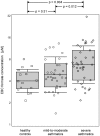
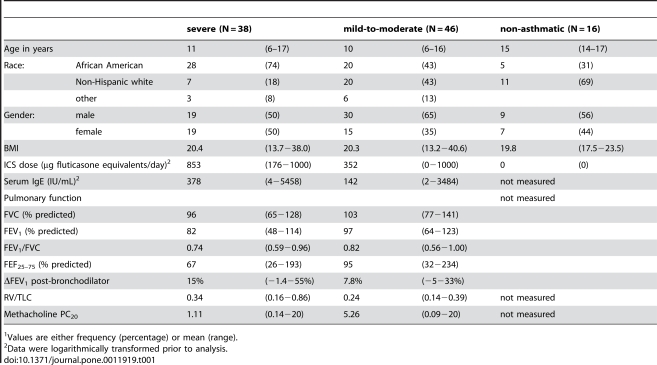
We collected EBC samples from children and adolescents, including 38 with severe asthma, 46 with mild-to-moderate asthma and 16 healthy adolescent controls, and the concentration of ionic constituents was quantified using ion chromatography. The concentrations of EBC components with volatile conjugates were log-normally distributed. Formate was the principal ion that displayed a significant difference between asthma status classifications. The mean EBC formate concentration was 40% higher in samples collected from all asthmatics than from healthy controls (mean = 5.7 µM, mean±standard deviation = 3.1−10.3 µM vs. 4.0, 2.8−5.8 µM, p = 0.05). EBC formate was higher in severe asthmatics than in mild-to-moderate asthmatics (6.8, 3.7−12.3 µM vs. 4.9, 2.8−8.7 µM, p = 0.012). In addition, formate concentration was negatively correlated with methacholine PC20 (r = −0.39, p = 0.002, asthmatics only), and positively correlated with the NO-derived ion nitrite (r = 0.46, p<0.0001) as well as with total serum IgE (r = 0.28, p = 0.016, asthmatics only). Furthermore, formate was not significantly correlated with other volatile organic acids nor with inhaled corticosteroid dose.
Conclusions
We conclude that EBC formate concentration is significantly higher in the breath of children with asthma than in those without asthma. In addition, amongst asthmatics, formate is elevated in the breath of those with severe asthma compared to those with mild-to-moderate asthma. We suggest that this difference is related to asthma pathology and may be a product of increased catabolism of endogenous S-nitrosothiols. -
Subjects:
-
Source:PLoS One. 5(7).
-
Pubmed ID:20689836
-
Pubmed Central ID:PMC2912922
-
Document Type:
-
Funding:
-
Volume:5
-
Issue:7
-
Download URL:
-
File Type:
 [PDF - 274.79 KB]
 -
Collection(s):
-
Main Document Checksum:urn:sha256:71de4421555226657ff961351f2453d024ef6b360e169414691ebe9503ba29c4
Supporting Files


File Language:
English
 Was this page helpful?
 Found an issue?



CDC STACKS serves as an archival repository of CDC-published products including
scientific findings, journal articles, guidelines, recommendations, or other public health information authored or
co-authored by CDC or funded partners.
As a repository, CDC STACKS retains documents in their original published format to ensure public access to scientific information.
As a repository, CDC STACKS retains documents in their original published format to ensure public access to scientific information.
You May Also Like