


Comparison of WTC Dust Size on Macrophage Inflammatory Cytokine Release In vivo and In vitro
Supporting Files

-
Jul 18 2012
-
File Language:
English
Details
-
Alternative Title:PLoS One
-
Personal Author:
-
Description:Background
The WTC collapse exposed over 300,000 people to high concentrations of WTC-PM; particulates up to ∼50 mm were recovered from rescue workers’ lungs. Elevated MDC and GM-CSF independently predicted subsequent lung injury in WTC-PM-exposed workers. Our hypotheses are that components of WTC dust strongly induce GM-CSF and MDC in AM; and that these two risk factors are in separate inflammatory pathways.
Methodology/Principal Findings
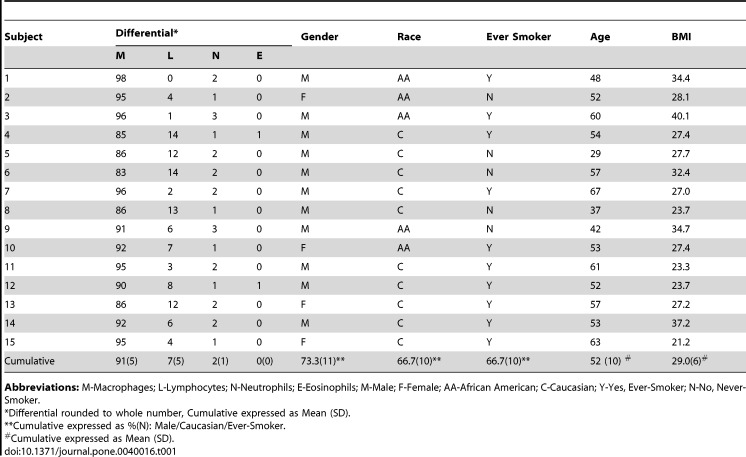
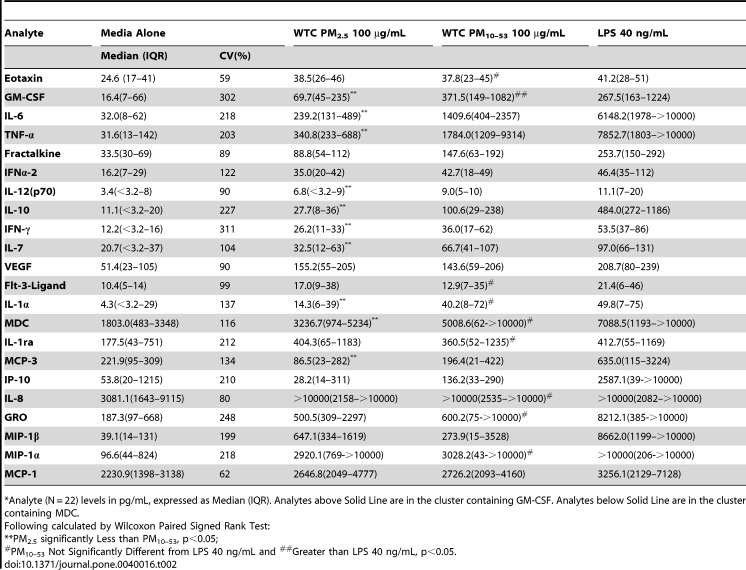
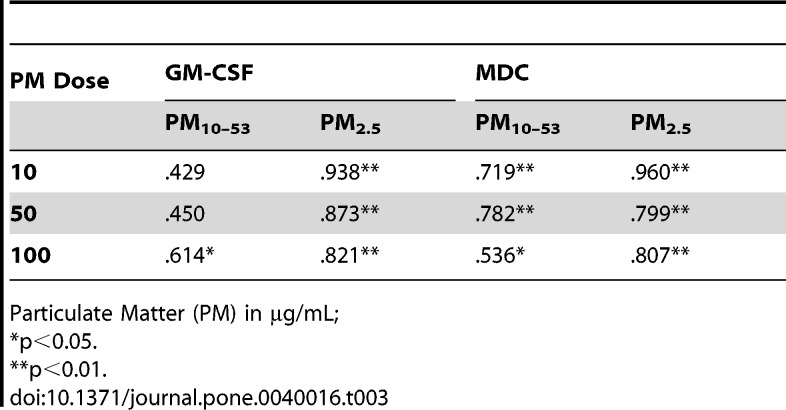
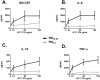
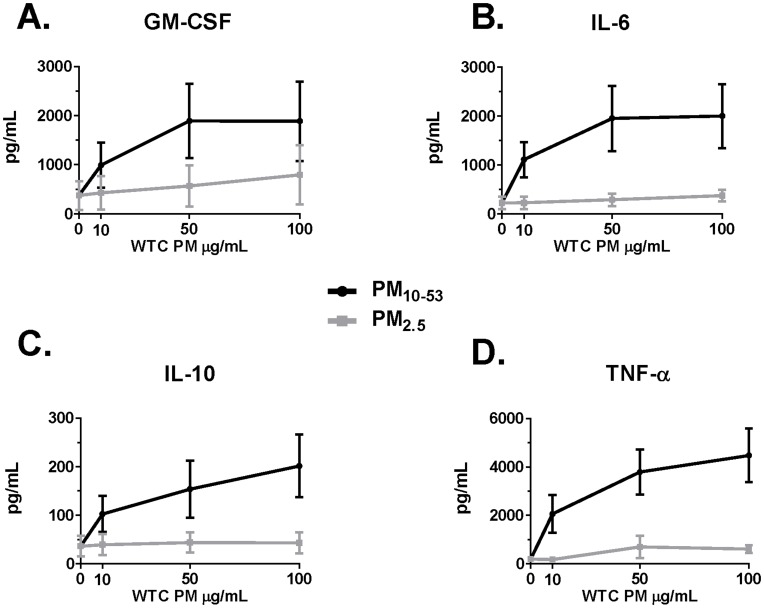
Normal adherent AM from 15 subjects without WTC-exposure were incubated in media alone, LPS 40 ng/mL, or suspensions of WTC-PM10–53 or WTC-PM2.5 at concentrations of 10, 50 or 100 µg/mL for 24 hours; supernatants assayed for 39 chemokines/cytokines. In addition, sera from WTC-exposed subjects who developed lung injury were assayed for the same cytokines. In the in vitro studies, cytokines formed two clusters with GM-CSF and MDC as a result of PM10–53 and PM2.5. GM-CSF clustered with IL-6 and IL-12(p70) at baseline, after exposure to WTC-PM10–53 and in sera of WTC dust-exposed subjects (n = 70) with WTC lung injury. Similarly, MDC clustered with GRO and MCP-1. WTC-PM10–53 consistently induced more cytokine release than WTC-PM2.5 at 100 µg/mL. Individual baseline expression correlated with WTC-PM-induced GM-CSF and MDC.
Conclusions
WTC-PM10–53 induced a stronger inflammatory response by human AM than WTC-PM2.5. This large particle exposure may have contributed to the high incidence of lung injury in those exposed to particles at the WTC site. GM-CSF and MDC consistently cluster separately, suggesting a role for differential cytokine release in WTC-PM injury. Subject-specific response to WTC-PM may underlie individual susceptibility to lung injury after irritant dust exposure.
-
Subjects:
-
Source:PLoS One. 2012; 7(7).
-
Pubmed ID:22815721
-
Pubmed Central ID:PMC3399845
-
Document Type:
-
Funding:1UL1RR029893/RR/NCRR NIH HHS/United States ; K23 HL084191/HL/NHLBI NIH HHS/United States ; K23HL084191/HL/NHLBI NIH HHS/United States ; K24A1080298/PHS HHS/United States ; R01HL090316/HL/NHLBI NIH HHS/United States ; R01OH008280/OH/NIOSH CDC HHS/United States ; T32-ES007267/ES/NIEHS NIH HHS/United States ; U01CA008617/CA/NCI NIH HHS/United States ; U10-OH008242/OH/NIOSH CDC HHS/United States ; U10-OH008243/OH/NIOSH CDC HHS/United States ; UL1 RR029893/RR/NCRR NIH HHS/United States
-
Volume:7
-
Issue:7
-
Collection(s):
-
Main Document Checksum:urn:sha256:bc18c5c7b87f90d0ceefce84f81a7ceb05d957967fcf4d393f74dbd7e055afe7
-
Download URL:
-
File Type:
 [PDF
- 291.29 KB
]
[PDF
- 291.29 KB
]
Supporting Files


File Language:
English
ON THIS PAGE




CDC STACKS serves as an archival repository of CDC-published products including
scientific findings,
journal articles, guidelines, recommendations, or other public health information authored or
co-authored by CDC or funded partners.
As a repository, CDC STACKS retains documents in their original published format to ensure public access to scientific information.
As a repository, CDC STACKS retains documents in their original published format to ensure public access to scientific information.
You May Also Like
COLLECTION
CDC Public Access