


Variants in the vitamin D pathway, serum levels of vitamin D, and estrogen receptor negative breast cancer among African-American women: a case-control study
Supporting Files

-
Apr 04 2012
-
File Language:
English
Details
-
Alternative Title:Breast Cancer Res
-
Personal Author:Yao, Song ; Zirpoli, Gary ; Bovbjerg, Dana H ; Jandorf, Lina ; Hong, Chi Chen ; Zhao, Hua ; Sucheston, Lara E ; Tang, Li ; Roberts, Michelle ; Ciupak, Gregory ; Davis, Warren ; Hwang, Helena ; Johnson, Candace S ; Trump, Donald L ; McCann, Susan E ; Ademuyiwa, Foluso ; Pawlish, Karen S ; Bandera, Elisa V ; Ambrosone, Christine B
-
Description:Introduction
American women of African ancestry (AA) are more likely than European Americans (EA) to have estrogen receptor (ER)-negative breast cancer. 25-hydroxyvitamin D (25OHD) is low in AAs, and was associated with ER-negative tumors in EAs. We hypothesized that racial differences in 25OHD levels, as well as in inherited genetic variations, may contribute, in part, to the differences in tumor characteristics.
Methods
In a case (n = 928)-control (n = 843) study of breast cancer in AA and EA women, we measured serum 25OHD levels in controls and tested associations between risk and tag single nucleotide polymorphisms (SNPs) in VDR, CYP24A1 and CYP27B1, particularly by ER status.
Results
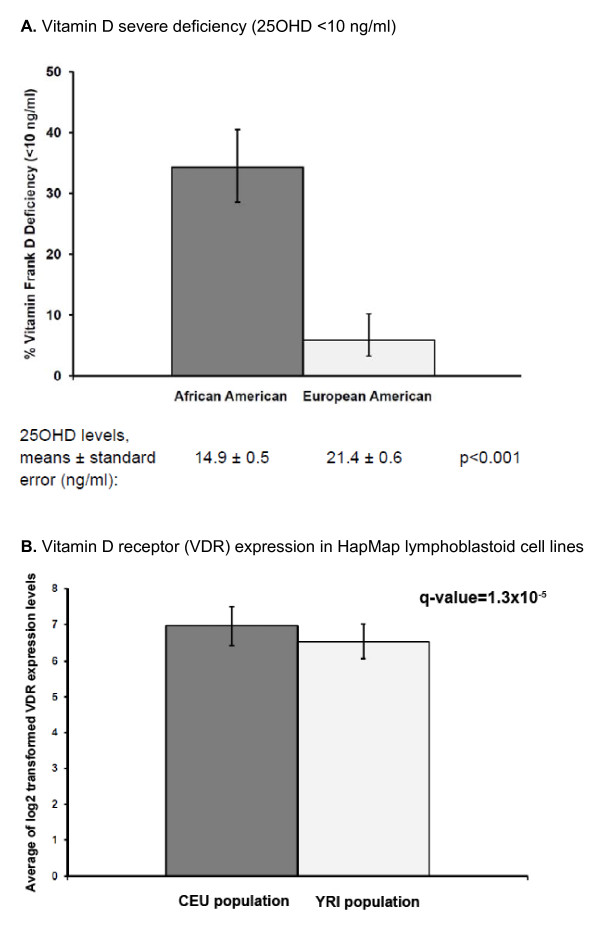
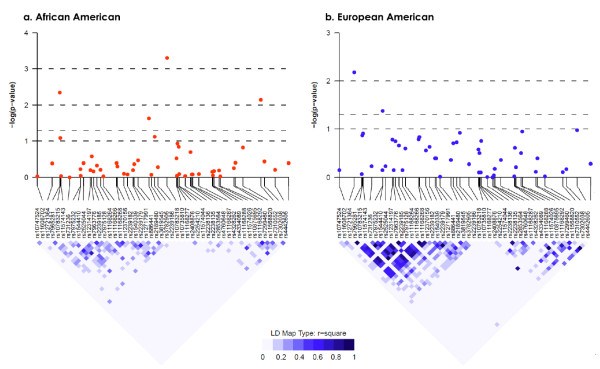
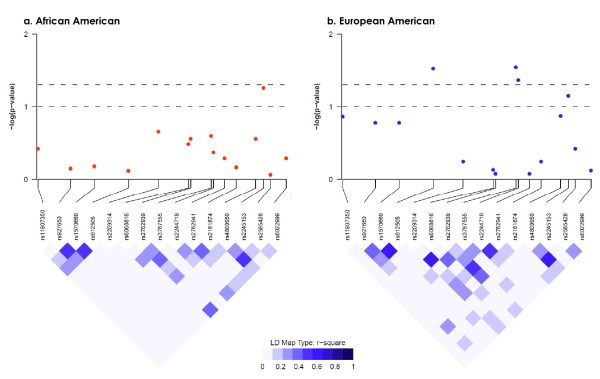
More AAs had severe vitamin D deficiency (< 10 ng/ml) than EAs (34.3% vs 5.9%), with lowest levels among those with the highest African ancestry. Associations for SNPs differed by race. Among AAs, VDR SNP rs2239186, associated with higher serum levels of 25OHD, decreased risk after correction for multiple testing (OR = 0.53, 95% CI = 0.31-0.79, p by permutation = 0.03), but had no effect in EAs. The majority of associations were for ER-negative breast cancer, with seven differential associations between AA and EA women for CYP24A1 (p for interaction < 0.10). SNP rs27622941 was associated with a > twofold increased risk of ER-negative breast cancer among AAs (OR = 2.62, 95% CI = 1.38-4.98), but had no effect in EAs. rs2209314 decreased risk among EAs (OR = 0.38, 95% CI = 0.20-0.73), with no associations in AAs. The increased risk of ER-negative breast cancer in AAs compared to EAs was reduced and became non-significant (OR = 1.20, 95% CI = 0.80-1.79) after adjusting for these two CYP24A1 SNPs.
Conclusions
These data suggest that genetic variants in the vitamin D pathway may be related to the higher prevalence of ER-negative breast cancer in AA women.
-
Subjects:
-
Source:Breast Cancer Res. 2012; 14(2):R58.
-
Pubmed ID:22480149
-
Pubmed Central ID:PMC3446393
-
Document Type:
-
Funding:DP07-703/DP/NCCDPHP CDC HHS/United States ; K07 CA148888/CA/NCI NIH HHS/United States ; K22 CA138563/CA/NCI NIH HHS/United States ; N01-PC-95001-20/PC/NCI NIH HHS/United States ; P01 CA151135/CA/NCI NIH HHS/United States ; P30 CA016056-32/CA/NCI NIH HHS/United States ; R01 CA100598/CA/NCI NIH HHS/United States
-
Volume:14
-
Issue:2
-
Collection(s):
-
Main Document Checksum:urn:sha256:f56c8c9d109bdddf9220b6d42d62e07fda7b89217f033c5c3f21993fffc4fa2f
-
Download URL:
-
File Type:
 [PDF
- 912.16 KB
]
[PDF
- 912.16 KB
]
Supporting Files


File Language:
English
ON THIS PAGE



CDC STACKS serves as an archival repository of CDC-published products including
scientific findings,
journal articles, guidelines, recommendations, or other public health information authored or
co-authored by CDC or funded partners.
As a repository, CDC STACKS retains documents in their original published format to ensure public access to scientific information.
As a repository, CDC STACKS retains documents in their original published format to ensure public access to scientific information.
You May Also Like
COLLECTION
CDC Public Access