



Data-Driven Modeling to Assess Receptivity for Rift Valley Fever Virus
Supporting Files

-
Nov 14 2013
File Language:
English
Details
-
Alternative Title:PLoS Negl Trop Dis
-
Personal Author:
-
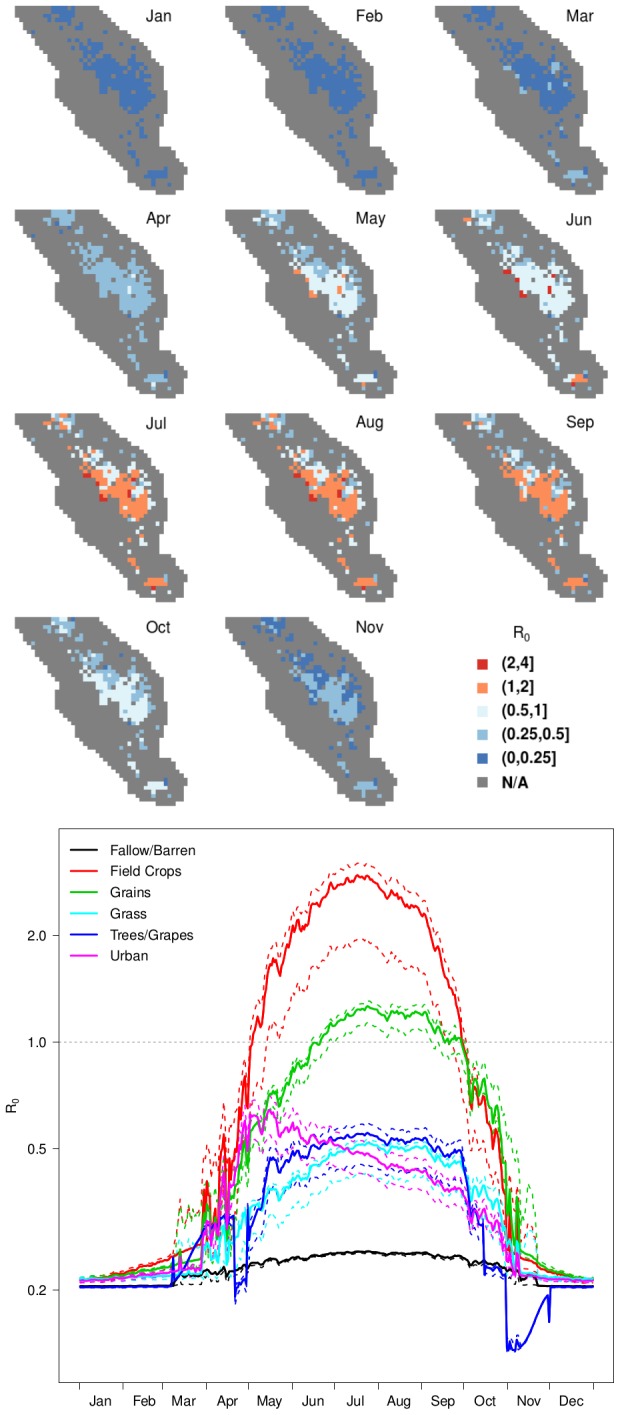
Description:Rift Valley Fever virus (RVFV) is an enzootic virus that causes extensive morbidity and mortality in domestic ruminants in Africa, and it has shown the potential to invade other areas such as the Arabian Peninsula. Here, we develop methods for linking mathematical models to real-world data that could be used for continent-scale risk assessment given adequate data on local host and vector populations. We have applied the methods to a well-studied agricultural region of California with Formula: see text1 million dairy cattle, abundant and competent mosquito vectors, and a permissive climate that has enabled consistent transmission of West Nile virus and historically other arboviruses. Our results suggest that RVFV outbreaks could occur from February-November, but would progress slowly during winter-early spring or early fall and be limited spatially to areas with early increases in vector abundance. Risk was greatest in summer, when the areas at risk broadened to include most of the dairy farms in the study region, indicating the potential for considerable economic losses if an introduction were to occur. To assess the threat that RVFV poses to North America, including what-if scenarios for introduction and control strategies, models such as this one should be an integral part of the process; however, modeling must be paralleled by efforts to address the numerous remaining gaps in data and knowledge for this system.
-
Subjects:
-
Source:PLoS Negl Trop Dis. 2013; 7(11).
-
Pubmed ID:24244769
-
Pubmed Central ID:PMC3828160
-
Document Type:
-
Funding:
-
Place as Subject:
-
Volume:7
-
Issue:11
-
Download URL:
-
File Type:
 [PDF - 2.57 MB]
 -
Collection(s):
-
Main Document Checksum:urn:sha256:9964724c5af81ec9983f331ce2a276cd38ca7dc57e161e5738bf2cdbc390c58b
Supporting Files


File Language:
English
 Was this page helpful?
 Found an issue?














CDC STACKS serves as an archival repository of CDC-published products including
scientific findings, journal articles, guidelines, recommendations, or other public health information authored or
co-authored by CDC or funded partners.
As a repository, CDC STACKS retains documents in their original published format to ensure public access to scientific information.
As a repository, CDC STACKS retains documents in their original published format to ensure public access to scientific information.
You May Also Like
COLLECTION
CDC Public Access