


Predictors of Serum Chlorinated Pesticide Concentrations among Prepubertal Russian Boys
Supporting Files

-
2013/11/01
-
File Language:
English
Details
-
Journal Article:Environmental Health Perspectives
-
Personal Author:
-
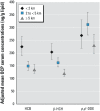
Description:BACKGROUND: Few studies have evaluated predictors of childhood exposure to organochlorine pesticides (OCPs), a class of lipophilic persistent chemicals. OBJECTIVES: Our goal was to identify predictors of serum OCP concentrations-hexachlorobenzene (HCB), beta-hexachlorocyclohexane (beta-HCH), and p,p-dichlorodiphenyldichloroethylene (p,p'-DDE)-among boys in Chapaevsk, Russia. METHODS: Between 2003 and 2005, 499 boys 8-9 years of age were recruited in a prospective cohort. The initial study visit included a physical examination; blood collection; health, lifestyle, and food-frequency questionnaires; and determination of residential distance from a local factory complex that produced HCB and beta-HCH. Fasting serum samples were analyzed for OCPs at the U.S. Centers for Disease Control and Prevention. General linear regression models were used to identify predictors of the boys' serum HCB, beta-HCH, and p,p'-DDE concentrations. RESULTS: Among 355 boys with OCP measurements, median serum HCB, beta-HCH, and p,p'-DDE concentrations were 158, 167, and 284 ng/g lipid, respectively. Lower body mass index, longer breastfeeding duration, and local dairy consumption were associated with higher concentrations of OCPs. Boys who lived < 2 km from the factory complex had 64% (95% CI: 37, 96) and 57% (95% CI: 32, 87) higher mean HCB and beta-HCH concentrations, respectively, than boys who lived = 5 km away. Living > 3 years in Chapaevsk predicted higher beta-HCH concentrations, and having parents who lacked a high school education predicted higher p,p'-DDE concentrations. CONCLUSIONS: Among this cohort of prepubertal Russian boys, predictors of serum OCPs included consumption of local dairy products, longer local residence, and residential proximity to the local factory complex. [Description provided by NIOSH]
-
Subjects:
-
Keywords:
-
Source:Environ Health Perspect 2013 Nov-Dec; 121(11-12):1372-1377
-
ISSN:0091-6765
-
Pubmed ID:23955839
-
Pubmed Central ID:PMC3855511
-
Document Type:
-
Funding:
-
Genre:
-
Place as Subject:
-
CIO:
-
Topic:
-
Location:
-
Pages in Document:6 pdf pages
-
Volume:121
-
Issue:11
-
NIOSHTIC Number:nn:20044809
-
Contact Point Address:Thuy Lam, Environmental and Occupational Medicine and Epidemiology Program, 665 Huntington Ave., Building 1, Room 1406N, Boston, MA 02115
-
Email:tlam@mail.harvard.edu
-
CAS Registry Number:
-
Federal Fiscal Year:2014
-
Performing Organization:Harvard School of Public Health
-
Peer Reviewed:True
-
Collection(s):
-
Main Document Checksum:urn:sha-512:bbbd3c942c73fff2c3a221629e18b0f03b2e63503d5660175a917ec5974a9a5be9e7ee1dbde7523e28b416b56d6e92a8137ab588427463a730b6df945abda7b9
-
Download URL:
-
File Type:
 [PDF
- 241.00 KB
]
[PDF
- 241.00 KB
]
Supporting Files


File Language:
English
ON THIS PAGE


CDC STACKS serves as an archival repository of CDC-published products including
scientific findings,
journal articles, guidelines, recommendations, or other public health information authored or
co-authored by CDC or funded partners.
As a repository, CDC STACKS retains documents in their original published format to ensure public access to scientific information.
As a repository, CDC STACKS retains documents in their original published format to ensure public access to scientific information.
You May Also Like