


How should social mixing be measured: comparing web-based survey and sensor-based methods
Supporting Files

-
Mar 10 2014
-
File Language:
English
Details
-
Alternative Title:BMC Infect Dis
-
Personal Author:
-
Description:Background
Contact surveys and diaries have conventionally been used to measure contact networks in different settings for elucidating infectious disease transmission dynamics of respiratory infections. More recently, technological advances have permitted the use of wireless sensor devices, which can be worn by individuals interacting in a particular social context to record high resolution mixing patterns. To date, a direct comparison of these two different methods for collecting contact data has not been performed.
Methods
We studied the contact network at a United States high school in the spring of 2012. All school members (i.e., students, teachers, and other staff) were invited to wear wireless sensor devices for a single school day, and asked to remember and report the name and duration of all of their close proximity conversational contacts for that day in an online contact survey. We compared the two methods in terms of the resulting network densities, nodal degrees, and degree distributions. We also assessed the correspondence between the methods at the dyadic and individual levels.
Results
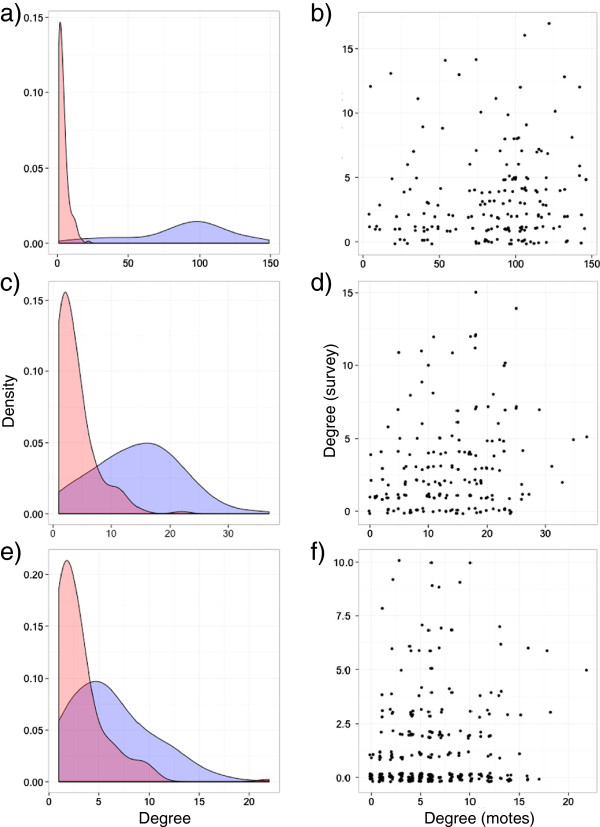
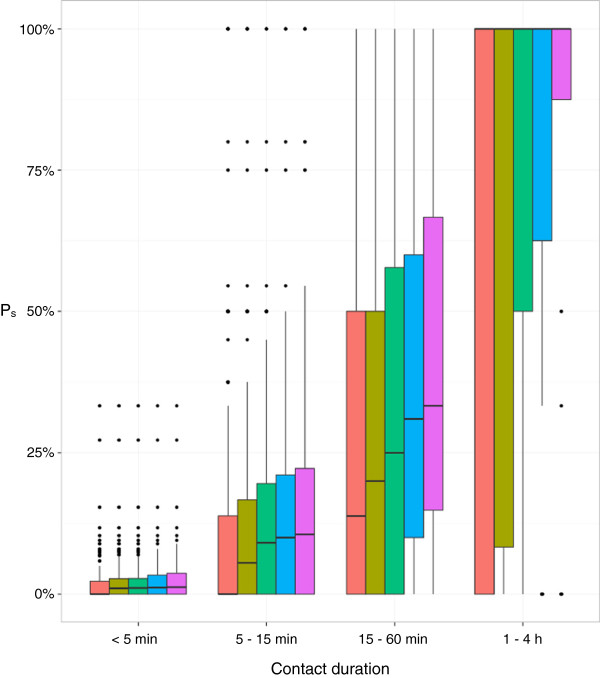
We found limited congruence in recorded contact data between the online contact survey and wireless sensors. In particular, there was only negligible correlation between the two methods for nodal degree, and the degree distribution differed substantially between both methods. We found that survey underreporting was a significant source of the difference between the two methods, and that this difference could be improved by excluding individuals who reported only a few contact partners. Additionally, survey reporting was more accurate for contacts of longer duration, and very inaccurate for contacts of shorter duration. Finally, female participants tended to report more accurately than male participants.
Conclusions
Online contact surveys and wireless sensor devices collected incongruent network data from an identical setting. This finding suggests that these two methods cannot be used interchangeably for informing models of infectious disease dynamics.
-
Subjects:
-
Source:BMC Infect Dis. 2014; 14:136.
-
Pubmed ID:24612900
-
Pubmed Central ID:PMC3984737
-
Document Type:
-
Funding:
-
Place as Subject:
-
Volume:14
-
Collection(s):
-
Main Document Checksum:urn:sha256:479e116a1c7bc5e8f13763117c367c4f0282a61c383a4734cc97a01197de069a
-
Download URL:
-
File Type:
 [PDF
- 829.26 KB
]
[PDF
- 829.26 KB
]
Supporting Files


File Language:
English
ON THIS PAGE


CDC STACKS serves as an archival repository of CDC-published products including
scientific findings,
journal articles, guidelines, recommendations, or other public health information authored or
co-authored by CDC or funded partners.
As a repository, CDC STACKS retains documents in their original published format to ensure public access to scientific information.
As a repository, CDC STACKS retains documents in their original published format to ensure public access to scientific information.
You May Also Like
COLLECTION
CDC Public Access