


Estimates of Social Contact in a Middle School Based on Self-Report and Wireless Sensor Data
Supporting Files
Public Domain

-
Apr 21 2016
-
File Language:
English
Details
-
Alternative Title:PLoS One
-
Personal Author:
-
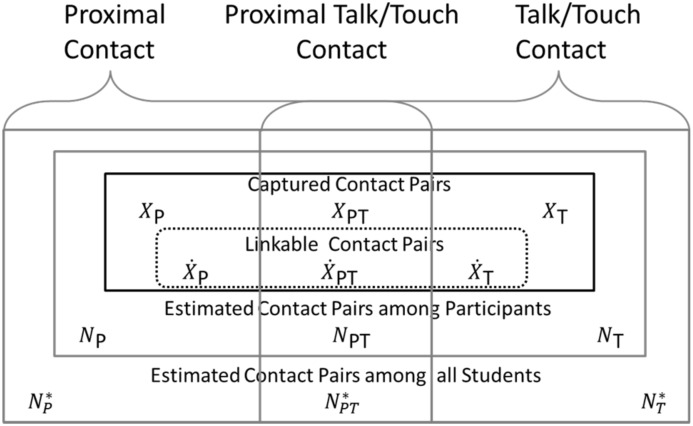
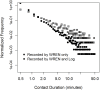
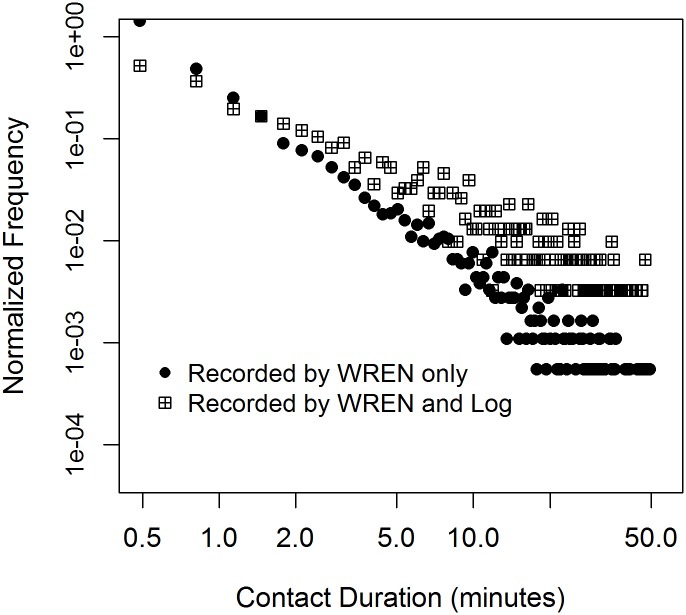
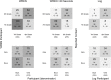
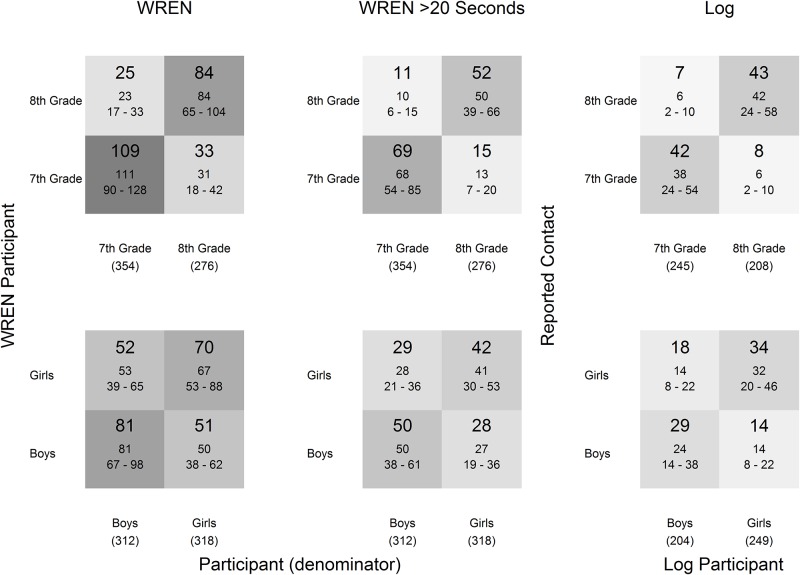
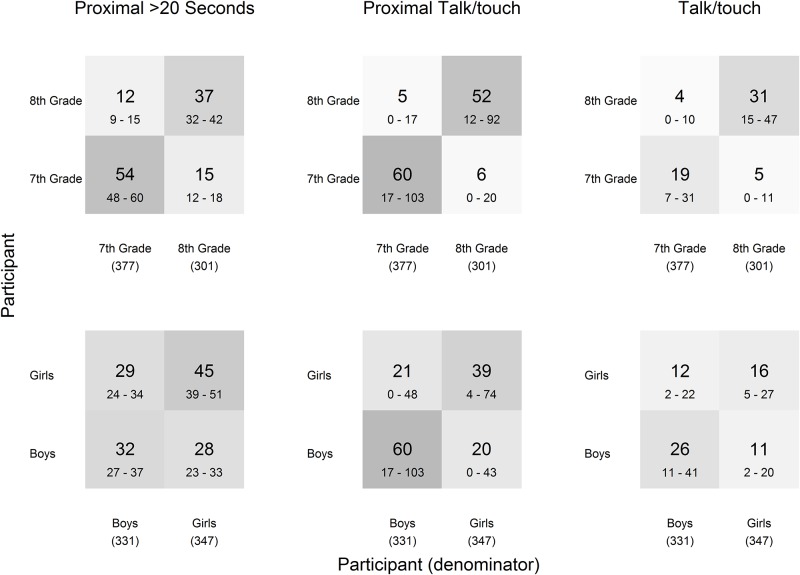
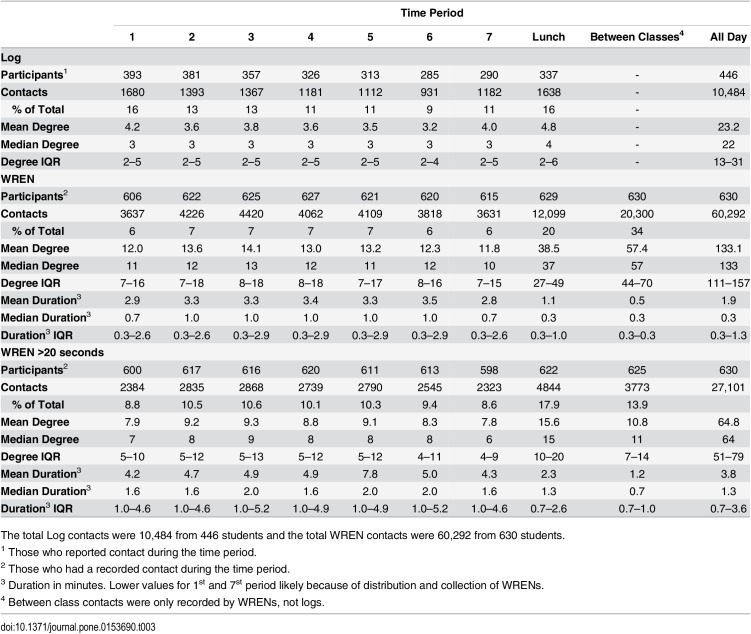
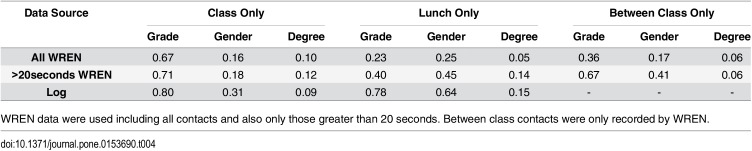
Description:Estimates of contact among children, used for infectious disease transmission models and understanding social patterns, historically rely on self-report logs. Recently, wireless sensor technology has enabled objective measurement of proximal contact and comparison of data from the two methods. These are mostly small-scale studies, and knowledge gaps remain in understanding contact and mixing patterns and also in the advantages and disadvantages of data collection methods. We collected contact data from a middle school, with 7th and 8th grades, for one day using self-report contact logs and wireless sensors. The data were linked for students with unique initials, gender, and grade within the school. This paper presents the results of a comparison of two approaches to characterize school contact networks, wireless proximity sensors and self-report logs. Accounting for incomplete capture and lack of participation, we estimate that "sensor-detectable", proximal contacts longer than 20 seconds during lunch and class-time occurred at 2 fold higher frequency than "self-reportable" talk/touch contacts. Overall, 55% of estimated talk-touch contacts were also sensor-detectable whereas only 15% of estimated sensor-detectable contacts were also talk-touch. Contacts detected by sensors and also in self-report logs had longer mean duration than contacts detected only by sensors (6.3 vs 2.4 minutes). During both lunch and class-time, sensor-detectable contacts demonstrated substantially less gender and grade assortativity than talk-touch contacts. Hallway contacts, which were ascertainable only by proximity sensors, were characterized by extremely high degree and short duration. We conclude that the use of wireless sensors and self-report logs provide complementary insight on in-school mixing patterns and contact frequency.
-
Subjects:
-
Source:PLoS One. 11(4).
-
Pubmed ID:27100090
-
Pubmed Central ID:PMC4839567
-
Document Type:
-
Volume:11
-
Issue:4
-
Collection(s):
-
Main Document Checksum:urn:sha256:26fda6232259290022e629c0f47dcdec78cab68f3d3d6de33a19f0009ef95a85
-
Download URL:
-
File Type:
 [PDF
- 1.20 MB
]
[PDF
- 1.20 MB
]
Supporting Files


File Language:
English
ON THIS PAGE



































CDC STACKS serves as an archival repository of CDC-published products including
scientific findings,
journal articles, guidelines, recommendations, or other public health information authored or
co-authored by CDC or funded partners.
As a repository, CDC STACKS retains documents in their original published format to ensure public access to scientific information.
As a repository, CDC STACKS retains documents in their original published format to ensure public access to scientific information.
You May Also Like
COLLECTION
CDC Public Access