


Impact of breast cancer subtypes on 3-year survival among adolescent and young adult women
Supporting Files

-
2013
-
File Language:
English
Details
-
Alternative Title:Breast Cancer Res
-
Personal Author:
-
Description:Introduction
Young women have poorer survival after breast cancer than do older women. It is unclear whether this survival difference relates to the unique distribution of hormone receptor (HR) and human epidermal growth factor receptor 2 (HER2)-defined molecular breast cancer subtypes among adolescent and young adult (AYA) women aged 15 to 39 years. The purpose of our study was to examine associations between breast cancer subtypes and short-term survival in AYA women, as well as to determine whether the distinct molecular subtype distribution among AYA women explains the unfavorable overall breast cancer survival statistics reported for AYA women compared with older women.
Methods
Data for 5,331 AYA breast cancers diagnosed between 2005 and 2009 were obtained from the California Cancer Registry. Survival by subtype (triple-negative; HR+/HER2-; HR+/HER2+; HR-/HER2+) and age-group (AYA versus 40- to 64-year-olds) was analyzed with Cox proportional hazards regression with follow-up through 2010.
Results
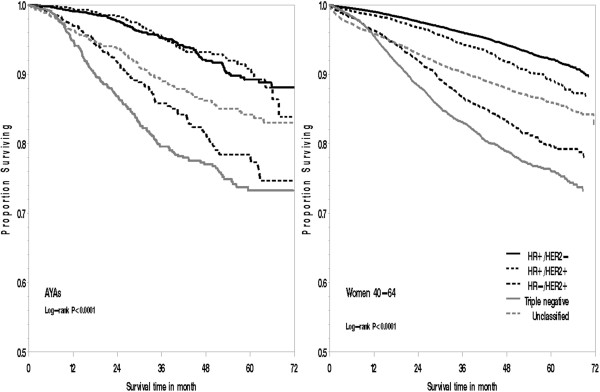
With up to 6 years of follow-up and a mean survival time of 3.1 years (SD = 1.5 years), AYA women diagnosed with HR-/HER + and triple-negative breast cancer experienced a 1.6-fold and 2.7-fold increased risk of death, respectively, from all causes (HR-/HER + hazard ratio: 1.55; 95% confidence interval (CI): 1.10 to 2.18; triple-negative HR: 2.75; 95% CI, 2.06 to 3.66) and breast cancer (HR-/HER + hazard ratio: 1.63; 95% CI, 1.12 to 2.36; triple-negative hazard ratio: 2.71; 95% CI, 1.98 to 3.71) than AYA women with HR+/HER2- breast cancer. AYA women who resided in lower socioeconomic status neighborhoods, had public health insurance, and were of Black, compared with White, race/ethnicity experienced worse survival. This race/ethnicity association was attenuated somewhat after adjusting for breast cancer subtypes (hazard ratio, 1.33; 95% CI, 0.98 to 1.82). AYA women had similar all-cause and breast cancer-specific short-term survival as older women for all breast cancer subtypes and across all stages of disease.
Conclusions
Among AYA women with breast cancer, short-term survival varied by breast cancer subtypes, with the distribution of breast cancer subtypes explaining some of the poorer survival observed among Black, compared with White, AYA women. Future studies should consider whether distribution of breast cancer subtypes and other factors, including differential receipt of treatment regimens, influences long-term survival in young compared with older women.
-
Subjects:
-
Source:Breast Cancer Res. 2013; 15(5):R95.
-
Pubmed ID:24131591
-
Pubmed Central ID:PMC3978627
-
Document Type:
-
Funding:
-
Place as Subject:
-
Volume:15
-
Issue:5
-
Collection(s):
-
Main Document Checksum:urn:sha256:8beaf612c87581d55e4062e0e72ee4f2c44f255d14a569318cfe85ef72d1a4fc
-
Download URL:
-
File Type:
 [PDF
- 376.42 KB
]
[PDF
- 376.42 KB
]
Supporting Files


File Language:
English
ON THIS PAGE

CDC STACKS serves as an archival repository of CDC-published products including
scientific findings,
journal articles, guidelines, recommendations, or other public health information authored or
co-authored by CDC or funded partners.
As a repository, CDC STACKS retains documents in their original published format to ensure public access to scientific information.
As a repository, CDC STACKS retains documents in their original published format to ensure public access to scientific information.
You May Also Like
COLLECTION
CDC Public Access