



Evolutionary history of rat-borne Bartonella: the importance of commensal rats in the dissemination of bacterial infections globally
Supporting Files
Public Domain

-
Aug 06 2013
Details
-
Alternative Title:Ecol Evol
-
Personal Author:
-
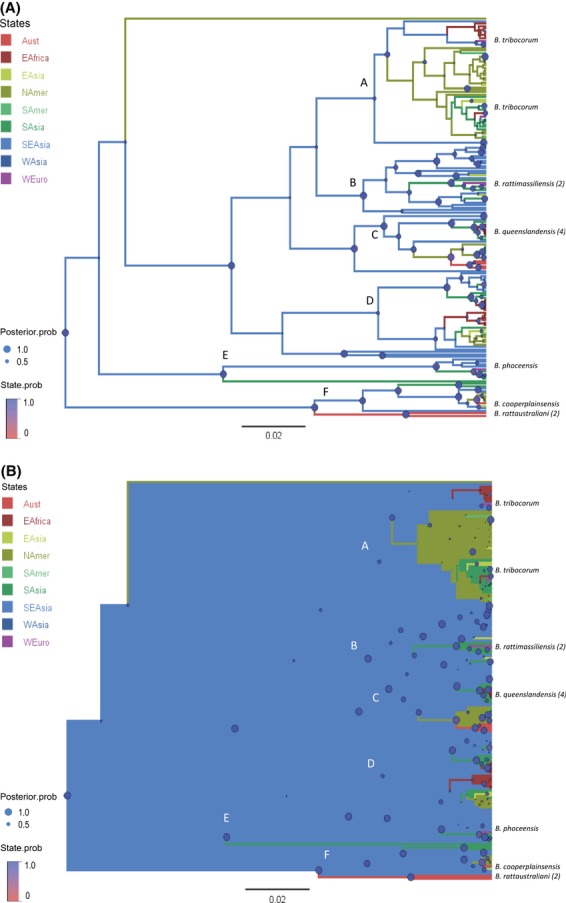
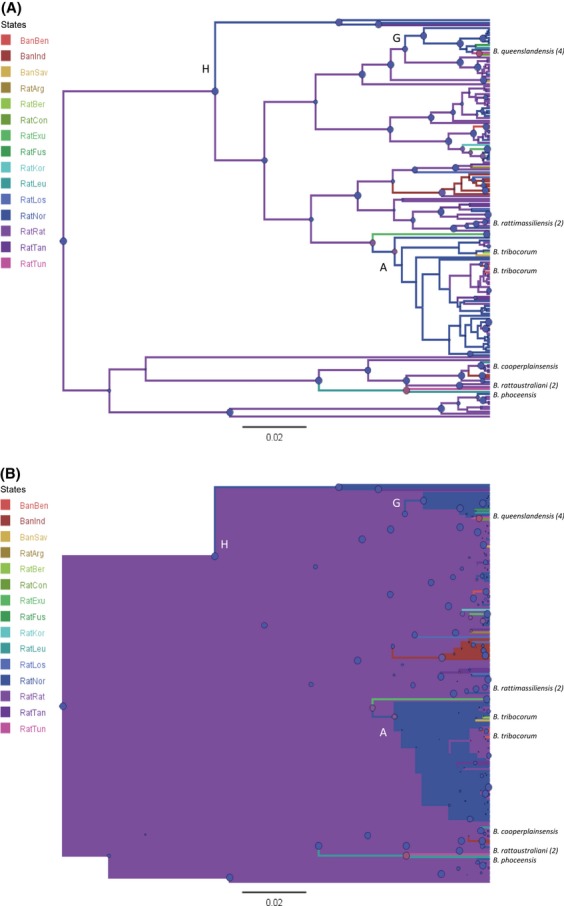
Description:Emerging pathogens that originate from invasive species have caused numerous significant epidemics. Some bacteria of genus Bartonella are rodent-borne pathogens that can cause disease in humans and animals alike. We analyzed gltA sequences of 191 strains of rat-associated bartonellae from 29 rodent species from 17 countries to test the hypotheses that this bacterial complex evolved and diversified in Southeast Asia before being disseminated by commensal rats Rattus rattus (black rat) and Rattus norvegicus (Norway rat) to other parts of the globe. The analysis suggests that there have been numerous dispersal events within Asia and introductions from Asia to other regions, with six major clades containing Southeast Asian isolates that appear to have been dispersed globally. Phylogeographic analyses support the hypotheses that these bacteria originated in Southeast Asia and commensal rodents (R. rattus and R. norvegicus) play key roles in the evolution and dissemination of this Bartonella complex throughout the world.
-
Subjects:
-
Source:Ecol Evol. 2013; 3(10):3195-3203.
-
Document Type:
-
Volume:3
-
Issue:10
-
Collection(s):
-
Main Document Checksum:urn:sha256:02bf2c4178361537b3735a5e84157f563f1029bfeb7e4ce4ec71b2c8156804ee
-
Download URL:
-
File Type:
 [PDF
- 845.58 KB
]
[PDF
- 845.58 KB
]
Supporting Files


 Was this page helpful?
 Found an issue?


CDC STACKS serves as an archival repository of CDC-published products including
scientific findings,
journal articles, guidelines, recommendations, or other public health information authored or
co-authored by CDC or funded partners.
As a repository, CDC STACKS retains documents in their original published format to ensure public access to scientific information.
As a repository, CDC STACKS retains documents in their original published format to ensure public access to scientific information.
You May Also Like
COLLECTION
CDC Public Access