


Migration and Persistence of Human Influenza A Viruses, Vietnam, 2001–2008
Supporting Files

-
Nov 2013
-
File Language:
English
Details
-
Alternative Title:Emerg Infect Dis
-
Personal Author:
-
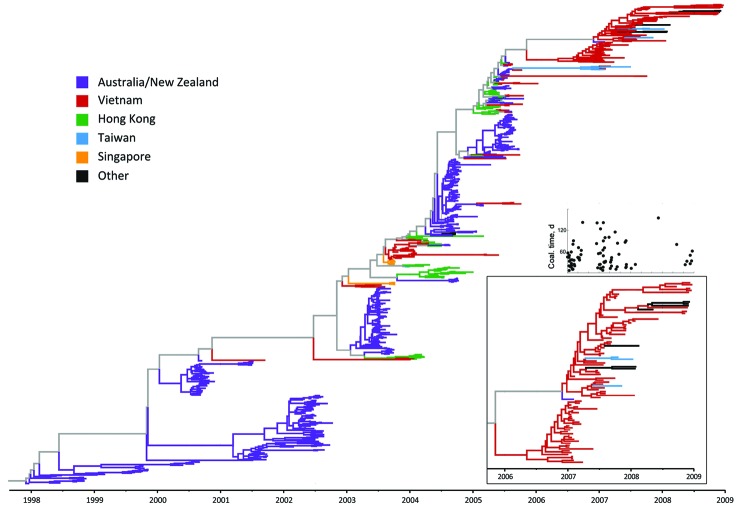
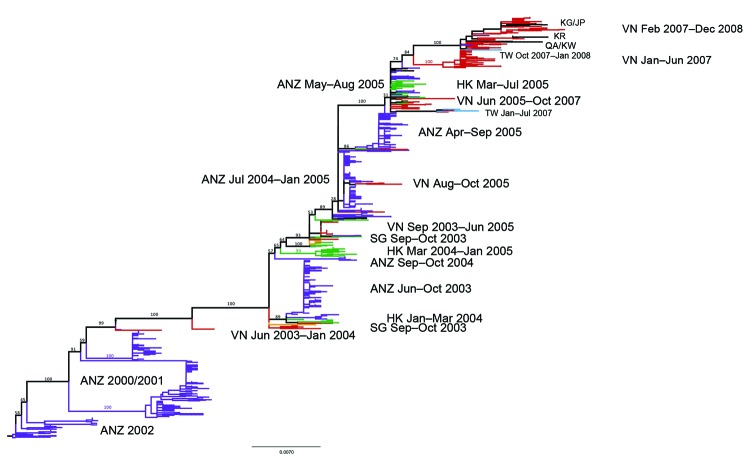
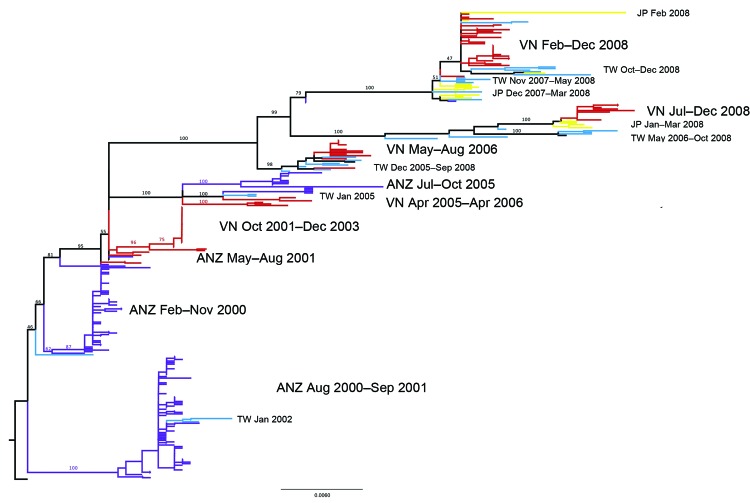
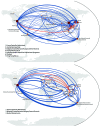
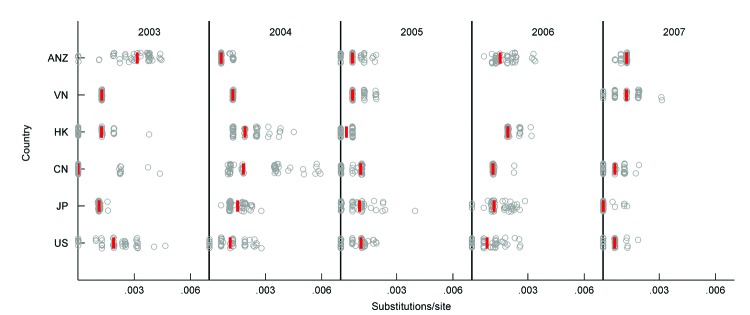
Description:Understanding global influenza migration and persistence is crucial for vaccine strain selection. Using 240 new human influenza A virus whole genomes collected in Vietnam during 2001-2008, we looked for persistence patterns and migratory connections between Vietnam and other countries. We found that viruses in Vietnam migrate to and from China, Hong Kong, Taiwan, Cambodia, Japan, South Korea, and the United States. We attempted to reduce geographic bias by generating phylogenies subsampled at the year and country levels. However, migration events in these phylogenies were still driven by the presence or absence of sequence data, indicating that an epidemiologic study design that controls for prevalence is required for robust migration analysis. With whole-genome data, most migration events are not detectable from the phylogeny of the hemagglutinin segment alone, although general migratory relationships between Vietnam and other countries are visible in the hemagglutinin phylogeny. It is possible that virus lineages in Vietnam persisted for >1 year.
-
Subjects:
-
Source:Emerg Infect Dis. 19(11):1756-1765.
-
Document Type:
-
Funding:
-
Place as Subject:
-
Volume:19
-
Issue:11
-
Collection(s):
-
Main Document Checksum:urn:sha256:cae7473b136c34e4cfd833112ae9c22af9bed8c51d155c57dc0ba4462b9f14e7
-
Download URL:
-
File Type:
 [PDF
- 711.84 KB
]
[PDF
- 711.84 KB
]
Supporting Files


File Language:
English
ON THIS PAGE




CDC STACKS serves as an archival repository of CDC-published products including
scientific findings,
journal articles, guidelines, recommendations, or other public health information authored or
co-authored by CDC or funded partners.
As a repository, CDC STACKS retains documents in their original published format to ensure public access to scientific information.
As a repository, CDC STACKS retains documents in their original published format to ensure public access to scientific information.
You May Also Like
COLLECTION
Emerging Infectious Diseases