



Managed-Medicare Health Club Benefit and Reduced Health Care Costs Among Older Adults
Supporting Files
Public Domain

-
Dec 15 2007
File Language:
English
Details
-
Journal Article:Preventing Chronic Disease (PCD)
-
Personal Author:
-
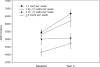
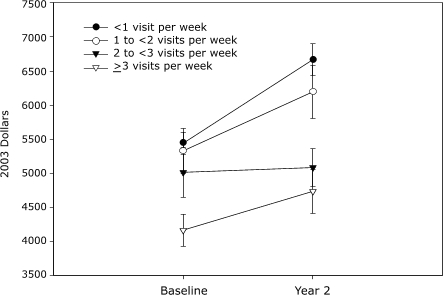
Description:Introduction ; Our study was undertaken to determine the association between use of a health plan-sponsored health club benefit by older adults and total health care costs over 2 years. ; Methods ; This retrospective cohort study used administrative and claims data from a Medicare Advantage plan. Participants (n = 4766) were enrolled in the plan for at least 1 year before participating in the plan-sponsored health club benefit (Silver Sneakers). Controls (n = 9035) were matched to participants by age and sex according to the index date of Silver Sneakers enrollment. Multivariate regression models were used to estimate health care use and costs and to make subgroup comparisons according to frequency of health club visits. ; Results ; Compared with controls, Silver Sneakers participants were older and more likely to be male, used more preventive services, and had higher total health care costs at baseline. Adjusted total health care costs for Silver Sneakers participants and controls did not differ significantly in year 1. By year 2, compared with controls, Silver Sneakers participants had significantly fewer inpatient admissions (−2.3%, 95% confidence interval, −3.3% to −1.2%; P < .001) and lower total health care costs (−$500; 95% confidence interval, −$892 to −$106; P = .01. Silver Sneakers participants who averaged at least two health club visits per week over 2 years incurred at least $1252 (95% confidence interval, −$1937 to −$567; P < .001) less in health care costs in year 2 than did those who visited on average less than once per week. ; Conclusion ; Regular use of a health club benefit was associated with slower growth in total health care costs in the long term but not in the short term. These findings warrant additional prospective investigations to determine whether policies to offer health club benefits and promote physical activity among older adults can reduce increases in health care costs.
-
Subjects:
- Original Research
- Age Factors
- Aged
- Case-Control Studies
- Confidence Intervals
- Cost Savings
- Female
- Fitness Centers
- Health Care Costs
- Health Promotion
- Humans
- Insurance Benefits
- Male
- Managed Care Programs
- Medicare Part C
- Multivariate Analysis
- Physical Fitness
- Probability
- Reference Values
- Retrospective Studies
- Sex Factors
-
Source:Prev Chronic Dis. 2008; 5(1).
-
ISSN:1545-1151
-
Document Type:
-
Place as Subject:
-
Location:
-
Volume:5
-
Issue:1
-
Download URL:
-
File Type:
 [PDF - 501.11 KB]
 -
Collection(s):
-
Main Document Checksum:urn:sha-512:b1da2804618611d1c2117ef96bc404a1d492621f45ba80cc0e52714beb8ac28bb99972a968fbace45c49f8425bba0a961ccd129d88eeed9f09d4783aafd96815
Supporting Files


File Language:
English
 Was this page helpful?
 Found an issue?

CDC STACKS serves as an archival repository of CDC-published products including
scientific findings, journal articles, guidelines, recommendations, or other public health information authored or
co-authored by CDC or funded partners.
As a repository, CDC STACKS retains documents in their original published format to ensure public access to scientific information.
As a repository, CDC STACKS retains documents in their original published format to ensure public access to scientific information.
You May Also Like
COLLECTION
Preventing Chronic Disease