


Autochthonous and Dormant Cryptococcus gattii Infections in Europe
Supporting Files
Public Domain

-
Oct 2012
-
File Language:
English
Details
-
Alternative Title:Emerg Infect Dis
-
Personal Author:Hagen, Ferry ; Colom, M. Francisca ; Swinne, Daniëlle ; Tintelnot, Kathrin ; Iatta, Roberta ; Montagna, Maria Teresa ; Torres-Rodriguez, Josep M. ; Cogliati, Massimo ; Velegraki, Aristea ; Burggraaf, Arjan ; Kamermans, Alwin ; Sweere, Johanna M. ; Meis, Jacques F. ; Klaassen, Corné H.W. ; Boekhout, Teun
-
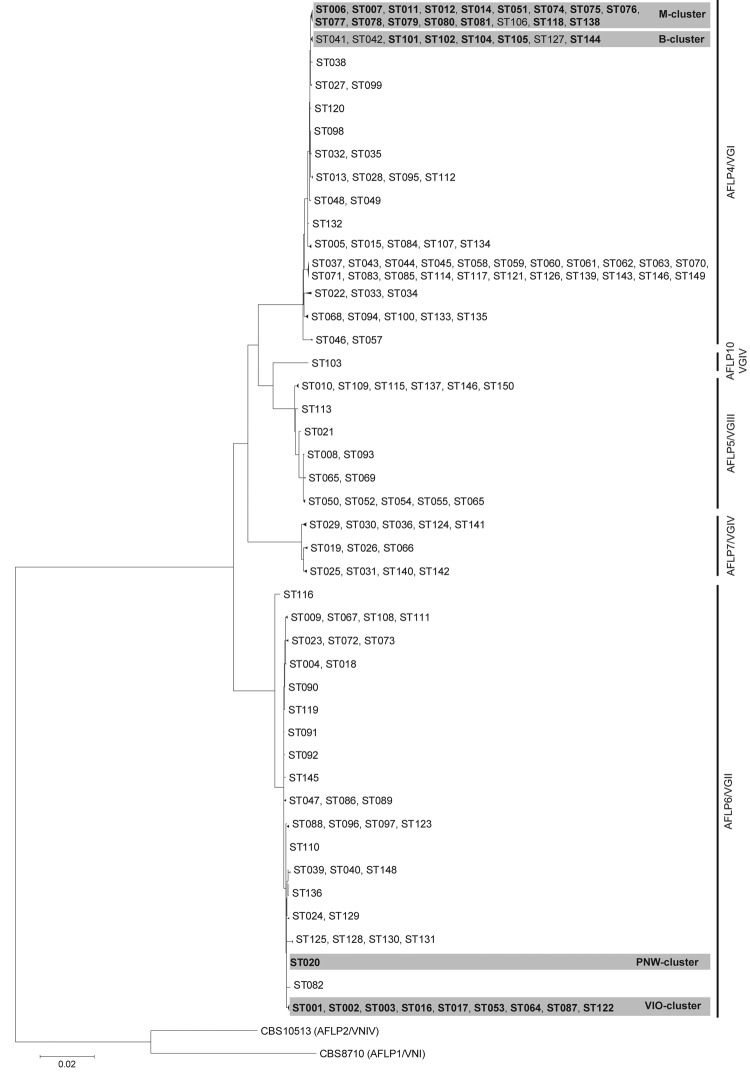
Description:Until recently, Cryptococcus gattii infections occurred mainly in tropical and subtropical climate zones. However, during the past decade, C. gattii infections in humans and animals in Europe have increased. To determine whether the infections in Europe were acquired from an autochthonous source or associated with travel, we used multilocus sequence typing to compare 100 isolates from Europe (57 from 40 human patients, 22 from the environment, and 21 from animals) with 191 isolates from around the world. Of the 57 human patient isolates, 47 (83%) were obtained since 1995. Among the 40 patients, 24 (60%) probably acquired the C. gattii infection outside Europe; the remaining 16 (40%) probably acquired the infection within Europe. Human patient isolates from Mediterranean Europe clustered into a distinct genotype with animal and environmental isolates. These results indicate that reactivation of dormant C. gattii infections can occur many years after the infectious agent was acquired elsewhere.
-
Subjects:
-
Source:Emerg Infect Dis. 18(10):1618-1624.
-
Document Type:
-
Place as Subject:
-
Location:
-
Volume:18
-
Issue:10
-
Collection(s):
-
Main Document Checksum:urn:sha256:9202e094ee384bef1367da660c647a33d87bc01d314235d1f5595280913b0a15
-
Download URL:
-
File Type:
 [PDF
- 216.99 KB
]
[PDF
- 216.99 KB
]
Supporting Files


File Language:
English
ON THIS PAGE

CDC STACKS serves as an archival repository of CDC-published products including
scientific findings,
journal articles, guidelines, recommendations, or other public health information authored or
co-authored by CDC or funded partners.
As a repository, CDC STACKS retains documents in their original published format to ensure public access to scientific information.
As a repository, CDC STACKS retains documents in their original published format to ensure public access to scientific information.
You May Also Like
COLLECTION
Emerging Infectious Diseases