



Outbreaks of Pandemic (H1N1) 2009 and Seasonal Influenza A (H3N2) on Cruise Ship
Supporting Files
Public Domain

-
Nov 2010
File Language:
English
Details
-
Journal Article:Emerg Infect Dis
-
Personal Author:
-
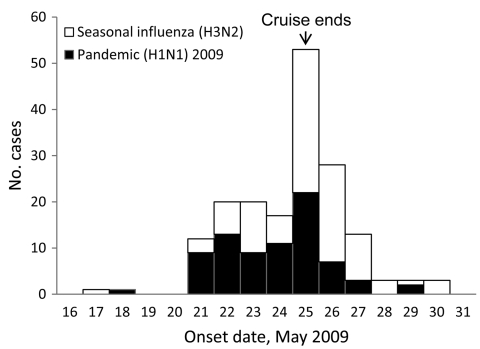
Description:To determine the extent and pattern of influenza transmission and effectiveness of containment measures, we investigated dual outbreaks of pandemic (H1N1) 2009 and influenza A (H3N2) that had occurred on a cruise ship in May 2009. Of 1,970 passengers and 734 crew members, 82 (3.0%) were infected with pandemic (H1N1) 2009 virus, 98 (3.6%) with influenza A (H3N2) virus, and 2 (0.1%) with both. Among 45 children who visited the ship's childcare center, infection rate for pandemic (H1N1) 2009 was higher than that for influenza A (H3N2) viruses. Disembarked passengers reported a high level of compliance with isolation and quarantine recommendations. We found 4 subsequent cases epidemiologically linked to passengers but no evidence of sustained transmission to the community or passengers on the next cruise. Among this population of generally healthy passengers, children seemed more susceptible to pandemic (H1N1) 2009 than to influenza (H3N2) viruses. Intensive disease control measures successfully contained these outbreaks.
-
Subjects:
-
Source:Emerg Infect Dis. 16(11):1731-1737.
-
Document Type:
-
Volume:16
-
Issue:11
-
Download URL:
-
File Type:
 [PDF - 231.72 KB]
 -
Collection(s):
-
Main Document Checksum:urn:sha-512:3106185bdc607b65995fa9643082804b52e19dcc2c373866e3f9909c4b2e23df3e028aa660e003b17c99654b8a23cb564be8b92ffd653692c191fda4f325c7d2
Supporting Files


File Language:
English
 Was this page helpful?
 Found an issue?

CDC STACKS serves as an archival repository of CDC-published products including
scientific findings, journal articles, guidelines, recommendations, or other public health information authored or
co-authored by CDC or funded partners.
As a repository, CDC STACKS retains documents in their original published format to ensure public access to scientific information.
As a repository, CDC STACKS retains documents in their original published format to ensure public access to scientific information.
You May Also Like
COLLECTION
Emerging Infectious Diseases