



Entomologic and Virologic Investigation of Chikungunya, Singapore
Supporting Files
Public Domain

-
Aug 2009
Details
-
Alternative Title:Emerg Infect Dis
-
Personal Author:
-
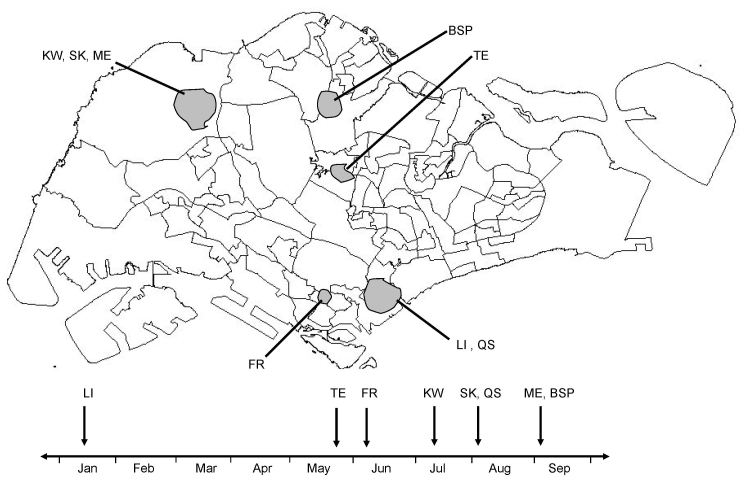
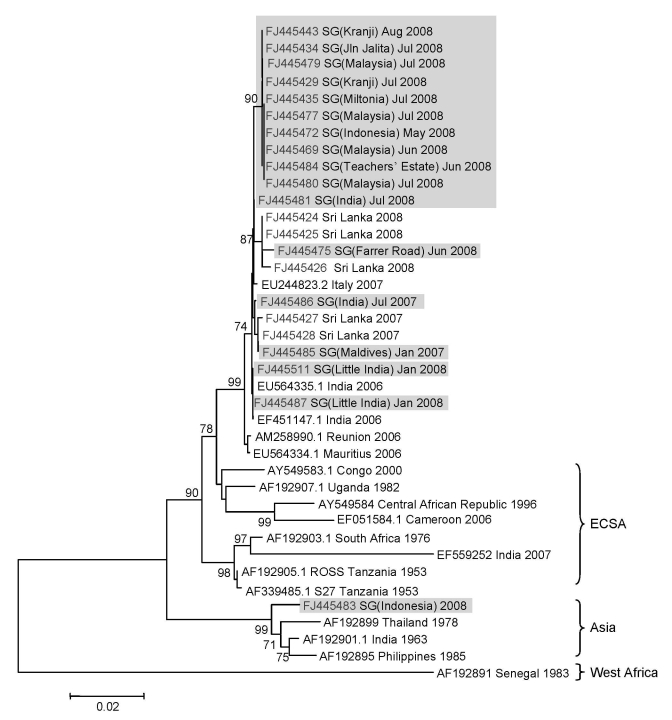
Description:Local transmission of chikungunya, a debilitating mosquito-borne viral disease, was first reported in Singapore in January 2008. After 3 months of absence, locally acquired Chikungunya cases resurfaced in May 2008, causing an outbreak that resulted in a total of 231 cases by September 2008. The circulating viruses were related to East, Central, and South African genotypes that emerged in the Indian Ocean region in 2005. The first local outbreak was due to a wild-type virus (alanine at codon 226 of the envelope 1 gene) and occurred in an area where Aedes aegypti mosquitoes were the primary vector. Strains isolated during subsequent outbreaks showed alanine to valine substitution (A226V) and largely spread in areas predominated by Ae. albopictus mosquitoes. These findings led to a revision of the current vector control strategy in Singapore. This report highlights the use of entomologic and virologic data to assist in the control of chikungunya in disease-endemic areas.
-
Subjects:
- Research
- Chikungunya
- chikungunya virus
- surveillance
- entomology
- virology
- sequencing
- phylogenetic analysis
- Singapore
- viruses
- research
- Aedes
- Alphavirus Infections
- Amino Acid Substitution
- Animals
- Base Sequence
- Chikungunya virus
- Communicable Diseases, Emerging
- DNA Primers
- DNA, Viral
- Disease Outbreaks
- Genes, env
- Humans
- Insect Vectors
- Molecular Epidemiology
- Phylogeny
- Viral Envelope Proteins
-
Source:Emerg Infect Dis. 15(8):1243-1249.
-
Document Type:
-
Volume:15
-
Issue:8
-
Download URL:
-
File Type:
 [PDF - 569.97 KB]
 -
Collection(s):
-
Main Document Checksum:urn:sha256:41563fc9bc79d842e9ee6132363f8eb4c01da303656beff3b5357e84004e54b2
Supporting Files


 Was this page helpful?
 Found an issue?

CDC STACKS serves as an archival repository of CDC-published products including
scientific findings, journal articles, guidelines, recommendations, or other public health information authored or
co-authored by CDC or funded partners.
As a repository, CDC STACKS retains documents in their original published format to ensure public access to scientific information.
As a repository, CDC STACKS retains documents in their original published format to ensure public access to scientific information.
You May Also Like
COLLECTION
Emerging Infectious Diseases