



Effects of blood lead levels <10 µg/dL in school-age children and adolescents: a scoping review
Supporting Files

-
10 01 2024 ; 10-01-
-
Available in CDC Stacks on October 01, 2025, 12:00 AM
File Language:
English
Details
-
Alternative Title:Pediatrics
-
Personal Author:
-
Description:Context:
Lead exposures among school-age children are a major public health issue. While the harmful effects of lead exposure during the first years of life are well known, there is not as much understanding of the effects of low levels of lead exposure during later childhood.
Objective:
To review the effects of blood lead levels (BLLs) <10 µg/dL in school-age children and adolescents
Data Sources:
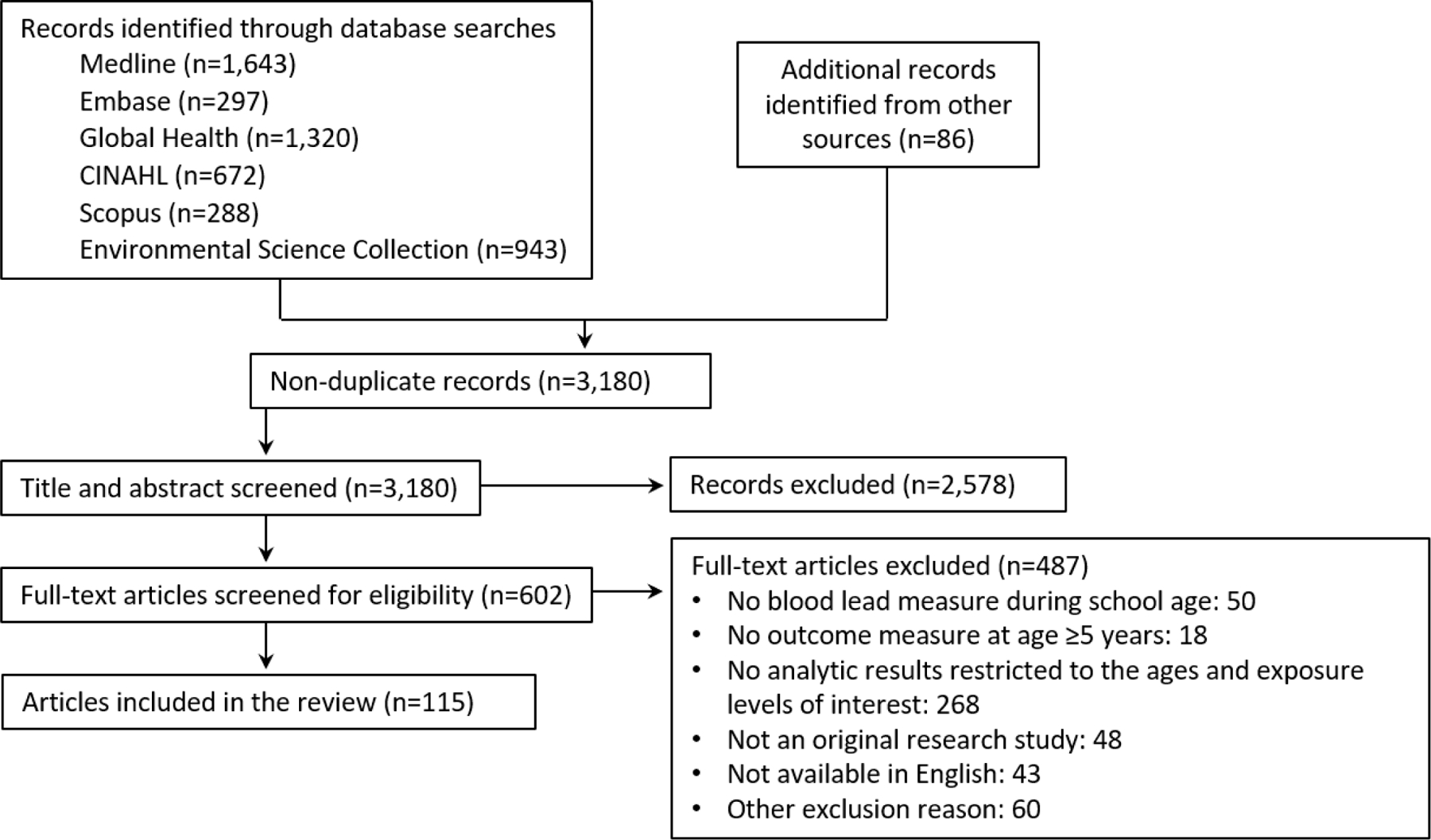
We searched Medline, Embase, Global health, CINAHL, Scopus, and Environmental Science Collection databases between January 1, 2000, and May 11, 2023.
Study Selection:
We included peer-reviewed English-language articles that presented data on the effects of BLLs <10 µg/dL in individuals ages 5 through 18 years.
Data Extraction:
Data on country, population, analytic design, sample size, age, BLLs, outcomes, covariates, and results were extracted.
Results:
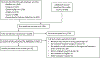
Overall, 115 of 3,180 screened articles met the inclusion criteria. The reported mean or median BLL was <5 µg/dL in 98 articles (85%). Of the included articles, 89 (77%) presented some evidence of an association between BLLs <10 µg/dL during school age and detrimental outcomes in a wide range of categories. The strongest evidence of an association was for the outcomes of intelligence quotient (IQ), and attention-deficit/hyperactivity disorder (ADHD) diagnoses or behaviors.
Limitations:
Few articles controlled for BLLs at age younger than 5 years, limiting conclusions about the relation between later BLLs and outcomes
Conclusions:
BLLs <10 µg/dL in school-age children and adolescents may be associated with negative outcomes. This review highlights areas that could benefit from additional investigation. -
Subjects:
-
Source:Pediatrics. 154(Suppl 2)
-
Pubmed ID:39352036
-
Pubmed Central ID:PMC11610497
-
Document Type:
-
Funding:
-
Volume:154
-
Download URL:
-
File Type:
 [PDF - 248.24 KB]
 -
Collection(s):
-
Main Document Checksum:urn:sha-512:696da838fb5810ee221bcefc67d34cfbb4a6952467a82d09f2dfeecac2a33ef31975385900501380fc0961dc182eefbacaa6ee56a535e9049d02fc10bb7a1da1
Supporting Files


File Language:
English
 Was this page helpful?
 Found an issue?

CDC STACKS serves as an archival repository of CDC-published products including
scientific findings, journal articles, guidelines, recommendations, or other public health information authored or
co-authored by CDC or funded partners.
As a repository, CDC STACKS retains documents in their original published format to ensure public access to scientific information.
As a repository, CDC STACKS retains documents in their original published format to ensure public access to scientific information.
You May Also Like
COLLECTION
CDC Public Access