



Detection and Prevalence Patterns of Group I Coronaviruses in Bats, Northern Germany
Supporting Files
Public Domain

-
Apr 2008
File Language:
English
Details
-
Alternative Title:Emerg Infect Dis
-
Personal Author:Gloza-Rausch, Florian ; Ipsen, Anne ; Seebens, Antje ; Göttsche, Matthias ; Panning, Marcus ; Drexler, Jan Felix ; Petersen, Nadine ; Annan, Augustina ; Grywna, Klaus ; Müller, Marcel ; Pfefferle, Susanne ; Drosten, Christian
-
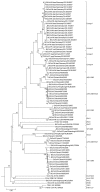
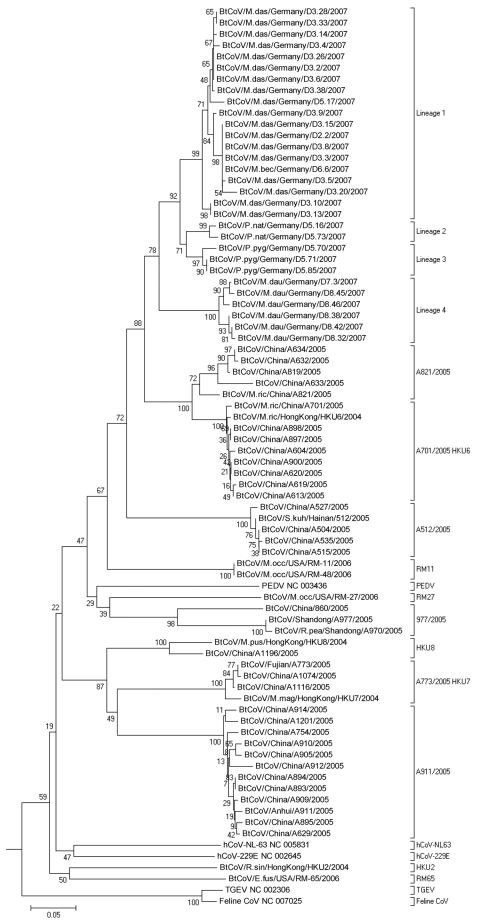
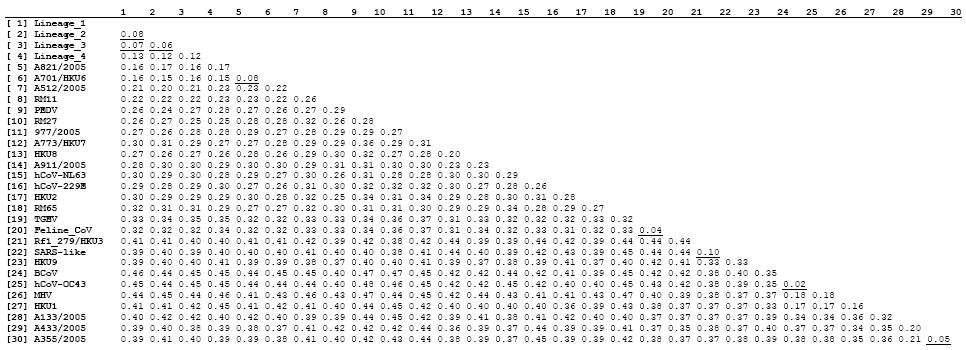
Description:We tested 315 bats from 7 different bat species in northern Germany for coronaviruses by reverse transcription-PCR. The overall prevalence was 9.8%. There were 4 lineages of group I coronaviruses in association with 4 different species of verspertilionid bats (Myotis dasycneme, M. daubentonii, Pipistrellus nathusii, P. pygmaeus). The lineages formed a monophyletic clade of bat coronaviruses found in northern Germany. The clade of bat coronaviruses have a sister relationship with a clade of Chinese type I coronaviruses that were also associated with the Myotis genus (M. ricketti). Young age and ongoing lactation, but not sex or existing gravidity, correlated significantly with coronavirus detection. The virus is probably maintained on the population level by amplification and transmission in maternity colonies, rather than being maintained in individual bats.
-
Subjects:
-
Source:Emerg Infect Dis. 14(4):626-631.
-
Document Type:
-
Place as Subject:
-
Volume:14
-
Issue:4
-
Download URL:
-
File Type:
 [PDF - 324.97 KB]
 -
Collection(s):
-
Main Document Checksum:urn:sha256:bd44e39090787469b26af2790cfecda8a8f5b00aacbe509c4b20471f89416172
Supporting Files


File Language:
English
 Was this page helpful?
 Found an issue?



CDC STACKS serves as an archival repository of CDC-published products including
scientific findings, journal articles, guidelines, recommendations, or other public health information authored or
co-authored by CDC or funded partners.
As a repository, CDC STACKS retains documents in their original published format to ensure public access to scientific information.
As a repository, CDC STACKS retains documents in their original published format to ensure public access to scientific information.
You May Also Like
COLLECTION
Emerging Infectious Diseases