



Ecologic Factors Associated with West Nile Virus Transmission, Northeastern United States
Supporting Files
Public Domain

-
Oct 2008
File Language:
English
Details
-
Alternative Title:Emerg Infect Dis
-
Personal Author:
-
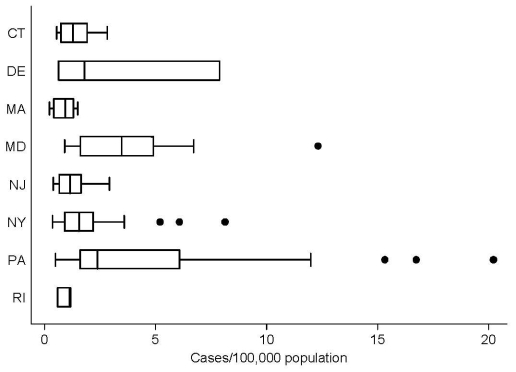
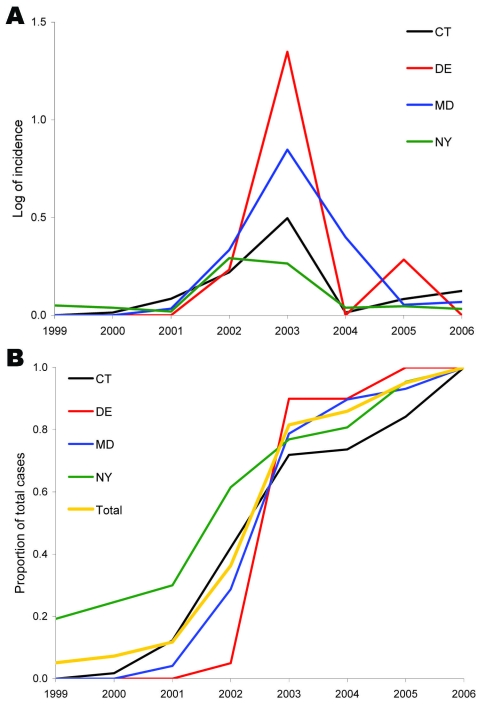
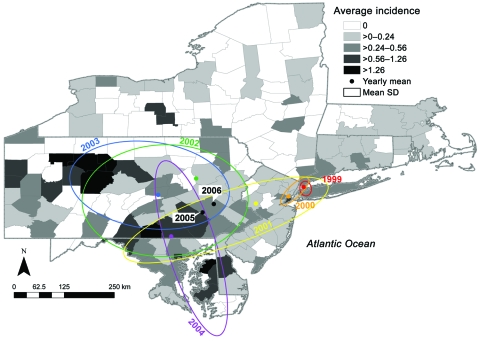
Description:Since 1999, West Nile virus (WNV) disease has affected the northeastern United States. To describe the spatial epidemiology and identify risk factors for disease incidence, we analyzed 8 years (1999-2006) of county-based human WNV disease surveillance data. Among the 56.6 million residents in 8 northeastern states sharing primary enzootic vectors, we found 977 cases. We controlled for population density and potential bias from surveillance and spatial proximity. Analyses demonstrated significant spatial spreading from 1999 through 2004 (p<0.01, r2 = 0.16). A significant trend was apparent among increasingly urban counties; county quartiles with the least (<38%) forest cover had 4.4-fold greater odds (95% confidence interval CI 1.4-13.2, p = 0.01) of having above-median disease incidence (>0.75 cases/100,000 residents) than counties with the most (>70%) forest cover. These results quantify urbanization as a risk factor for WNV disease incidence and are consistent with knowledge of vector species in this area.
-
Subjects:
-
Source:Emerg Infect Dis. 14(10):1539-1545
-
Pubmed ID:18826816
-
Pubmed Central ID:PMC2609885
-
Document Type:
-
Volume:14
-
Issue:10
-
Download URL:
-
File Type:
 [PDF - 191.15 KB]
 -
Collection(s):
-
Main Document Checksum:urn:sha256:f49131ca22602b31f8c4c103b10a687aa5bae80578dba6c28465aa4cfb5cde92
Supporting Files


File Language:
English
 Was this page helpful?
 Found an issue?


CDC STACKS serves as an archival repository of CDC-published products including
scientific findings, journal articles, guidelines, recommendations, or other public health information authored or
co-authored by CDC or funded partners.
As a repository, CDC STACKS retains documents in their original published format to ensure public access to scientific information.
As a repository, CDC STACKS retains documents in their original published format to ensure public access to scientific information.
You May Also Like
COLLECTION
Emerging Infectious Diseases