



Genome Analysis Linking Recent European and African Influenza (H5N1) Viruses
Supporting Files

-
May 2007
File Language:
English
Details
-
Alternative Title:Emerg Infect Dis
-
Personal Author:Salzberg, Steven L. ; Kingsford, Carl ; Cattoli, Giovanni ; Spiro, David J. ; Janies, Daniel A. ; Aly, Mona Mehrez ; Brown, Ian H. ; Couacy-Hymann, Emmanuel ; De Mia, Gian Mario ; Dung, Do Huu ; Guercio, Annalisa ; Joannis, Tony ; Ali, Ali Safar Maken ; Osmani, Azizullah ; Padalino, Iolanda ; Saad, Magdi D. ; Savić, Vladimir ; Sengamalay, Naomi A. ; Yingst, Samuel ; Zaborsky, Jennifer ; Zorman-Rojs, Olga ; Ghedin, Elodie ; Capua, Ilaria
-
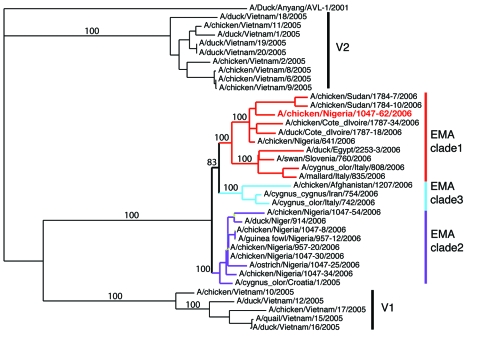
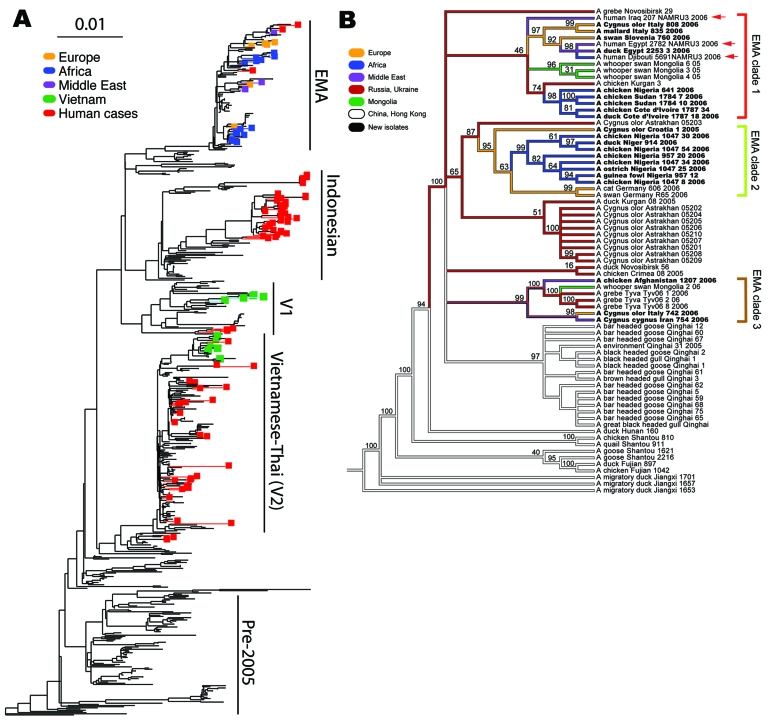
Description:To better understand the ecology and epidemiology of the highly pathogenic avian influenza virus in its transcontinental spread, we sequenced and analyzed the complete genomes of 36 recent influenza A (H5N1) viruses collected from birds in Europe, northern Africa, and southeastern Asia. These sequences, among the first complete genomes of influenza (H5N1) viruses outside Asia, clearly depict the lineages now infecting wild and domestic birds in Europe and Africa and show the relationships among these isolates and other strains affecting both birds and humans. The isolates fall into 3 distinct lineages, 1 of which contains all known non-Asian isolates. This new Euro-African lineage, which was the cause of several recent (2006) fatal human infections in Egypt and Iraq, has been introduced at least 3 times into the European-African region and has split into 3 distinct, independently evolving sublineages. One isolate provides evidence that 2 of these sublineages have recently reassorted.
-
Subjects:
-
Source:Emerg Infect Dis. 13(5):713-718.
-
Document Type:
-
Funding:
-
Place as Subject:
-
Volume:13
-
Issue:5
-
Download URL:
-
File Type:
 [PDF - 317.25 KB]
 -
Collection(s):
-
Main Document Checksum:urn:sha256:54b6c96c8f3400f6d7dbf2b65249eff3099ce3aed9bd72b199217a749f32e371
Supporting Files


File Language:
English
 Was this page helpful?
 Found an issue?


CDC STACKS serves as an archival repository of CDC-published products including
scientific findings, journal articles, guidelines, recommendations, or other public health information authored or
co-authored by CDC or funded partners.
As a repository, CDC STACKS retains documents in their original published format to ensure public access to scientific information.
As a repository, CDC STACKS retains documents in their original published format to ensure public access to scientific information.
You May Also Like
COLLECTION
Emerging Infectious Diseases