



Epidemiology of Nontuberculous Mycobacteria in Patients without HIV Infection, New York City
Supporting Files
Public Domain

-
Mar 2008
File Language:
English
Details
-
Alternative Title:Emerg Infect Dis
-
Personal Author:
-
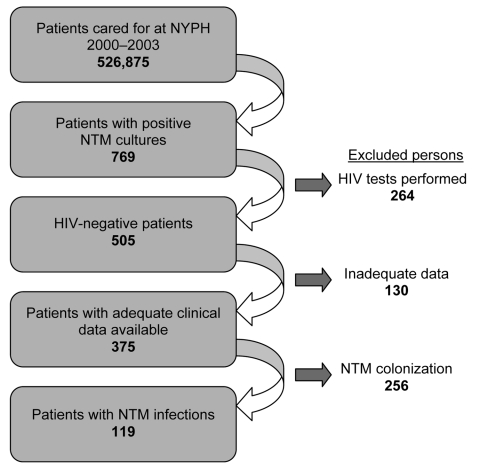
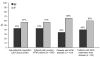
Description:We reviewed medical records of patients without known HIV and with positive cultures for nontuberculous mycobacteria (NTM) isolated during 2000-2003 from 1 large hospital in New York, New York. Overall, 505 patients had positive NTM cultures; 119 (24%) met the criteria for NTM disease. The difference between demographic characteristics of case-patients in our study (66% female, 61% white, and 59% > 60 years of age) and those of the base population as determined by regional census data was statistically significant. Estimated incidences for positive cultures, all disease, and respiratory tract disease were 17.7, 2.7, and 2.0 per 100,000 persons, respectively. More patients with rapidly growing mycobacteria (61%), Mycobacterium kansasii (70%), or M. marinum (100%) met criteria for disease than did patients with M. avium complex (MAC) (27%, (p < 0.01). NTM disease in patients without HIV is increasing. Laboratory-based surveillance may be useful for detecting non-MAC and non-respiratory tract disease.
-
Subjects:
-
Source:Emerg Infect Dis. 14(3):390-396.
-
Document Type:
-
Place as Subject:
-
Volume:14
-
Issue:3
-
Download URL:
-
File Type:
 [PDF - 190.40 KB]
 -
Collection(s):
-
Main Document Checksum:urn:sha256:d8e8b67cd823d1d13cf181b2c473c734b4f578a9ca60229e678b85b82ba84685
Supporting Files


File Language:
English
 Was this page helpful?
 Found an issue?



CDC STACKS serves as an archival repository of CDC-published products including
scientific findings, journal articles, guidelines, recommendations, or other public health information authored or
co-authored by CDC or funded partners.
As a repository, CDC STACKS retains documents in their original published format to ensure public access to scientific information.
As a repository, CDC STACKS retains documents in their original published format to ensure public access to scientific information.
You May Also Like
COLLECTION
Emerging Infectious Diseases