



Person-to-Person Transmission of Nipah Virus in a Bangladeshi Community
Supporting Files
Public Domain

-
Jul 2007
File Language:
English
Details
-
Alternative Title:Emerg Infect Dis
-
Personal Author:Gurley, Emily S. ; Montgomery, Joel M. ; Hossain, M. Jahangir ; Bell, Michael ; Azad, Abul Kalam ; Islam, Mohammed Rafiqul ; Molla, Mohammed Abdur Rahim ; Carroll, Darin S. ; Ksiazek, Thomas G. ; Rota, Paul A. ; Lowe, Luis ; Comer, James A. ; Rollin, Pierre ; Czub, Markus ; Grolla, Allen ; Feldmann, Heinz ; Luby, Stephen P. ; Woodward, Jennifer L. ; Breiman, Robert F.
-
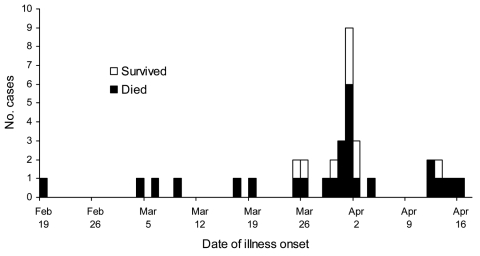
Description:An encephalitis outbreak was investigated in Faridpur District, Bangladesh, in April-May 2004 to determine the cause of the outbreak and risk factors for disease. Biologic specimens were tested for Nipah virus. Surfaces were evaluated for Nipah virus contamination by using reverse transcription-PCR (RT-PCR). Thirty-six cases of Nipah virus illness were identified; 75% of case-patients died. Multiple peaks of illness occurred, and 33 case-patients had close contact with another Nipah virus patient before their illness. Results from a case-control study showed that contact with 1 patient carried the highest risk for infection (odds ratio 6.7, 95% confidence interval 2.9-16.8, p < 0.001). RT-PCR testing of environmental samples confirmed Nipah virus contamination of hospital surfaces. This investigation provides evidence for person-to-person transmission of Nipah virus. Capacity for person-to-person transmission increases the potential for wider spread of this highly lethal pathogen and highlights the need for infection control strategies for resource-poor settings.
-
Subjects:
- Research
- Adolescent
- Adult
- Case-Control Studies
- Child
- Child, Preschool
- Communicable Diseases, Emerging
- Confidence Intervals
- Contact Tracing
- Cross Infection
- Disease Outbreaks
- Disease Transmission, Infectious
- Encephalitis, Viral
- Environmental Microbiology
- Female
- Henipavirus Infections
- Humans
- Infant
- Male
- Middle Aged
- Nipah Virus
- Odds Ratio
- Reverse Transcriptase Polymerase Chain Reaction
- Risk Factors
-
Source:Emerg Infect Dis. 13(7):1031-1037.
-
Document Type:
-
Place as Subject:
-
Location:
-
Volume:13
-
Issue:7
-
Download URL:
-
File Type:
 [PDF - 239.45 KB]
 -
Collection(s):
-
Main Document Checksum:urn:sha256:0b33f56204cae0cc13bd6f411cd98b6e77b244c6cfccec6c79ae42acdce4410d
Supporting Files


File Language:
English
 Was this page helpful?
 Found an issue?



CDC STACKS serves as an archival repository of CDC-published products including
scientific findings, journal articles, guidelines, recommendations, or other public health information authored or
co-authored by CDC or funded partners.
As a repository, CDC STACKS retains documents in their original published format to ensure public access to scientific information.
As a repository, CDC STACKS retains documents in their original published format to ensure public access to scientific information.
You May Also Like
COLLECTION
Emerging Infectious Diseases