



Human Alveolar Echinococcosis after Fox Population Increase, Switzerland
Supporting Files
Public Domain

-
Jun 2007
Details
-
Alternative Title:Emerg Infect Dis
-
Personal Author:Schweiger, Alexander ; Ammann, Rudolf W. ; Candinas, Daniel ; Clavien, Pierre-Alain ; Eckert, Johannes ; Gottstein, Bruno ; Halkic, Nerman ; Muellhaupt, Beat ; Prinz, Bettina Mareike ; Reichen, Juerg ; Tarr, Philip E. ; Torgerson, Paul R. ; Deplazes, Peter
-
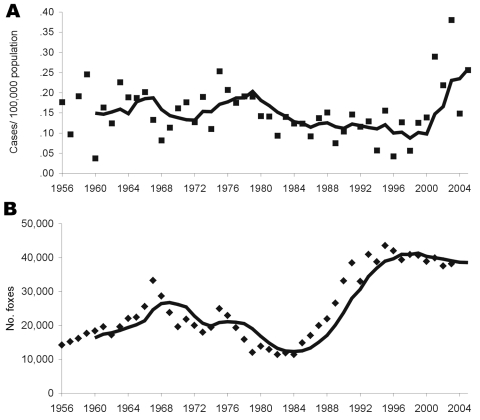
Description:We analyzed databases spanning 50 years, which included retrospective alveolar echinococcosis (AE) case finding studies and databases of the 3 major centers for treatment of AE in Switzerland. A total of 494 cases were recorded. Annual incidence of AE per 100,000 population increased from 0.12-0.15 during 1956-1992 and a mean of 0.10 during 1993-2000 to a mean of 0.26 during 2001-2005. Because the clinical stage of the disease did not change between observation periods, this increase cannot be explained by improved diagnosis. Swiss hunting statistics suggested that the fox population increased 4-fold from 1980 through 1995 and has persisted at these higher levels. Because the period between infection and development of clinical disease is long, the increase in the fox population and high Echinococcus multilocularis prevalence rates in foxes in rural and urban areas may have resulted in an emerging epidemic of AE 10-15 years later.
-
Subjects:
- Research
- Alveolar echinococcosis
- Echinococcus multilocularis
- epidemiology
- fox (Vulpes vulpes)
- zoonosis
- incidence
- Switzerland
- research
- Adolescent
- Adult
- Aged
- Aged, 80 and over
- Animals
- Child
- Echinococcosis, Hepatic
- Foxes
- Host-Parasite Interactions
- Humans
- Incidence
- Middle Aged
- Prevalence
- Retrospective Studies
- Rural Population
- Urban Population
- Zoonoses
-
Source:Emerg Infect Dis. 13(6):878-882.
-
Document Type:
-
Volume:13
-
Issue:6
-
Download URL:
-
File Type:
 [PDF - 358.46 KB]
 -
Collection(s):
-
Main Document Checksum:urn:sha256:7e0928854309f7b7dbcdd6a1d53440dd6e95adf89896469ae7861ee93c36354f
Supporting Files


 Was this page helpful?
 Found an issue?


CDC STACKS serves as an archival repository of CDC-published products including
scientific findings, journal articles, guidelines, recommendations, or other public health information authored or
co-authored by CDC or funded partners.
As a repository, CDC STACKS retains documents in their original published format to ensure public access to scientific information.
As a repository, CDC STACKS retains documents in their original published format to ensure public access to scientific information.
You May Also Like
COLLECTION
Emerging Infectious Diseases