



Spatiotemporal Analysis of Invasive Meningococcal Disease, Germany
Supporting Files
Public Domain

-
Nov 2006
File Language:
English
Details
-
Alternative Title:Emerg Infect Dis
-
Personal Author:
-
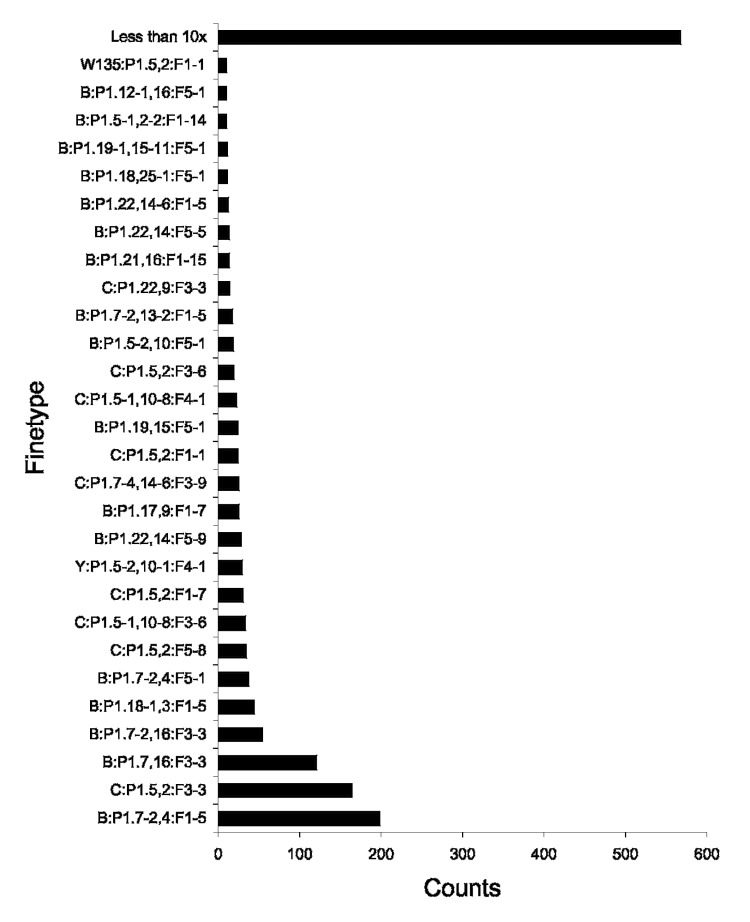
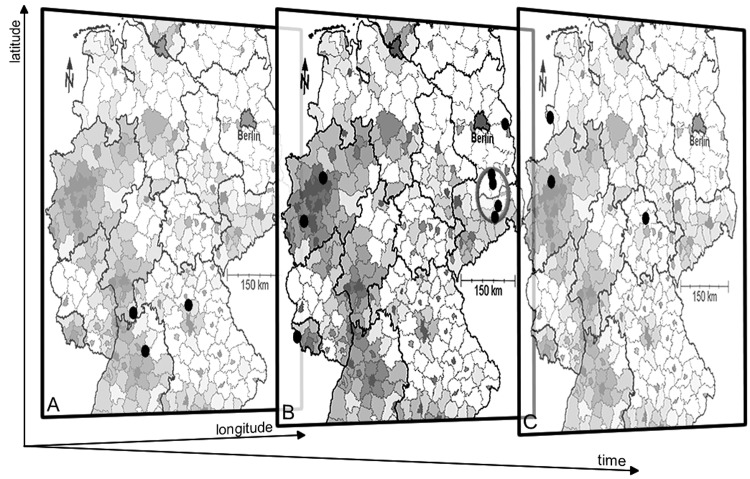
Description:Meningococci can cause clusters of disease. Specimens from 1,616 patients in Germany obtained over 42 months were typed by serogrouping and sequence typing of PorA and FetA and yielded a highly diverse dataset (Simpson's index 0.963). A retrospective spatiotemporal scan statistic (SaTScan) was applied in an automated fashion to identify clusters for each finetype defined by serogroup variable region (VR) VR1 and VR2 of the PorA and VR of the FetA. A total of 26 significant clusters (p< or =0.05) were detected. On average, a cluster consisted of 2.6 patients. The median population in the geographic area of a cluster was 475,011, the median cluster duration was 4.0 days, and the proportion of cases in spatiotemporal clusters was 4.2%. The study exemplifies how the combination of molecular finetyping and spatiotemporal analysis can be used to assess an infectious disease in a large European country.
-
Subjects:
-
Source:Emerg Infect Dis. 12(11):1689-1695.
-
Document Type:
-
Place as Subject:
-
Volume:12
-
Issue:11
-
Download URL:
-
File Type:
 [PDF - 176.92 KB]
 -
Collection(s):
-
Main Document Checksum:urn:sha256:45ec0200663f166a417cfd6248fe4bffe2c96bfc19fb069ae9a6ef303de95b55
Supporting Files


File Language:
English
 Was this page helpful?
 Found an issue?


CDC STACKS serves as an archival repository of CDC-published products including
scientific findings, journal articles, guidelines, recommendations, or other public health information authored or
co-authored by CDC or funded partners.
As a repository, CDC STACKS retains documents in their original published format to ensure public access to scientific information.
As a repository, CDC STACKS retains documents in their original published format to ensure public access to scientific information.
You May Also Like
COLLECTION
Emerging Infectious Diseases