



Aedes aegypti Larval Indices and Risk for Dengue Epidemics
Supporting Files
Public Domain

-
May 2006
File Language:
English
Details
-
Alternative Title:Emerg Infect Dis
-
Personal Author:
-
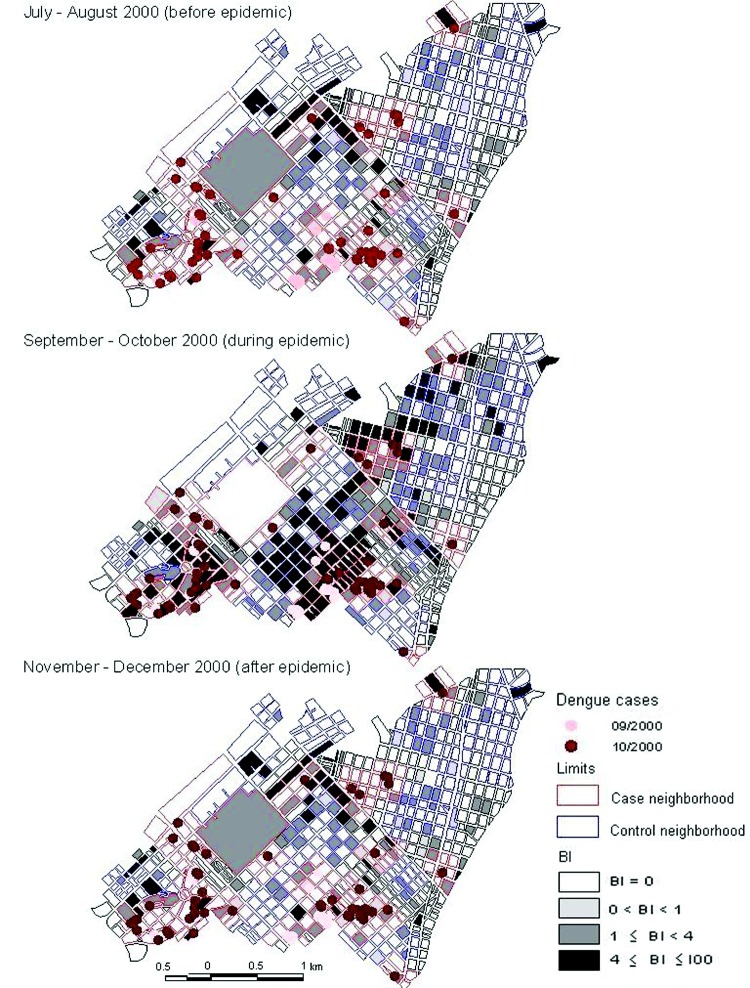
Description:We assessed in a case-control study the test-validity of Aedes larval indices for the 2000 Havana outbreak. "Cases" were blocks where a dengue fever patient lived during the outbreak. "Controls" were randomly sampled blocks. Before, during, and after the epidemic, we calculated Breteau index (BI) and house index at the area, neighborhood, and block level. We constructed receiver operating characteristic (ROC) curves to determine their performance as predictors of dengue transmission. We observed a pronounced effect of the level of measurement. The BI(max) (maximum block BI in a radius of 100 m) at 2-month intervals had an area under the ROC curve of 71%. At a cutoff of 4.0, it significantly (odds ratio 6.00, p<0.05) predicted transmission with 78% sensitivity and 63% specificity. Analysis of BI at the local level, with human-defined boundaries, could be introduced in control programs to identify neighborhoods at high risk for dengue transmission.
-
Subjects:
-
Source:Emerg Infect Dis. 12(5):800-806.
-
Document Type:
-
Place as Subject:
-
Volume:12
-
Issue:5
-
Download URL:
-
File Type:
 [PDF - 353.99 KB]
 -
Collection(s):
-
Main Document Checksum:urn:sha256:6a015bcf7335dbf1b45aa6592483eb796398652ffdf68747add5d3bff67d345d
Supporting Files


File Language:
English
 Was this page helpful?
 Found an issue?


CDC STACKS serves as an archival repository of CDC-published products including
scientific findings, journal articles, guidelines, recommendations, or other public health information authored or
co-authored by CDC or funded partners.
As a repository, CDC STACKS retains documents in their original published format to ensure public access to scientific information.
As a repository, CDC STACKS retains documents in their original published format to ensure public access to scientific information.
You May Also Like
COLLECTION
Emerging Infectious Diseases