



Fluid Cognition among Individuals with Systemic Lupus Erythematosus
Supporting Files

-
8 2024 ; 8-2024
-
Available in CDC Stacks on 2025-08-01T00:00:00Z
File Language:
English
Details
-
Alternative Title:Arthritis Care Res (Hoboken)
-
Personal Author:
-
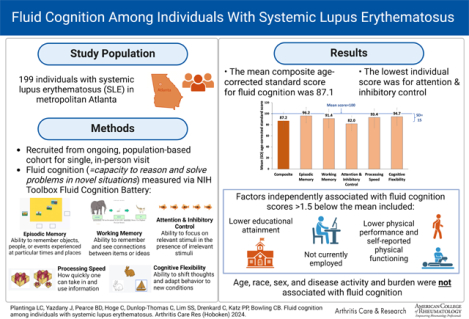
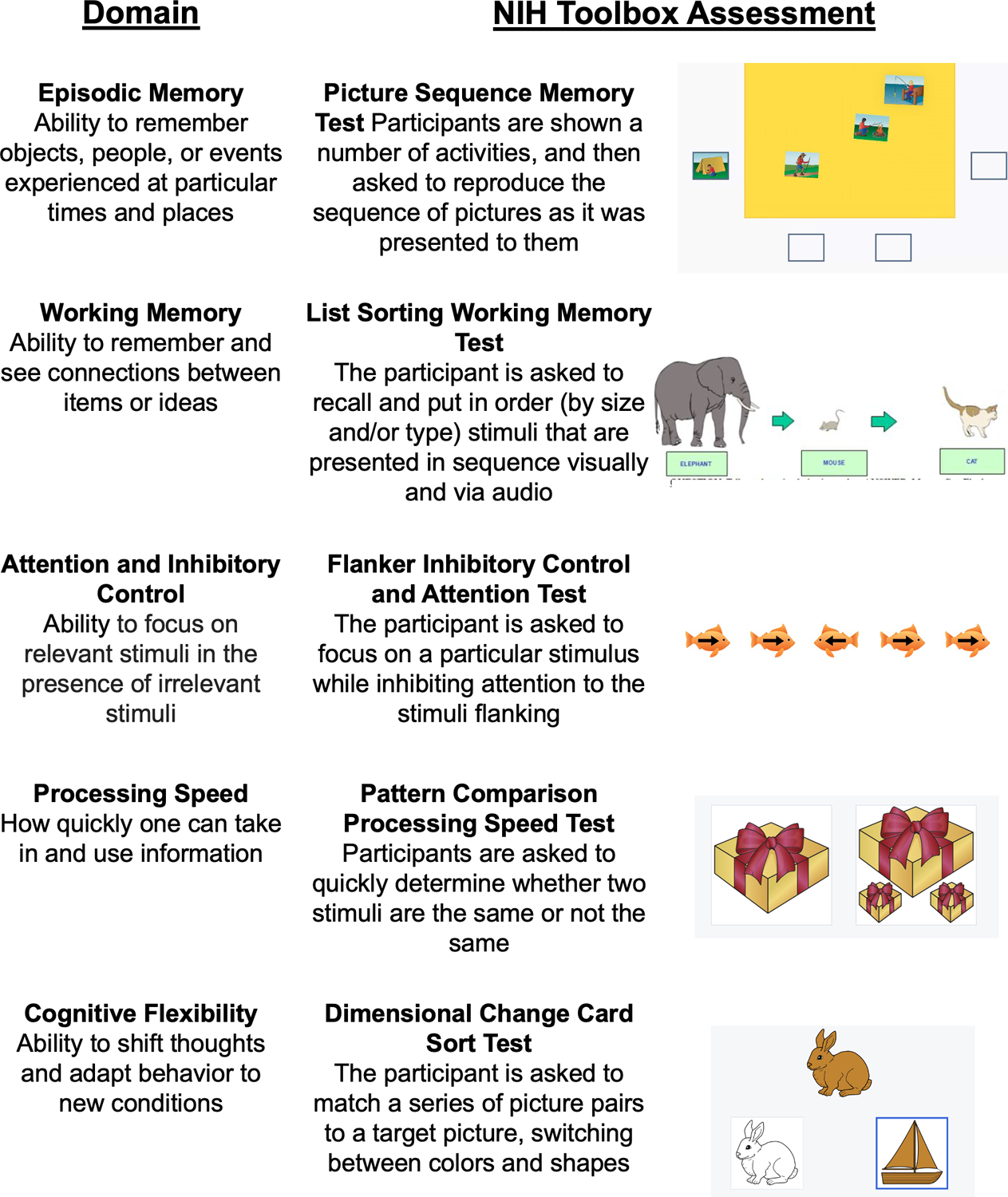
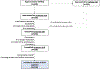
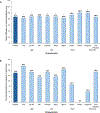
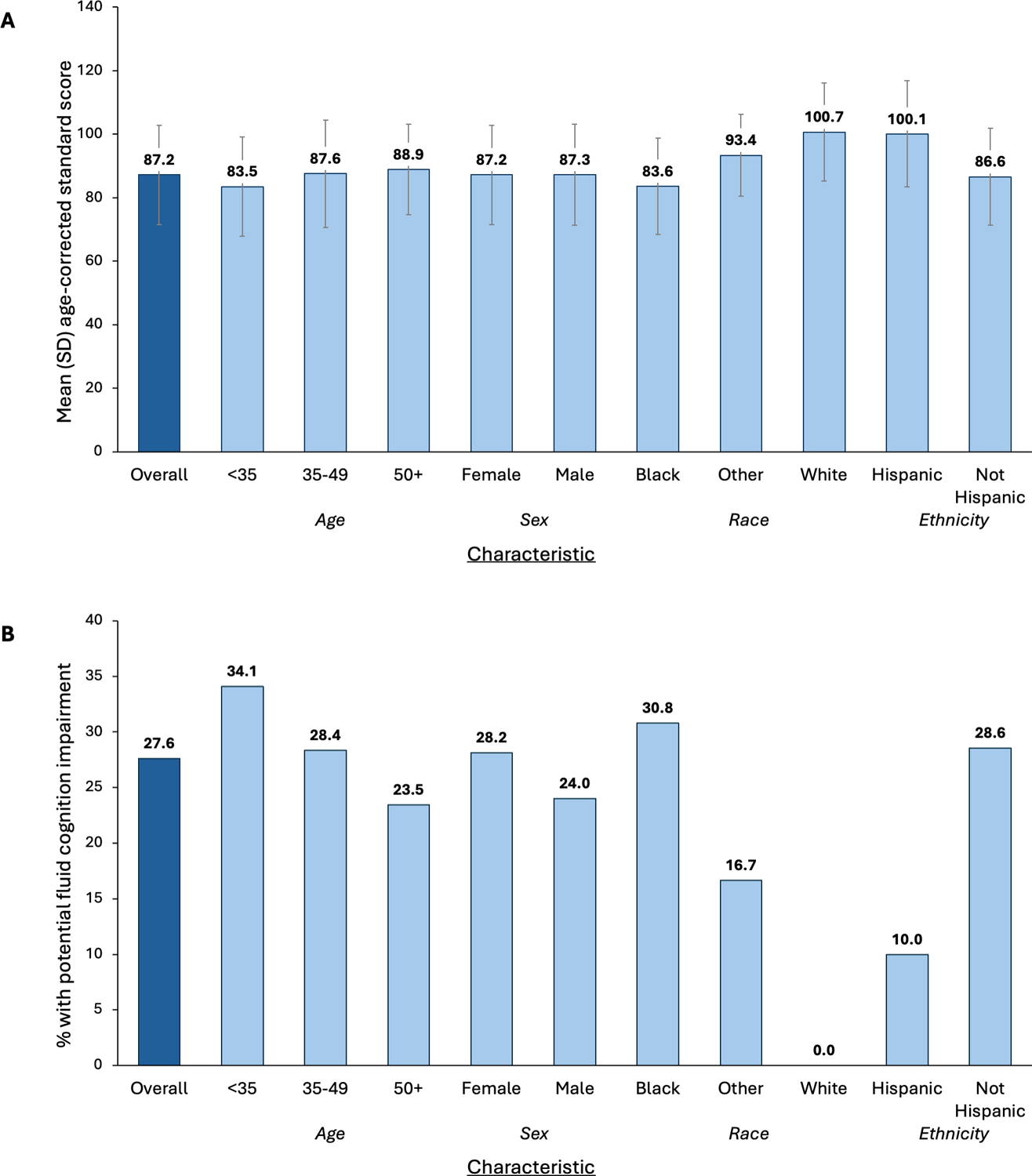
Description:Objective: ; We sought to describe fluid cognition and its correlates among individuals with SLE. ; Methods: ; Participants (n=199) were recruited from a population-based cohort for a single study visit (10/2019–5/2022). Fluid cognition was measured via the NIH Toolbox Fluid Cognition Battery (including episodic memory, working memory, attention and inhibitory control, processing speed, and cognitive flexibility domains) and expressed as age-corrected standard scores (mean=100; SD=15). Potential impairment was defined as a standard score >1.5 SD below the mean. Descriptive statistics were calculated and associations of various participant characteristics with the potential fluid cognition impairment were assessed with multivariable logistic regression. ; Results: ; Participants’ mean age was 46.1 years; most were female (87.4%), Black (86.4%), and non-Hispanic (95.0%). The mean overall fluid cognition score was 87.2; of the individual domains, participants’ mean score was lowest on attention and inhibitory control (82.0). Working status OR=0.30 (95% CI, 0.14–0.64) and higher self-reported physical functioning OR=0.46 (95% CI, 0.28–0.75) and physical performance OR=0.72 (95% CI 0.59–0.87) were associated with lower odds of fluid cognition impairment; lower educational attainment was associated with higher odds OR=3.82 (95% CI, 1.67–8.75). Self-reported forgetfulness, neuropsychiatric damage, and depressive symptoms were not statistically significantly associated with potential impairment. ; Conclusion: ; Fluid cognition and, particularly, attention and inhibitory control were low in those with SLE relative to the general U.S. population. Working status, higher physical functioning and performance, and higher educational attainment were associated with lower prevalence of potential impairment. Future work is needed to develop and implement interventions to help support cognition in SLE.
-
Subjects:
-
Source:Arthritis Care Res (Hoboken). 76(8):1121-1131
-
Pubmed ID:38528776
-
Pubmed Central ID:PMC11288780
-
Document Type:
-
Funding:U01 DP006698/DP/NCCDPHP CDC HHSUnited States/ ; U01DP006698/ACL/ACL HHSUnited States/ ; 1U01-DP-006488/CC/CDC HHSUnited States/ ; R01-AG-061179/National Institute on Aging of the NIH/ ; R01 AG061179/AG/NIA NIH HHSUnited States/ ; The Georgians Organized Against Lupus (GOAL)/ ; 1U01-DP-006698/CC/CDC HHSUnited States/ ; U01 DP006488/DP/NCCDPHP CDC HHSUnited States/
-
Volume:76
-
Issue:8
-
Download URL:
-
File Type:
 [PDF - 974.41 KB]
 -
Collection(s):
-
Main Document Checksum:urn:sha-512:6105561b1db9d7805e1f48b3bc0e05b55332ce5976b5b023a87e6d8f3c55a02680e52104692cf719b8aa1fc419c552444870c58f0be16215ff743c0134dc4b99
Supporting Files


File Language:
English
 Was this page helpful?
 Found an issue?


CDC STACKS serves as an archival repository of CDC-published products including
scientific findings, journal articles, guidelines, recommendations, or other public health information authored or
co-authored by CDC or funded partners.
As a repository, CDC STACKS retains documents in their original published format to ensure public access to scientific information.
As a repository, CDC STACKS retains documents in their original published format to ensure public access to scientific information.
You May Also Like
COLLECTION
CDC Public Access