



Perceived Stress and Reported Cognitive Symptoms among Georgia Patients with Systemic Lupus Erythematosus
Supporting Files

-
9 2017 ; 9-2017
-
Available in CDC Stacks on 2018-09-01T00:00:00Z
File Language:
English
Details
-
Alternative Title:Lupus
-
Personal Author:
-
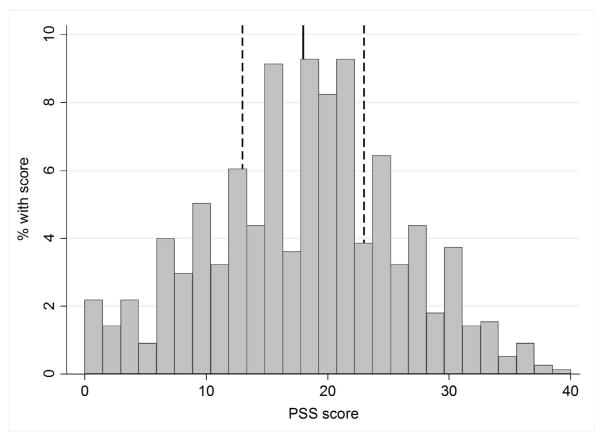
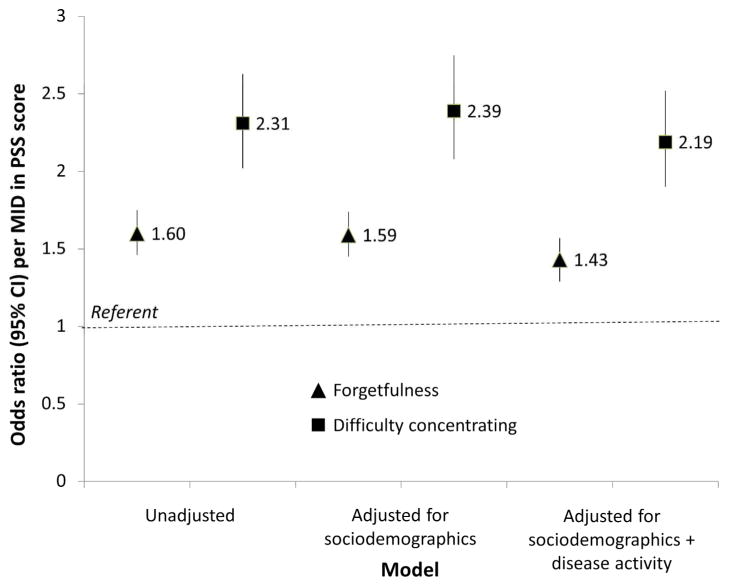
Description:Objective ; To examine associations of perceived stress with cognitive symptoms among adults with systemic lupus erythematosus (SLE). ; Methods ; Among 777 adult (>18 years) SLE patients, we examined the association of Perceived Stress Scale (PSS) scores with two self-reported cognitive symptoms: forgetfulness severe/moderate vs. mild/none; from the Systemic Lupus Activity Questionnaire and difficulty concentrating (all/most vs. some/little/none of the time; from the Lupus Impact Tracker). We used multivariable logistic regression to estimate the odds ratios (ORs) per minimal important difference (MID=0.5*SD) of PSS score and cognitive symptoms. ; Results ; Forgetfulness and difficulty concentrating were reported by 41.7% and 29.5%, respectively. Women and those with less education and high disease activity had higher PSS scores and were more likely to report cognitive symptoms than their counterparts. With adjustment for age, race, sex, education, and disease activity, each MID increase in PSS score was associated with higher prevalence of forgetfulness (OR=1.43, 95% CI 1.29–1.47) and difficulty concentrating (OR=2.19, 95% CI 1.90–2.52). No substantial differences in this association by age, race, sex, or disease activity were noted. ; Conclusions ; SLE patients, particularly those with high disease activity, report a high burden of cognitive symptoms, for which stress may be a modifiable risk factor.
-
Keywords:
- systemic lupus erythematosus
- stress
- cognitive function
- African-American
- Adult
- Cognition Disorders
- Cross-Sectional Studies
- Female
- Georgia
- Humans
- Logistic Models
- Lupus Erythematosus, Systemic
- Male
- Middle Aged
- Multivariate Analysis
- Prevalence
- Risk Factors
- Self Report
- Severity of Illness Index
- Stress, Psychological
- Surveys and Questionnaires
-
Source:Lupus. 26(10):1064-1071
-
Pubmed ID:28420055
-
Pubmed Central ID:PMC5494014
-
Document Type:
-
Funding:
-
Volume:26
-
Issue:10
-
Download URL:
-
File Type:
 [PDF - 510.83 KB]
 -
Collection(s):
-
Main Document Checksum:urn:sha256:a503f651494845f2a5ebfe5ddcaa30e87655fdc696fca2b83c60be0dd29c62b6
Supporting Files


File Language:
English
 Was this page helpful?
 Found an issue?

CDC STACKS serves as an archival repository of CDC-published products including
scientific findings, journal articles, guidelines, recommendations, or other public health information authored or
co-authored by CDC or funded partners.
As a repository, CDC STACKS retains documents in their original published format to ensure public access to scientific information.
As a repository, CDC STACKS retains documents in their original published format to ensure public access to scientific information.
You May Also Like
COLLECTION
CDC Public Access