


At the Intersections: Examining trends in experiences of violence, mental health status, and suicidal risk behaviors among U.S. high school students using intersectionality, national Youth Risk Behavior Survey, 2015–2019
Supporting Files

-
9 2022
-
File Language:
English
Details
-
Alternative Title:J Adolesc Health
-
Personal Author:
-
Description:Objectives:
Surveillance data are used for public health action, but the practice of analyzing data by single demographic characteristics may produce findings that reflect abstract categories rather than a person’s lived experience. Intersectionality is a theoretical framework that advocates for individuals to be recognized as the whole of their identity and within context of power structures. Using the national Youth Risk Behavior Survey 2015–2019, we examined five-year trends in experiencing violence, poor mental health, and suicidal risk behavior among U.S. high school students using intersections of race/ethnicity and sex.
Methods:
We used SUDAAN to calculate prevalence estimates and logistic regression models to assess for linear trends while accounting for the weighting and complex survey design.
Results:
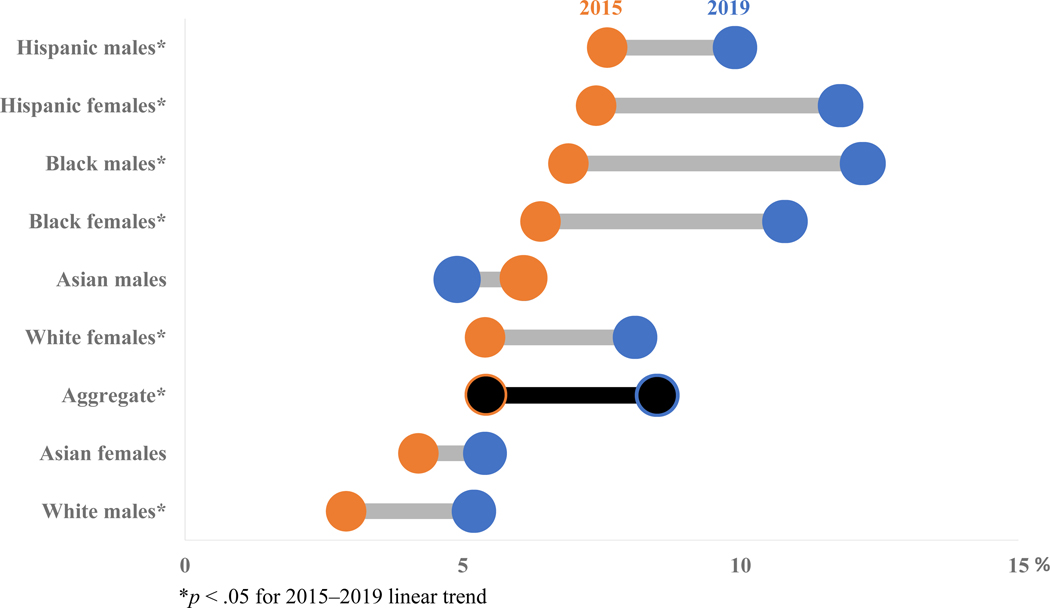
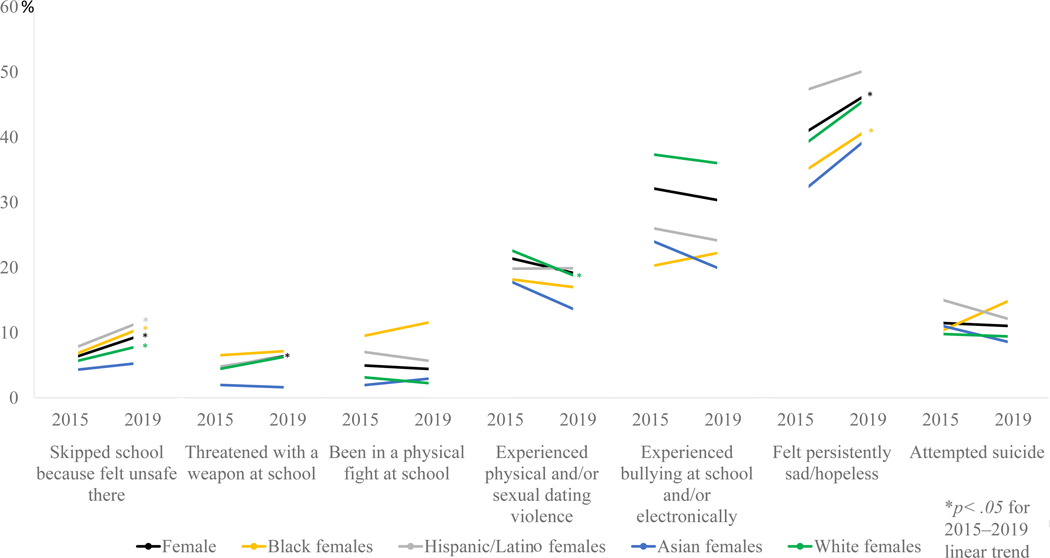
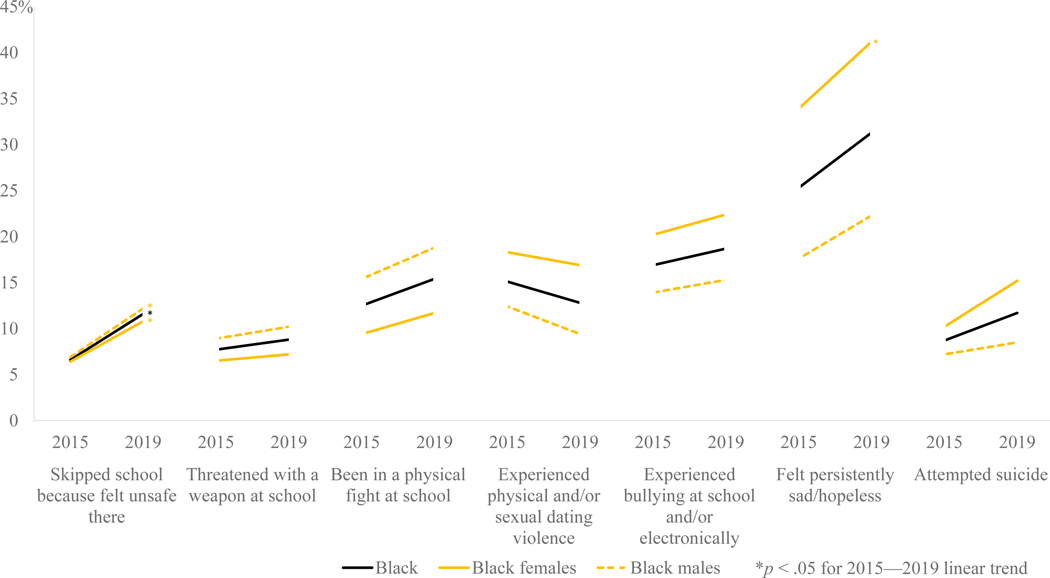
Among all students in aggregate, experiencing dating violence decreased while being threatened with a weapon at school and feeling persistently sad or hopeless increased over time; however, these trends did not apply to most students when stratified by identity. The one near-universal experience was that students in aggregate and almost all identities had an increased trend of skipping school because they felt unsafe there.
Conclusions:
By focusing on identities defined by two main drivers of health disparities; race/ethnicity and sex, we found that changes in risk behaviors did not occur equally among students and that prevalence estimates were highest among Black males, Black females, and Hispanic females. We outlined the power structures that frame the current educational environment. Patterns of health disparities can be highlighted by analyzing surveillance data through an intersectional lens.
-
Subjects:
-
Source:J Adolesc Health. 71(3):293-300
-
Pubmed ID:35562300
-
Pubmed Central ID:PMC11264245
-
Document Type:
-
Funding:
-
Volume:71
-
Issue:3
-
Collection(s):
-
Main Document Checksum:urn:sha-512:d593a20347f3bcc39973ac12e50ec13f5188500225e2e49c5b4cfca4f0ddb508290e8e218deb7115be82aa1e625d3c18474102e41b68498ab11bff32bb3dfe6c
-
Download URL:
-
File Type:
 [PDF
- 546.56 KB
]
[PDF
- 546.56 KB
]
Supporting Files


File Language:
English
ON THIS PAGE

CDC STACKS serves as an archival repository of CDC-published products including
scientific findings,
journal articles, guidelines, recommendations, or other public health information authored or
co-authored by CDC or funded partners.
As a repository, CDC STACKS retains documents in their original published format to ensure public access to scientific information.
As a repository, CDC STACKS retains documents in their original published format to ensure public access to scientific information.
You May Also Like
COLLECTION
CDC Public Access