



Economics of Neuraminidase Inhibitor Stockpiling for Pandemic Influenza, Singapore
Supporting Files
Public Domain

-
2006/01/01
File Language:
English
Details
-
Alternative Title:Emerg Infect Dis
-
Personal Author:
-
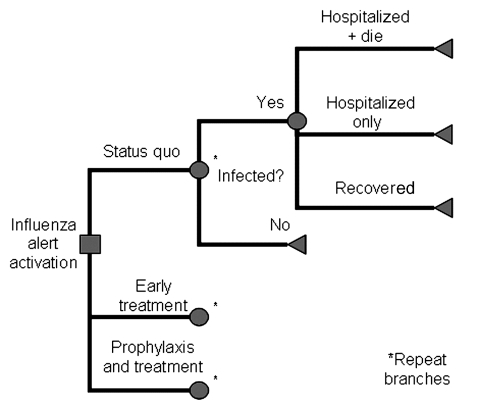
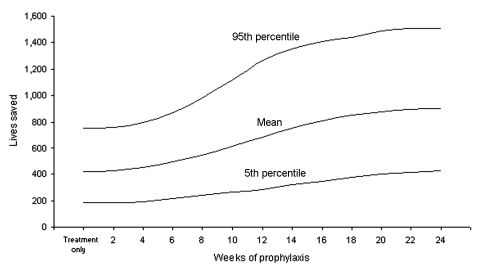
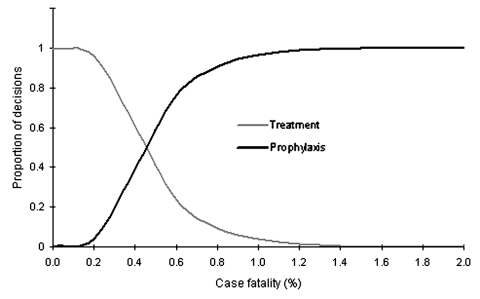
Description:We compared strategies for stock piling neuraminidase inhibitors to treat and prevent influenza in Singapore. Cost-benefit and cost-effectiveness analyses, with Monte Carlo simulations, were used to determine economic outcomes. A pandemic in a population of 4.2 million would result in an estimated 525-1,775 deaths, 10,700-38,600 hospitalization days, and economic costs of 0.7 dollars to 2.2 billion Singapore dollars. The treatment-only strategy had optimal economic benefits: stock piles of antiviral agents for 40% of the population would save an estimated 418 lives and 414 million dollars, at a cost of 52.6 million dollars per shelf-life cycle of the stock pile. Prophylaxis was economically beneficial in high-risk subpopulations, which account for 78% of deaths, and in pandemics in which the death rate was >0.6%. Prophylaxis for pandemics with a 5% case-fatality rate would save 50,000 lives and 81 billion dollars. These models can help policymakers weigh the options for pandemic planning.
-
Subjects:
-
Source:Emerg Infect Dis. 12(1):95-102.
-
Document Type:
-
Genre:
-
Place as Subject:
-
Volume:12
-
Issue:1
-
Download URL:
-
File Type:
 [PDF - 263.47 KB]
 -
Collection(s):
-
Main Document Checksum:urn:sha-512:5724f1237907802a068ff671035c9e98221fc6ab69efc2c2553aa14d49fbf21de1a8d1391071b72575233ed11df0c0f0b7ddcc078a7a3ddf21eeae867c87f6f7
Supporting Files


File Language:
English
 Was this page helpful?
 Found an issue?


CDC STACKS serves as an archival repository of CDC-published products including
scientific findings, journal articles, guidelines, recommendations, or other public health information authored or
co-authored by CDC or funded partners.
As a repository, CDC STACKS retains documents in their original published format to ensure public access to scientific information.
As a repository, CDC STACKS retains documents in their original published format to ensure public access to scientific information.
You May Also Like
COLLECTION
Emerging Infectious Diseases